Is Princess Worth Reading? Review & Where to Read
Quick Answer
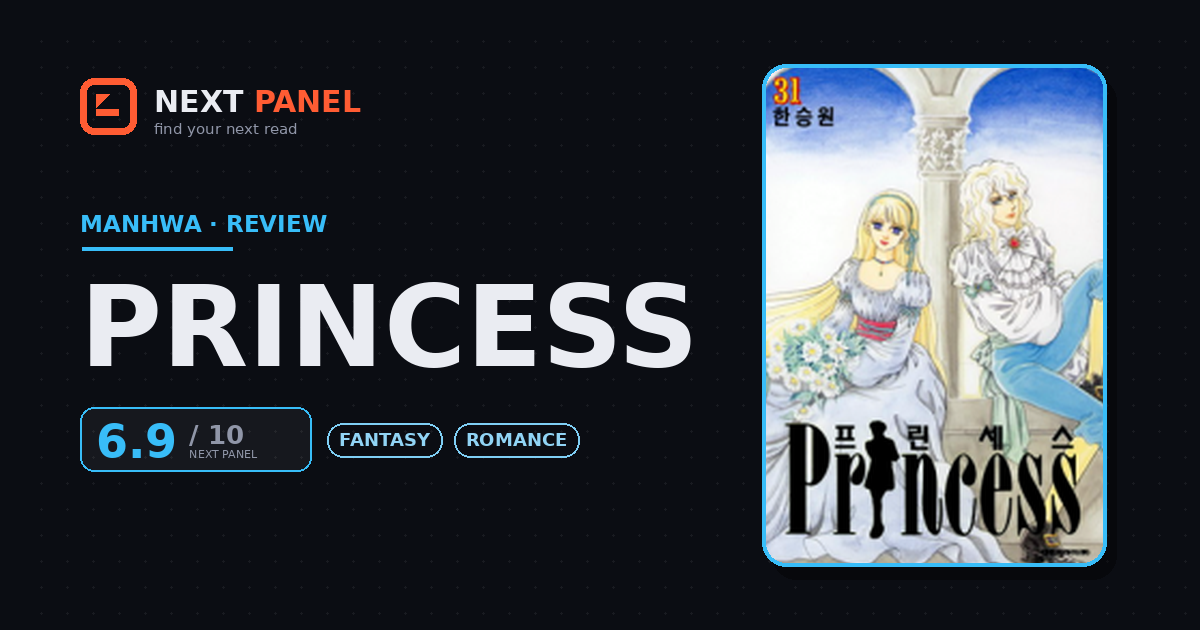
Only if you can make peace with the fact that this one may never finish. The scope, politics, and tragic romances across generations are genuinely absorbing, but Princess has been on and off hiatus for decades.
Quick Verdict
“Sprawling, tragic, and genuinely worth getting lost in, as long as you don't need it to actually end.”
Best for: Readers who want an old-school, generations-spanning political fantasy with tangled royal romances and don't mind an open-ended reading experience.
Not for: Readers who need narrative closure, or who find dated 1990s shoujo art (including the era's stylized blank-eyed reaction faces) a dealbreaker.
- Type
- Manhwa
- Genres
- Romance, Fantasy
- Status
- On Hiatus
- This review
- Minor Spoilers
- Author
- Han Seung-won
- Publisher
- Daiwon / Naver
| Quick facts | |
|---|---|
| Format | Manhwa (shōjo), 37 chapters, 31 volumes |
| Run | on hiatus |
| Community score | MangaUpdates 8.5 |
Overview
Princess is set in an unnamed medieval world of three countries, centered on the island empire of Ramira. Its first arcs trace generations of Ramira's royal women, building toward the eventual rise of Preia, the empire's greatest Empress, beloved by her people and surrounded by men fiercely loyal to her. Han Seung-won structures the story less as a single romance and more as a multi-generational political saga, where marriages, betrayals, and successions in one generation directly shape the fates of the next.
The story has run, with major interruptions, since 1995 — first through 31 volumes under Daiwon, then in a webtoon relaunch through Naver that itself later stalled.
What it does well
The generational structure is what sets Princess apart from most shoujo fantasy. Political decisions and romantic entanglements from earlier royal generations echo forward in ways that give later arcs genuine emotional stakes, and the empire of Ramira is built with a level of historical and political texture that a lot of similar fantasy manhwa don't bother with. Rather than centering everything on one couple, the story spreads its attention across several distinct royal romances, each with its own tone and trajectory, which keeps a very long-running series from feeling repetitive.
The tragedy also lands. Han Seung-won treats the human cost of royal politics seriously, and losses throughout the story carry real weight because the narrative has spent the time building up the relationships behind them.
Where it falls short
The unavoidable problem is that Princess has never been finished. Serialization went on extended hiatus in the mid-2000s due to the creator's health, and even after a hopeful 2015 relaunch through Naver, the current installment has itself stalled again with the story's major threads still unresolved after three decades. Long-time readers openly express, in the series' own comment sections, that they've made peace with likely never getting a real ending.
The cast is also genuinely large, spanning multiple royal generations with overlapping names and titles, and it's easy to lose track of who's related to whom without outside notes. And the 1990s shoujo art, including its era-typical stylized blank-eyed shock expressions, will read as more dated than most readers are used to today, which is a real barrier for some.
Verdict
Princess is a genuinely ambitious, emotionally serious royal saga that rewards patience with real political and romantic depth across generations. The catch is significant: after thirty years, there's still no ending, and there may never be one. If you can enjoy the journey without needing a destination, this is worth the time; if you can't, the incompleteness will likely outweigh everything it does well.
Strengths & Weaknesses
Strengths
- The generations-spanning structure gives the political maneuvering and tragic romances real weight, since choices made by one royal generation visibly shape the next.
- The empire of Ramira and its surrounding kingdoms are built with a level of political and historical detail that's rare in shoujo fantasy.
- Multiple couples across the timeline get real, distinct arcs rather than the story leaning on a single central romance to carry the whole cast.
- The tragedy is played with genuine conviction — losses land hard because the story takes its royal politics and their human cost seriously.
Weaknesses
- The story has never been completed. It's been on and off hiatus since the mid-2000s over the creator's health, and even its 2015 relaunch stalled again partway through.
- The large cast spanning multiple royal generations can be genuinely disorienting to track without a family tree in hand.
- The art's 1990s shoujo conventions, including stylized blank-eyed shock reactions, will read as dated or even off-putting to modern readers unused to the era's visual shorthand.
Similar Titles
A different, more contained shoujo classic from the same era if the generations-spanning scale here is too much of a commitment.
Another long, ambitious Korean epic that similarly rewards patience with rough edges along the way.
A different genre, but a similar case of real quality undercut by a story that never got to finish.
Frequently Asked Questions
Does Princess have an ending?
No. The story has been serialized on and off since 1995, went on extended hiatus in the mid-2000s over the creator's health, resumed in 2015 under Naver, and its current Part 5 is itself on hiatus with no confirmed conclusion.
Is Princess licensed in English?
No, there's no official English release. What exists in English comes from fan scanlations, which also stop short of the full available chapters.
Do I need to keep track of a lot of characters?
Yes — the story follows multiple royal generations and their respective romances, so expect a large cast and a genealogy that takes real attention to follow.