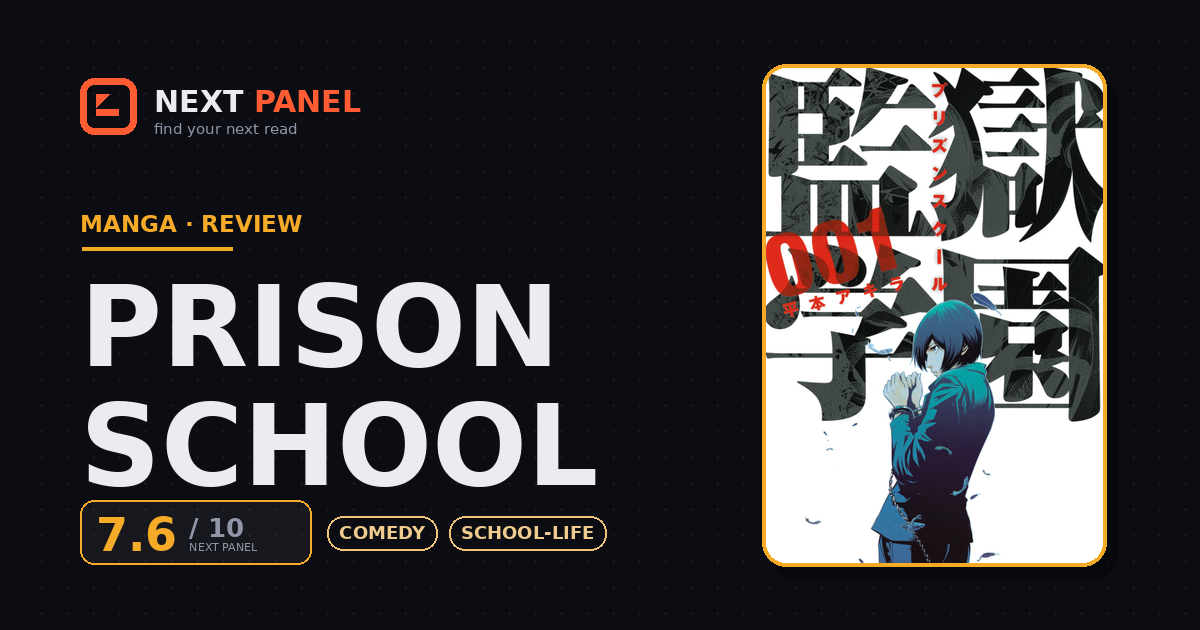
Is Prison School Worth Reading? Review & Where to Read
Quick Answer
Worth reading if you can handle nonstop ecchi fanservice — the comic timing, escalating plotting, and artwork are all well above the genre average. If wall-to-wall nudity gags aren't your thing, skip it; there's no watered-down version of this manga.
Quick Verdict
“Prison School commits harder to its dumbest jokes than almost any other comedy manga, and the art never lets up either.”
Best for: Readers who want raunchy, all-in slapstick comedy paired with genuinely excellent, detailed art.
Not for: Readers who want their comedy free of constant nudity and fanservice.
- Type
- Manga
- Genres
- School Life, Comedy
- Status
- Completed
- This review
- Minor Spoilers
- Author
- Akira Hiramoto
- Publisher
- Kodansha
- Platform
- Yen Press
| Quick facts | |
|---|---|
| Format | Manga (seinen), 279 chapters, 28 volumes |
| Run | 2011–2017 · completed |
| Community score | AniList 7.2 · MangaUpdates 7.6 |
| Content | Nudity, sexual content, violence |
| Where to read | Yen Press — official |
Overview
Kiyoshi Fujino and four other boys are the first male students ever admitted to the prestigious, all-girls Hachimitsu Academy. On their first day they get caught peeping on the girls' bath, and the school's real power — the Underground Student Council — sentences them to serve time in the campus's literal prison. What follows is a string of increasingly ridiculous punishments, prison breaks, and power struggles between the boys and the council, with a slow-burn romance between Kiyoshi and council vice president Chiyo running underneath all of it.
What it does well
The art is the first thing that surprises new readers. Akira Hiramoto draws Prison School like it's a serious thriller — full backgrounds, real shading, faces that can carry actual dread — and then points all that craft at a fart joke or a guy stuck to a ceiling overnight. That mismatch between drawing style and subject matter is most of the comedy, and it never stops working, chapter after chapter.
The pacing holds up over a long run too. Each arc escalates from the last one instead of just repeating the "boys get punished" formula: prison breaks turn into elections, elections turn into a full-blown power struggle for control of the school, and the stakes keep climbing without the tone ever losing its nerve. Hiramoto is also willing to let a joke breathe — a gag will run for several chapters, pay off in a way you didn't expect, and then get referenced again volumes later.
The Underground Student Council women end up being the real backbone of the cast. Mari's sadism, Meiko's temper, Hana's cluelessness, and Chiyo's straight-laced awkwardness could've stayed one-note, but the manga keeps putting them in situations that let them be funny and, eventually, genuinely sympathetic. By the later volumes you're rooting for characters you'd have written off as throwaway gags back in volume one.
Where it falls short
The fanservice is constant, and it's not subtle — full nudity and sexually charged slapstick show up in nearly every chapter. The craft around it is real, but the sheer volume of it will be a dealbreaker for a lot of readers no matter how well it's drawn.
The four boys outside Kiyoshi take a long time to become people rather than gags — the fat one, the tall quiet one, the delinquent — and some readers will lose patience before the manga gets around to giving them more to work with. The election arc in particular runs longer than the joke needs, stretching out a plot thread that would've hit harder trimmed down by a few chapters.
Verdict
Prison School knows exactly what it is and commits to it completely, which is rarer than it sounds. If you can get past — or actively enjoy — the nonstop nudity and slapstick, there's a genuinely well-drawn, well-paced comedy underneath it, with a cast that earns more depth than the premise promises. If constant fanservice is a hard no, no amount of good linework is going to change that.
Strengths & Weaknesses
Strengths
- The art is drawn with the detail and shading of a serious thriller, and pointing that level of craft at slapstick and fanservice is most of the joke — it never stops working.
- Each arc escalates from the last instead of repeating the same setup: prison breaks turn into elections, elections turn into a full power struggle, and the tone never loses its nerve as the stakes climb.
- Hiramoto lets gags breathe for chapters at a time and pays them off later in ways you don't see coming.
- The Underground Student Council women could've stayed one-note, but the manga keeps giving them room to be funny and, eventually, genuinely sympathetic.
Weaknesses
- The fanservice is constant and unsubtle — full nudity and sexually charged slapstick show up in nearly every chapter, and no amount of craft changes how much of it there is.
- The four boys besides Kiyoshi stay one-note gags (the fat one, the tall quiet one, the delinquent) for a long stretch before the story gives them more to do.
- The election arc in particular runs past the point its joke needs, stretching a plot thread that would've hit harder trimmed down.
Similar Titles
Same commitment to filthy, over-the-top comedy built around a tight group of students.
A different flavor of absurdist school comedy, but the same deadpan commitment to escalating a bit past reason.
A smaller-cast, lighter-touch ecchi comedy if Prison School's chaos is more than you want.
Where to Read Officially
| Platform | Format | Pricing | Region notes | Link |
|---|---|---|---|---|
| Yen Press | Print & digital volumes | Paid | Region availability varies | Open |
Frequently Asked Questions
Is Prison School just fanservice, or is there an actual story?
There's a real plot with an ongoing power struggle, character arcs, and a full ending — but yes, expect constant nudity and slapstick throughout it.
Is Prison School finished?
Yes. It ran in Weekly Young Magazine from 2011 to 2017 and wrapped at 28 volumes with a complete ending.
Where can I read Prison School legally?
Yen Press publishes it in English in both print and digital editions.