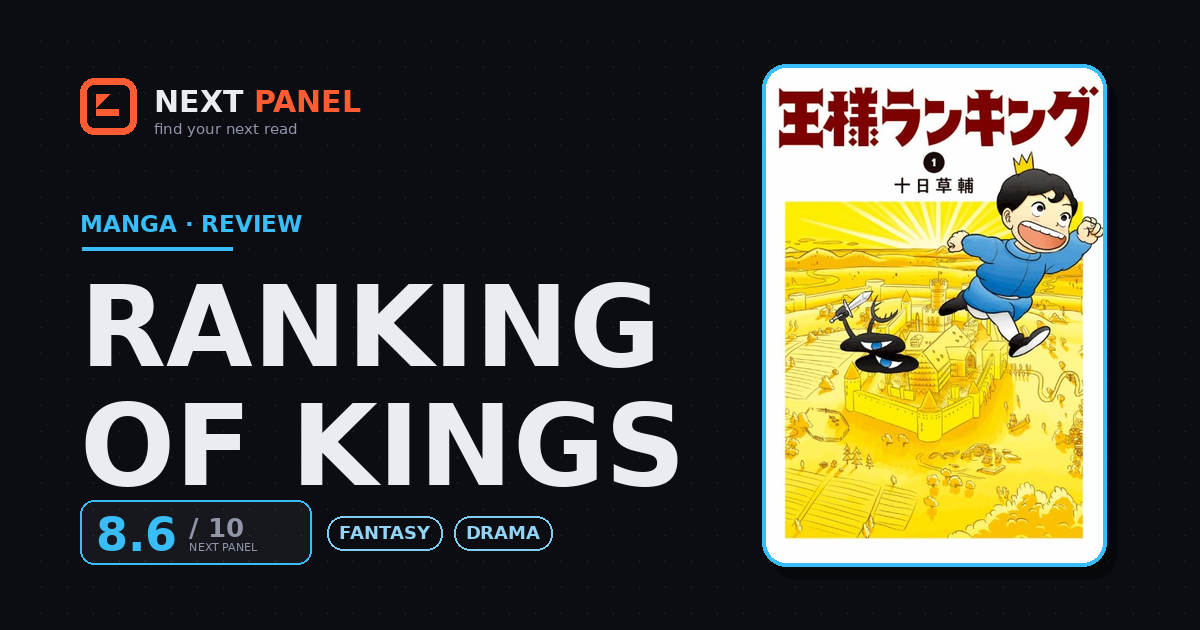
Is Ranking of Kings Worth Reading? Review & Where to Read
Quick Answer
Yes — it looks like a children's storybook and hits like a genuine emotional gut-punch, and the manga is already well ahead of what the anime has covered.
Quick Verdict
“One of the gentlest, saddest, and most purely well-drawn fantasy manga running right now.”
Best for: Readers who want emotionally sincere fantasy with a genuinely kind-hearted lead.
Not for: Readers who need conventional fantasy art or fast-paced, high-octane action throughout.
- Type
- Manga
- Genres
- Drama, Fantasy
- Status
- Ongoing
- This review
- Minor Spoilers
- Author
- Sosuke Toka
- Publisher
- BookLive
- Platform
- BookWalker Global
| Quick facts | |
|---|---|
| Format | Manga (shōnen) |
| Run | 2017–present · ongoing |
| Community score | AniList 7.7 |
| Content | Violence, emotional themes |
| Where to read | BookWalker Global — official |
Overview
Bojji is the eldest son of the king of Bosse, and by most standards, an unlikely heir. He's small, can't hear, can barely speak, and everyone assumes his younger half-brother Daida will take the throne instead. But Bojji has a kindness and a quiet determination that nobody around him expects, and when he befriends Kage, a shadow-being with a dark past of his own, the story quietly turns into a much bigger, sadder, and more hopeful thing than its premise suggests.
What it does well
Bojji is the reason this works as well as it does. Deaf, small, and physically outmatched by nearly everyone around him, he could easily have been written as a pity case or a joke — instead, his kindness and refusal to give up are treated with total sincerity, and it makes him one of the most quietly lovable protagonists in recent fantasy manga.
The art style is a big part of that. It's simple and almost storybook-like at first glance, but that simplicity is doing real work — silence, small gestures, and expressive faces carry entire emotional beats without needing a word of dialogue, and it hits harder because of how unassuming it looks.
The supporting cast backs this up. Kage, Daida, Miranjo, and the rest all get real motivations instead of falling into clean hero-and-villain roles, and the political maneuvering around the throne of Bosse gives the story real stakes beyond Bojji's personal journey. When the story reaches for a gut-punch, it's earned — the groundwork is always there first.
Where it falls short
The art style is genuinely a hurdle for some readers. It's unconventional enough, closer to a children's storybook than typical fantasy manga, that it takes real adjustment if you're expecting more traditional character designs or action choreography.
Some arcs also slow down considerably to handle worldbuilding and court politics, and that pacing shift can test your patience if you came in purely for Bojji and Kage's story rather than the wider kingdom drama around them.
Verdict
One of the gentlest, saddest, and most purely well-drawn fantasy manga running right now. Its unconventional art style and occasional detours into political worldbuilding ask a little patience, but Bojji's story is sincere enough, and earns its emotional moments honestly enough, to make Ranking of Kings worth the read.
Strengths & Weaknesses
Strengths
- Bojji might be the most purely lovable protagonist in recent fantasy manga — his kindness never reads as naive or a joke at his expense.
- The deceptively simple, storybook-like art style does incredible emotional work, especially in quiet, wordless scenes.
- The supporting cast — Kage, Daida, Miranjo, and the rest — all get real, sympathetic motivations instead of clean hero-and-villain lines.
- The story earns its emotional moments instead of manipulating you into them — the groundwork is always laid before the gut-punch lands.
Weaknesses
- The unconventional, sketch-like art style takes real adjustment if you're expecting a more traditional fantasy look.
- Some arcs slow down considerably for worldbuilding and court politics, which can test your patience if you're here purely for the emotional core.
Similar Titles
Another deceptively cute art style hiding genuinely devastating emotional stakes.
Berserk
A much darker fantasy, but shares an interest in a protagonist overcoming being underestimated.
Where to Read Officially
| Platform | Format | Pricing | Region notes | Link |
|---|---|---|---|---|
| BookWalker Global | Digital chapters | Digital volumes | Paid | Region availability varies | Open |
Frequently Asked Questions
Is Ranking of Kings finished?
No, it's still ongoing in Japan, and the story has progressed well past what the first anime season adapted.
Do I need to watch the anime first?
No — the manga is the original source and has gone further than the anime has covered so far, so you can start with either.
Is the art style off-putting?
It's unconventional, simple, almost storybook-like linework, but it's used with a lot of intention, especially in the story's quieter, more emotional scenes.