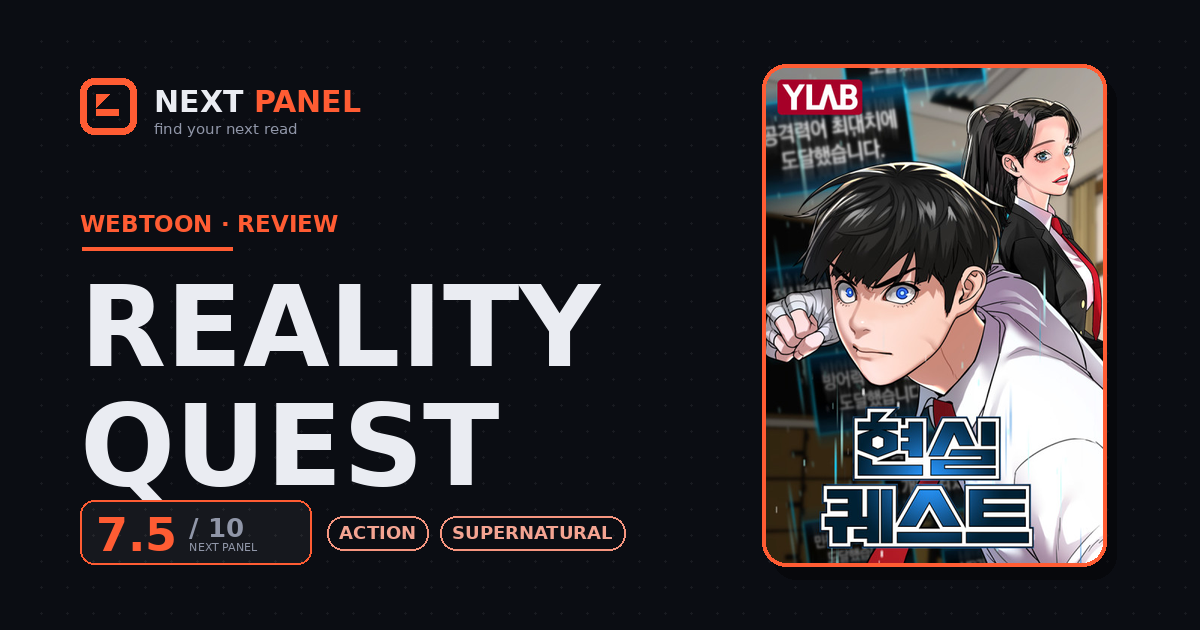
Is Reality Quest Worth Reading? Review & Where to Read
Quick Answer
Yes, if you want a game-power revenge story with personal, grounded stakes instead of a fantasy kingdom to save. Do Wan dismantling the specific hierarchy that made his life miserable feels satisfying and earned.
Quick Verdict
“Trading a fantasy kingdom for a school gang hierarchy makes this revenge power fantasy feel more personal than most system-power webtoons manage.”
Best for: Readers who want a system-power revenge story with grounded, personal stakes instead of a world-saving fantasy plot.
Not for: Readers who want the game-system mechanics to drive every chapter rather than occasionally taking a back seat to straightforward fights.
- Type
- Webtoon
- Genres
- Action, Supernatural
- Status
- Ongoing
- This review
- Minor Spoilers
- Author
- Joowoon Lee
- Artist
- Taesung
- Publisher
- Naver Webtoon
- Platform
- WEBTOON
| Quick facts | |
|---|---|
| Format | Webtoon, 190 chapters |
| Run | 2021–present · ongoing |
| Community score | AniList 7.4 · MangaUpdates 7.2 |
| Where to read | WEBTOON — official |
Overview
Ha Do Wan is a gamer who's been ground down by exhaustion and bullying in roughly equal measure, and it eventually kills him — he collapses from sheer overwork and dies. Except death isn't the end. He wakes up a week in the past with something impossible: the skills, stats, and system interface from his favorite game, now active in the real world. A voice tells him he's inside a "Reality Quest," and that real life is about to start handing him quests the same way the game once did. Do Wan doesn't waste the second chance. He starts climbing the school's gang hierarchy from the bottom, taking down the bullies and power structures that made his first life miserable, one target at a time.
It's a "game system bleeds into reality" story set specifically in a high school power structure, which gives it a more grounded, personal scale than the fantasy-kingdom version of this premise — Do Wan isn't saving a world, he's taking his own life back.
What it does well
Grounding the game-system premise in a school setting instead of a fantasy world gives Reality Quest a sharper, more personal edge. Do Wan's enemies aren't abstract monsters, they're the specific bullies and gang leaders who made his life hell, and watching him infiltrate and dismantle that hierarchy from the inside has real satisfaction to it. His system powers give him an edge, but the story still leans on strategy and infiltration rather than just brute stat growth, which keeps the "climb the gang hierarchy" arc feeling earned.
The mystery around his father's death gives the story a second engine beyond school-yard revenge, and alliances like the one with Eunseong add real texture to what could otherwise be a repetitive "beat up the next bully" structure. Jinseo Hyeon's role as Do Wan's emotional anchor gives him something to fight for beyond just personal vindication, which keeps him from reading as purely vengeance-driven. Action is confident, and the power fantasy lands because the stakes feel personal rather than abstract.
Where it falls short
The bullied-gamer-gets-real-power revenge structure is a familiar shape in this corner of the genre, and the climb-the-hierarchy structure means some gang leaders function mainly as the next obstacle to clear rather than as fully developed characters. The game-system mechanics, while a fun hook, occasionally take a back seat to straightforward beatdowns rather than driving the plot as directly as the premise promises. Readers who want the father's-death mystery to move faster may find it paced slower than the school-conflict plot around it.
Verdict
Taking the game-system-in-reality premise out of a fantasy kingdom and putting it into a specific, personal school hierarchy gives Reality Quest a sharper, more satisfying revenge arc than the genre's bigger-scale versions. If you want a power fantasy that stays grounded in specific grudges instead of a whole world to save, Do Wan's climb is worth following.
Strengths & Weaknesses
Strengths
- Grounding the game-system premise in a school gang hierarchy instead of a fantasy world gives the revenge arc a sharper, more personal edge.
- Do Wan relies on strategy and infiltration alongside his system powers, keeping his climb feeling earned rather than just a stat grind.
- The mystery around his father's death gives the story a second engine beyond school-yard revenge.
- Jinseo Hyeon's role as his emotional anchor keeps Do Wan from reading as purely vengeance-driven.
Weaknesses
- The bullied-gamer-gets-real-power revenge structure is familiar territory in this genre.
- Some gang leaders function mainly as the next obstacle to clear rather than fully developed characters.
- The game-system mechanics occasionally take a back seat to straightforward beatdowns rather than driving the plot directly.
Similar Titles
Another system-power story built around a previously powerless lead getting real leverage over people who wronged him.
Similar game-power-in-reality premise, though with a very different central character gimmick.
Where to Read Officially
| Platform | Format | Pricing | Region notes | Link |
|---|---|---|---|---|
| WEBTOON | Digital chapters | Free | Region availability varies | Open |
Frequently Asked Questions
Is Reality Quest finished?
No, it's ongoing and continues to release new chapters on WEBTOON.
Do I need to read a novel first?
No, Reality Quest is an original webtoon and doesn't require any outside source material.
Is this a school-life romance series?
No, it's primarily an action/power-fantasy story set in a school; there's a supporting romantic thread, but it isn't the main focus.