Is ReLIFE Worth Reading? Review & Where to Read
Quick Answer
Yes — especially if your own school years are behind you. The premise sounds like a gimmick, but the character work is real and the ending pays everything off. The catch: there's currently no official English release, so it's one to keep on your radar.
Quick Verdict
“The art is flat and the teen drama meanders in the middle, but the final stretch pays everything off — few series end this well.”
Best for: Readers in their twenties or thirties who want a second-chance story that takes its feelings seriously.
Not for: Readers who want polished art, a fast-moving plot, or hard rules behind their sci-fi premise.
- Type
- Manga
- Genres
- School Life, Drama
- Status
- Completed
- This review
- Minor Spoilers
- Author
- Yayoiso
- Publisher
- Earth Star Entertainment
| Quick facts | |
|---|---|
| Format | Manga, 238 chapters, 15 volumes |
| Run | 2013–2018 · completed |
| Community score | AniList 8.5 · MangaUpdates 8.5 |
| Content | Bullying, depression themes |
Overview
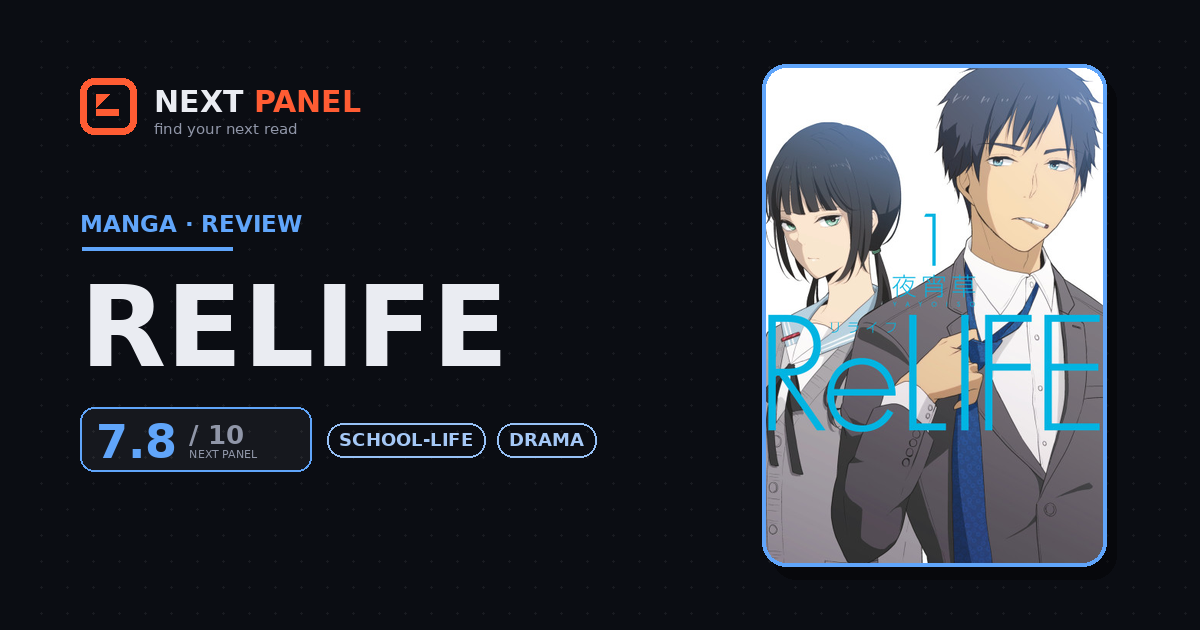
Arata Kaizaki is 27, unemployed, and lying about it. He quit his first real job after three months, nobody will hire him now, and his friends think he's still employed because he keeps up the act at drinking parties. Then a stranger from something called the ReLife Institute makes him an offer: take a pill that makes him look 17, spend one year as a high school senior, and get his living expenses covered while they observe him. ReLIFE is a full-color series that started as a webcomic, and it takes that silly setup somewhere surprisingly sincere.
What it does well
The premise isn't a costume — it's the whole engine. Arata walks into class with a decade of hindsight, fails his first test because he forgot everything, gets treated like a kid by teachers younger than him, and watches teenagers tear themselves apart over things he knows won't matter in five years. The comedy comes from that gap, and so does the sadness: he can see exactly which of his classmates are making his mistakes.
The supporting cast is where the series quietly earns its reputation. Chizuru Hishiro — brilliant, socially broken, trying to learn how to make friends from scratch — could have been a one-joke character and instead becomes the heart of the story. Rena Kariu starts as pure abrasive jealousy and gets one of the best growth arcs in the genre. Even the side romances get real time and real setbacks instead of being background noise.
And then there's the ending. Without spoiling anything: the experiment has a cruel condition attached, the story commits to it, and the final stretch turns a pleasant school comedy into something people still recommend years later mostly on the strength of how it closes. Endings are the hardest thing in serialized comics, and ReLIFE nails its own.
Where it falls short
The art is the obvious one. ReLIFE was drawn for phone screens — flat colors, simple faces, lots of talking heads. It's clean and readable, and the coloring helps the mood, but nobody is reading this for the draftsmanship. Put it next to any big-magazine series and it looks amateur.
The middle also sags. There's a stretch where the story cycles through club drama, tournament nerves, and misunderstandings between the teenage cast, and Arata — the reason you're here — fades into a spectator role. It picks back up, but if the adult perspective is what hooked you, you'll feel the drift.
And the sci-fi is pure hand-waving. The pill, the institute, the rules about who gets observed and why — none of it holds up to a second of scrutiny. The story knows this and moves on quickly, but if you need your premises airtight, this isn't that.
Verdict
ReLIFE is a comfort read with a knife hidden in it. It coasts for a while on charm and gap comedy, builds a cast worth caring about, then spends its final act cashing in every setup at once. The flat art and mid-series drift keep it out of the top tier, but the ending alone puts it above most of its genre. If it ever gets an official English release again, don't let it pass you by.
Strengths & Weaknesses
Strengths
- The adult-back-in-school premise does real work — Arata reads teenage drama with grown-up eyes, and that gap powers both the comedy and the heavier moments.
- The supporting cast gets actual arcs — Kariu especially grows from an abrasive rival into one of the best-written characters in the series.
- The ending is the payoff the whole premise was building toward — the last stretch ties the romance, the experiment, and the melancholy together cleanly.
- It's genuinely funny when it wants to be — the gap between Arata's inner 27-year-old and his classmates lands over and over.
Weaknesses
- The art is functional at best — simple faces, flat coloring, repeated framing; it carries emotion but never impresses on its own.
- The middle leans hard on teenage-misunderstanding drama that can drag if you came for the adult angle.
- The experiment itself runs on plot convenience — don't ask how the pill or the institute's rules actually work.
Similar Titles
Another second-chance school story built on regret, with a heavier tearjerker angle.
A literal do-over of high school, more comedic but chasing the same what-if itch.
Slow healing and found family, if ReLIFE's quieter emotional side is what hooked you.
Frequently Asked Questions
Is ReLIFE available in English?
Not officially right now. The English platforms that carried it — Crunchyroll Manga and later Pocket Comics — have both shut down their services, and there's no English print edition. We'll re-check and update this review if it gets licensed again.
Does the anime cover the whole story?
Yes, effectively. The TV series adapts most of the manga and a four-episode finale wraps up the ending, so the anime is a complete alternative. The manga still has more room for the side cast.
Is the manga finished?
Yes, the story is complete with a proper conclusion and epilogue material — no cliffhangers, no cancellation.