Is Restaurant to Another World Worth Reading? Review & Where to Read
Quick Answer
Yes, if you want something low-stakes and cozy. It's an anthology built around one gimmick — a restaurant that crosses worlds one day a week — so don't expect much plot momentum. Judged as comfort food, it delivers.
Quick Verdict
“The gimmick carries four volumes without wearing out its welcome, but you're here for the food, not the story.”
Best for: Readers who want a low-stress, one-sitting chapter they can dip into without tracking a season-long plot.
Not for: Readers who want a driving main plot and characters they'll follow across the whole series.
- Type
- Manga
- Genres
- Fantasy, Slice of Life
- Status
- Completed
- This review
- Minor Spoilers
- Author
- Junpei Inuzuka
- Artist
- Takaaki Kugatsu
- Publisher
- Square Enix (Yen Press, English)
- Platform
- Yen Press
| Quick facts | |
|---|---|
| Format | Manga (seinen), 29 chapters, 4 volumes |
| Run | 2016–2019 · completed |
| Community score | AniList 7.3 |
| Where to read | Yen Press — official |
Overview
Western Restaurant Nekoya looks like any small, slightly run-down diner tucked into a Tokyo basement — except on Saturdays, when its door quietly becomes a gate to a fantasy world. For one day a week, elves, dragons, knights, and demons wander in, order off a menu they've never seen, and eat food that doesn't exist where they come from. That's the entire premise, and the manga (adapting Junpei Inuzuka's light novels, drawn by Takaaki Kugatsu) never really asks for more than that. It isn't building toward a war or a reveal. It's a restaurant story that happens to have fantasy customers.
What it does well
The format is the strength. Because each chapter usually centers on one customer and one dish, you can pick this up cold, read a chapter, and walk away satisfied — there's no arc to catch up on. That makes it one of the easier long-running series to hand to someone who doesn't want a commitment.
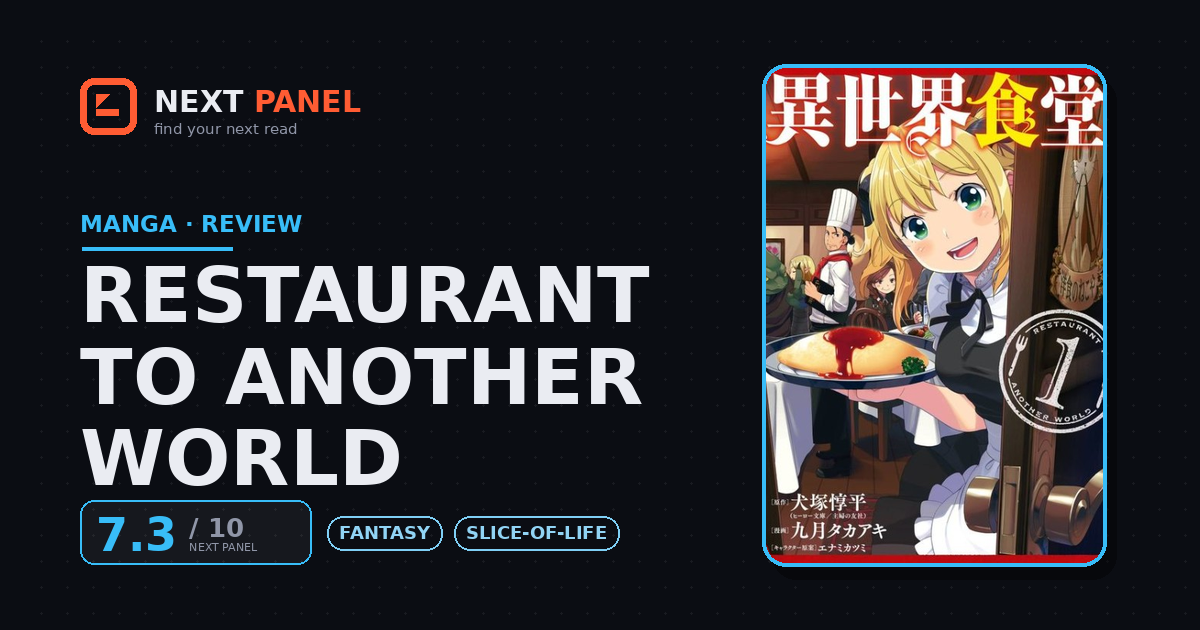
The food art carries a lot of weight, and it earns it. Kugatsu draws the dishes — omelet rice, beef stew, a simple glass of cola — with the kind of care usually reserved for the main cast, and the reactions from customers tasting Earth food for the first time land because the food itself looks worth reacting to. It's a manga that understands food is the actual protagonist.
The regulars are where the series shows some real craft. Aletta, the demon girl who ends up waitressing after taking shelter at the restaurant, and Kuro, a shapeshifting cat who treats the place like a second home, are both given enough small, specific character beats — how they order, what they're nervous about, what they're avoiding at home — that they read as people rather than a rotating cast of fantasy-race stand-ins. The series trusts small gestures over big speeches, and it mostly pays off.
Where it falls short
The anthology structure is also the ceiling. New customer, new dish, a bit of backstory, a satisfying meal, chapter over — once you've read four or five of these, you know the shape before it happens. The manga rarely breaks from it, and by the later volumes the surprises are almost entirely in which dish shows up, not in how the chapter unfolds.
Nobody really changes. The Master is unflappable in volume one and unflappable in volume four. Aletta grows a little more comfortable in her role, but there's no larger arc pulling any of this forward, which means the stakes never rise past whether this particular customer enjoys their meal. If you're reading for tension or character growth, this isn't going to give you much.
It also leans hard on its gimmick. Take away the isekai framing and this is a slice-of-life food manga, which is fine, but it means the fantasy-world elements — the demons, the magic, the other kingdoms — never get explored beyond being another interesting customer. Worldbuilding isn't really the point, but the setting does stay thin even after four volumes.
Verdict
This is comfort reading, and it knows it. If you want a manga you can pick up between other series, read a chapter of, and feel better for, Restaurant to Another World does that reliably across all four volumes. Just don't expect it to build toward anything — the door opens, someone eats a good meal, and the door closes again. That's the whole show, chapter after chapter, and for a lot of readers, that's exactly enough.
Strengths & Weaknesses
Strengths
- Every chapter is basically a stand-alone short story, so you can read one and stop without feeling like you're mid-cliffhanger.
- The food is drawn in loving, specific detail — it's about as close as a manga gets to real food photography.
- The fantasy regulars, like a demon waitress and a shapeshifting cat, get just enough personality to feel like real customers rather than props.
- The tone stays warm and unhurried even when a chapter touches on someone's hard year — it never turns preachy or maudlin.
Weaknesses
- The formula repeats: new customer arrives, orders a dish, reacts to it, chapter ends — by volume three you can see the beats coming.
- Nobody in the cast changes much. The regulars are the same people at the end as the start, which flattens the stakes.
- If you don't care for food-focused stories, there's not much else to hold onto — the fantasy-world elements stay in the background.
Similar Titles
Same episodic, self-contained-chapter structure, quiet and unhurried in a similar way.
Another gentle, food-focused slice of life built around small, specific meals.
Where to Read Officially
| Platform | Format | Pricing | Region notes | Link |
|---|---|---|---|---|
| Yen Press | Print & digital volumes | Paid | Region availability varies | Open |
Frequently Asked Questions
Do I need to read the light novels first?
No. The manga adapts the same anthology structure and works fine on its own — each chapter is a self-contained customer story.
Is there an overarching plot to Restaurant to Another World?
Barely. There's a loose frame explaining why the restaurant opens a door once a week, but it's not the focus — most chapters exist to spotlight one dish and one customer.
Is the manga finished?
Yes. It ran four volumes between 2016 and 2019 and is complete, so there's no cliffhanger to worry about.