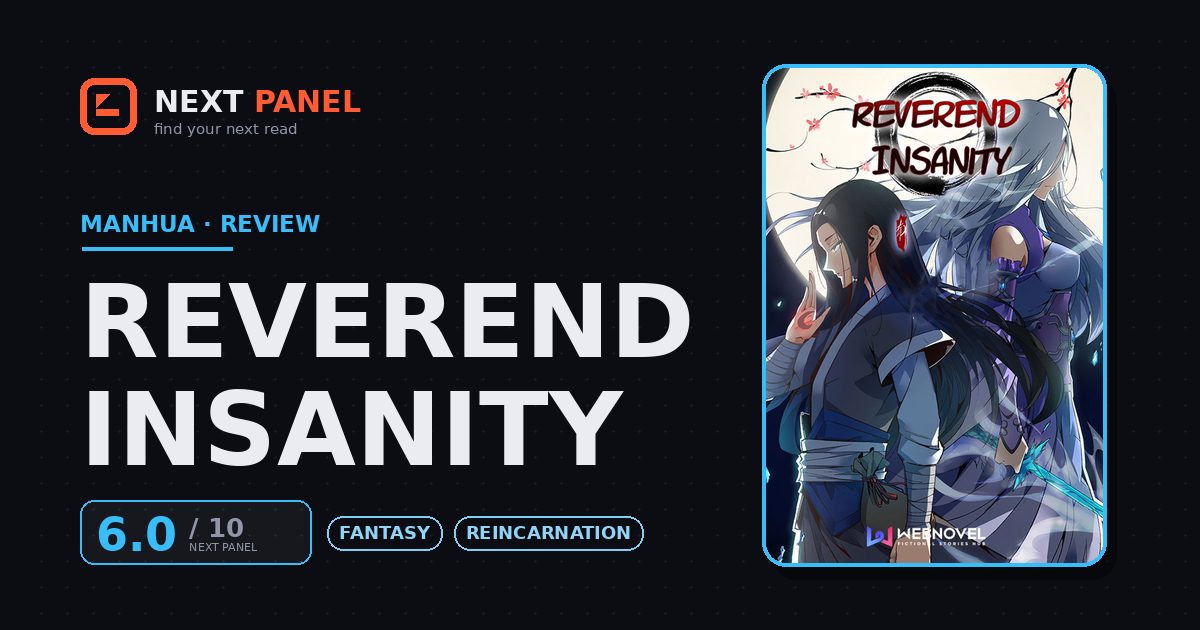
Is Reverend Insanity Worth Reading? Review & Where to Read
Quick Answer
As a comic on its own, it's a mixed bag — the art doesn't fully capture how ruthless Fang Yuan is supposed to be, and the official run stops well short of the story's end. As a taste of one of the most talked-about dark cultivation stories out there, it's still worth a look, with the understanding that you'll likely want the novel to get the full picture.
Quick Verdict
“Good bones, rough execution — this is the case for reading the novel with the manhua as a curiosity rather than the other way around.”
Best for: Readers curious about one of the most notorious morally-dark cultivation stories who want a low-commitment way to sample it.
Not for: Readers who want a complete story or art that matches the tone of what's actually happening on the page.
- Type
- Manhua
- Genres
- Fantasy, Reincarnation
- Status
- On Hiatus
- This review
- Minor Spoilers
- Author
- Gu Zhen Ren (original novel); Ranhui Culture (manhua)
- Artist
- Ranhui Culture
- Publisher
- Ranhui Culture
- Platform
- Webnovel
| Quick facts | |
|---|---|
| Format | Manhua, 96 chapters |
| Run | 2018–2020 · on hiatus |
| Community score | AniList 7.6 · MangaUpdates 6.8 |
| Content | Graphic violence, body horror, morally dark protagonist |
| Where to read | WebNovel — official |
Overview
Reverend Insanity follows Fang Yuan, a Gu Immortal — a cultivator who raises and refines venomous, magical "Gu" creatures for power — who's been reborn again and again chasing true immortality. He remembers his past lives, he's done monstrous things to get where he is, and he's completely fine with doing more. It's one of the most talked-about dark cultivation stories in the genre specifically because it refuses to soften its lead into a hero. The manhua adapts the opening stretch of that story, in the standard chapter-comic format rather than as a vertical webtoon.
What it does well
The premise alone carries a lot of weight. Fang Yuan isn't grinding through power tiers so much as running long cons across multiple lifetimes, and watching his plans click into place — years of setup paying off in a single conversation or ambush — is genuinely satisfying in a way most cultivation stories don't attempt. The Gu system itself is a real strength: bugs bred and refined for specific effects give the magic a body-horror, almost alchemical feel that's distinct from typical sword-and-qi cultivation, and it stays internally consistent as the scheming escalates.
When the manhua slows down enough to let a scheme play out panel by panel, it's easy to see why the source material has such a devoted following. The politics between Gu Masters, sects, and rival immortals given room to breathe are where the story is at its best.
Where it falls short
The adaptation has real problems as a comic in its own right. The art tends to draw Fang Yuan like a fairly standard shonen-style lead, which works against a character who's meant to read as cold and calculating underneath a friendly face. It's a mismatch between what the story is telling you and what the art is showing you, and it never fully closes.
More seriously, production stalled years ago and the official run simply stops mid-arc, with no ending in sight. If you're the kind of reader who needs a story to land somewhere, that's a real problem — you'll finish the available chapters mid-scheme with nothing to follow it up. The dense cast and layered plotting, which the novel can pace out over a huge word count, also get compressed here, so new readers without prior context may find the political web hard to follow.
Verdict
The idea underneath this manhua is one of the smarter, nastier concepts in the cultivation genre, and there's enough of that on display to see why the story has such a reputation. But as a standalone comic, it's an unfinished, softened version of something better experienced in its original novel form. Read it if you want a quick, low-commitment taste of Fang Yuan's world — just go in knowing it stops short, and that the real thing is elsewhere.
Strengths & Weaknesses
Strengths
- The core premise — a Gu Immortal who's died and restarted his climb to power more times than he can count, and has stopped pretending to be a good person about it — is one of the more distinctive hooks in the whole cultivation genre.
- Fang Yuan's plans are genuinely clever: he wins through decades of preparation, betrayal, and information control rather than raw power, which makes the political maneuvering the real draw.
- The Gu-based magic system is inventive and stays consistent, giving fights and schemes a distinct flavor you won't get from a standard sword-and-cultivation series.
Weaknesses
- The art frequently softens Fang Yuan into a more conventional-looking lead, which undercuts how calculating and amoral he's written to be in the source story.
- Production stalled well before the story resolves, so the manhua just stops mid-arc rather than building to any real conclusion.
- The huge cast and dense scheming, which the novel has room to unpack slowly, get compressed in the comic format and can be hard to track without prior context.
Similar Titles
Similar dense, plan-heavy dark fantasy with a protagonist who's constantly scheming several steps ahead.
Martial God Regressed to Level 2
Another morally grey, repeated-life protagonist working an angle rather than just grinding levels.
For readers who want a similarly cerebral, deception-driven cultivation story.
Where to Read Officially
| Platform | Format | Pricing | Region notes | Link |
|---|---|---|---|---|
| Webnovel | Digital chapters | Free + Paid | Region availability varies | Open |
Frequently Asked Questions
Does the Reverend Insanity manhua finish the story?
No. The official adaptation was discontinued partway through — production stalled after the original novel was banned in China, and it never resumed. It stops well before the story's ending.
Is the manhua as dark as the novel?
It covers the same events, but the art style leans more conventional than the novel's tone, which softens some of how coldly manipulative Fang Yuan actually is.
Should I read the novel instead?
If you get invested, yes — the novel is the complete, more faithful version of the story. The manhua works fine as an introduction but isn't the definitive way to experience it.