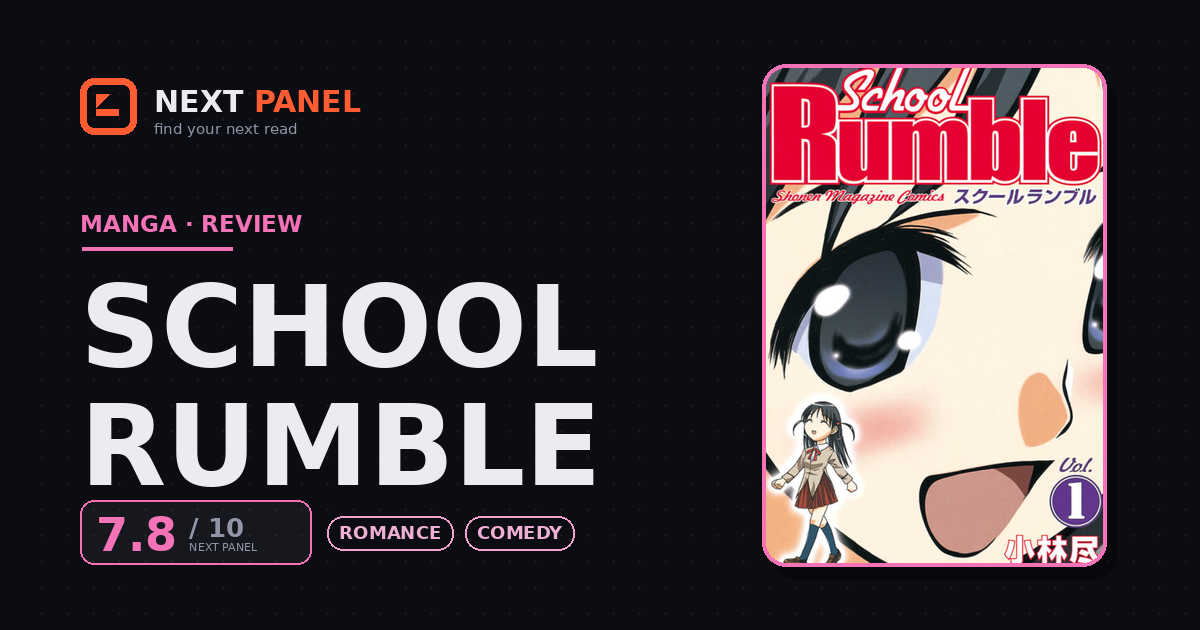
Is School Rumble Worth Reading? Review & Where to Read
Quick Answer
Yes, if you like slow-burn romantic comedies with a huge joke-per-page count. It's a comfort read more than a plot-driven one, and it never really resolves the central triangle until the very end.
Quick Verdict
“Funnier than almost anything else in the genre, and that's exactly why the stalled romance gets frustrating by volume ten.”
Best for: Readers who enjoy dense, fast-paced gag comedy and don't mind a romance that takes its time.
Not for: Readers who want a love triangle resolved quickly or a plot with forward momentum every chapter.
- Type
- Manga
- Genres
- Romance, Comedy
- Status
- Completed
- This review
- Minor Spoilers
- Author
- Jin Kobayashi
- Publisher
- Kodansha
- Platform
- Kodansha USA
| Quick facts | |
|---|---|
| Format | Manga, 345 chapters, 22 volumes |
| Run | 2002–2008 · completed |
| Community score | AniList 7.8 · MangaUpdates 8.0 |
| Where to read | Kodansha USA — official |
Overview
School Rumble is a high school romantic comedy built around one simple setup: Tenma Tsukamoto is hopelessly in love with a classmate who barely notices her, while Kenji Harima, the school's most feared delinquent, is just as hopelessly in love with Tenma, who barely notices him. Jin Kobayashi stretches that single joke across 22 volumes, and somehow it keeps working, because the manga is less about the love triangle resolving and more about the parade of gags, misunderstandings, and side characters that spin out of it.
What it does well
The comedy is the reason to read this. Kobayashi has a gift for visual gags and comic timing that rivals a well-cut sitcom — reaction shots land at exactly the right beat, running jokes get callbacks pages or volumes later, and the exaggerated art style never undercuts the emotional moments buried underneath the slapstick. Tenma and Harima both carry real comic chops as leads: she's dense in a way that feels like a genuine character trait rather than a plot device, and he's a delinquent whose soft, awkward crush plays against type without feeling like a gimmick.
What elevates School Rumble above a lot of its peers is how much care goes into the supporting cast. Characters who start as one-joke background students, like Tenma's sister Yakumo or Harima's crew of loyal delinquents, get genuine arcs and comedic spotlight chapters of their own. By the midpoint, the manga feels like an ensemble as much as a two-person love story, and several of those side arcs are as memorable as the main pairing.
The art holds up too. Kobayashi draws physical comedy with real clarity — you always know exactly what's happening in a chaotic panel, which matters a lot for a series this dependent on sight gags and slapstick misunderstandings.
Where it falls short
The flip side of that ensemble sprawl is pacing. There are stretches, especially in the middle volumes, where the core triangle just doesn't move, and Kobayashi leans on side-character arcs or extended gag setups to fill the space. Some of those detours are great; others run a joke a few chapters past its natural end point. If you're reading primarily for the romance, the plot's refusal to progress for long stretches will test your patience more than once.
The tonal whiplash is real too. School Rumble can pivot from broad slapstick to a genuinely quiet, sincere emotional beat within a few pages, and that shift doesn't always land smoothly. It works because the character work underneath is solid, but it can feel like tonal whiplash if you're not expecting it.
Verdict
School Rumble earns its reputation as one of the better romantic comedies in manga, mostly on the strength of its comic timing and a supporting cast that actually matters. It asks for patience with a love triangle that moves at a glacial pace, and if you need steady forward momentum, that ask might be too much. But if you're in it for the jokes and the slow-burn charm of two oblivious leads circling each other for years, it delivers exactly what it promises.
Strengths & Weaknesses
Strengths
- The comedic timing is relentless — Kobayashi packs sight gags, wordplay, and physical comedy into nearly every page without the jokes feeling padded.
- Tenma and Harima are both genuinely funny leads whose obliviousness feels earned rather than forced, so the miscommunication never tips into secondhand embarrassment.
- The side cast gets real development instead of staying one-note; several supporting students get their own subplots that pay off later.
- The art sells physical comedy extremely well, with exaggerated expressions timed like an actual sitcom rather than static reaction shots.
Weaknesses
- The central triangle barely moves for long stretches, and some readers will lose patience waiting for either lead to just say what they mean.
- A few extended gag arcs run longer than the joke can support, especially in the middle volumes.
- The tone occasionally swings between slapstick and quieter emotional beats without much warning, which can feel jarring chapter to chapter.
Similar Titles
Where to Read Officially
| Platform | Format | Pricing | Region notes | Link |
|---|---|---|---|---|
| Kodansha USA | Digital chapters & volumes | Paid | Region availability varies | Open |
Frequently Asked Questions
Is School Rumble finished?
Yes, the main series is complete at 22 volumes, and there's a short continuation volume as well.
Do Tenma and Harima end up together?
The series resolves the triangle by the end, but it takes its time getting there — that slow burn is a defining feature, not a bug.
Is this the same as the anime?
The two versions diverge in pacing and a few plot choices; the manga runs longer and covers more ground than either anime season.