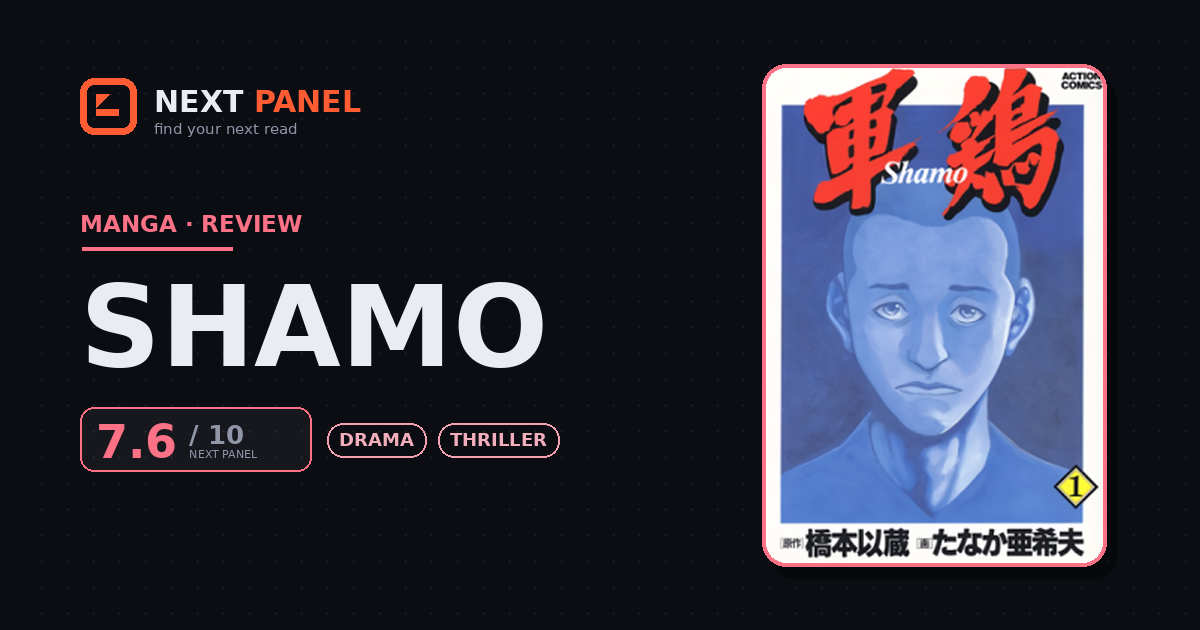
Is Shamo Worth Reading? Review & Where to Read
Quick Answer
Worth it only if you go in with eyes open: this is one of the ugliest, most morally uncompromising fighting manga out there, and it earns that reputation through craft, not shock value alone.
Quick Verdict
“The martial arts writing is some of the sharpest in the genre; whether you can stomach the man at the center of it is a real question you should ask before starting.”
Best for: Readers who want unflinching, technically detailed martial arts storytelling built around an irredeemable protagonist.
Not for: Readers who want a hero to root for or a story that isn't built around graphic violence and sexual assault.
- Type
- Manga
- Genres
- Drama, Thriller
- Status
- Completed
- This review
- Minor Spoilers
- Author
- Izo Hashimoto (story), Akio Tanaka (art)
- Artist
- Akio Tanaka
- Publisher
- Futabasha / Kodansha
| Quick facts | |
|---|---|
| Format | Manga (seinen), 338 chapters, 34 volumes |
| Run | 1998–2015 · completed |
| Community score | AniList 7.4 · MAL 7.6 · MangaUpdates 7.8 |
| Content | Graphic violence, sexual assault, disturbing themes |
Overview
Shamo opens with an act it never lets you forget: Ryo Narushima, a top student with a clear path to Tokyo University, murders both of his parents in a sudden, senseless outburst. Convicted at sixteen, he's sent to a reformatory where he's brutalized by other inmates until Kenji Kurokawa, a former revolutionary serving time for an assassination attempt, takes him under his wing and teaches him karate. From there, the manga follows Ryo out of the reformatory and into Japan's underground and semi-professional full-contact fighting scene, where his talent for violence finally has a legitimate outlet.
This isn't a redemption story. Ryo remains coldly self-interested for the entire run, and the manga is built around forcing you to watch a genuinely terrible person become very good at something.
What it does well
The fighting is the reason Shamo has the reputation it does. Akio Tanaka draws karate and full-contact matches with a level of technical patience that's rare even among fighting manga — stances set up payoffs pages later, fatigue and injury visibly accumulate, and matches are won and lost on specific, trackable decisions rather than sudden power spikes. If you care about martial arts as a discipline rather than just spectacle, this is one of the more rewarding depictions of it in the medium.
The choice to keep Ryo unrepentant is the manga's other real achievement. He doesn't soften, doesn't earn a sympathetic backstory that explains away what he did, and the story never asks you to forgive him — it just keeps putting him in front of you, fighting, and daring you to keep watching. That refusal to sand down its own premise is rare, and it's what separates Shamo from a more conventional underdog story wearing the same setup.
The world around him has real texture too: the business of arranging an underground match, the rival dojos with their own codes, the trainers who see him as a tool as much as a person. None of it feels generic.
Where it falls short
The manga's biggest problem is how it uses sexual assault as a recurring tool to escalate rivalries — most notably in the arc against Naoto Sugawara — and it's staged with a flatness that doesn't match the seriousness of what's happening. It reads less like the story grappling with Ryo's monstrousness and more like using it as a shortcut to raise the stakes, and it's the one place where the manga's commitment to ugliness curdles into something worse than provocative.
Because Ryo never changes and nobody around him is built up as a true counterweight, there's genuinely no one to root for, which will be a hard stop for a lot of readers regardless of how well the fights are drawn. And the later stretch of its fractured, decade-plus publication history shows the strain — training arcs and internal monologue stretch out in ways the tighter early volumes never needed.
Verdict
Shamo is a technically excellent martial arts manga wrapped around one of the genre's most disturbing protagonists, and it doesn't try to make that combination easy to swallow. If detailed, unglamorized fight craft is what you're after and you can stomach the character and content around it, it delivers; if you need someone to root for, look elsewhere.
Strengths & Weaknesses
Strengths
- The karate and full-contact fighting are drawn and paced with a technical precision most fighting manga don't bother with — stances, timing, and damage all track logically fight to fight.
- Ryo Narushima's total lack of remorse is played straight instead of softened into an antihero redemption arc, which makes the book genuinely unpredictable.
- The underground fighting world around him — trainers, rival dojos, the business side of a televised match — is built out with real texture instead of staying generic.
- The tension escalates fight by fight without the story ever needing to invent a power system or gimmick to raise the stakes.
Weaknesses
- The story repeatedly uses sexual assault as a plot device to escalate rivalries, and it's handled with none of the gravity the act would demand.
- There's no character here to root for in any conventional sense, which will be a dealbreaker for readers who need someone to be on the side of.
- The pacing sags in stretches of training and internal monologue between the fights, especially across its later, more fragmented publication run.
Similar Titles
Shares the obsessive focus on martial arts technique and escalating underground fights.
A far more introspective, morally grounded take on the same one-on-one duel structure.
Another seinen built around a protagonist you're not meant to simply like or trust.
Frequently Asked Questions
Is Shamo finished?
Yes, though its run was fractured — serialized from 1998, paused in 2007 over a creative dispute, resumed in 2011, and finished in 2015.
Is there an anime?
No TV anime adaptation exists, only the manga.
Is there an official English release?
Not currently. Shamo has no licensed English edition; this review will be updated if that changes.