Is Shiki Worth Reading? Review & Where to Read
Quick Answer
If you like horror that builds slowly and makes you uneasy rather than just startling you, Shiki is a strong pick. It's patient, morally murky, and genuinely creepy once it gets going — you just have to sit through a slow start and a large cast.
Quick Verdict
“Fujisaki's art turns a quiet rural outbreak into something deeply unsettling — patient horror that pays off if you let it build.”
Best for: Readers who like slow-burn horror that takes its time and treats victims and monsters alike as people.
Not for: Readers who want quick scares and a small, easy-to-follow cast.
- Type
- Manga
- Genres
- Horror, Supernatural
- Status
- Completed
- This review
- Minor Spoilers
- Author
- Fuyumi Ono
- Artist
- Ryu Fujisaki
- Publisher
- Viz Media
| Quick facts | |
|---|---|
| Format | Manga (shōnen), 42 chapters, 11 volumes |
| Run | 2007–2011 · completed |
| Community score | AniList 7.6 · MangaUpdates 8.0 |
| Content | Graphic violence, body horror |
Overview
Shiki starts with a simple, nasty premise: people in Sotoba, a small, isolated village ringed by mountains and forest, begin dying. At first it looks like an epidemic — summer heat, an unlucky run of illness. But the deaths keep spreading, they don't follow any natural pattern, and a stubborn local doctor refuses to accept the easy explanation. Based on a horror novel by Fuyumi Ono and drawn by Ryu Fujisaki, the manga is a patient, dread-soaked story about what happens when a closed community starts coming apart.
What it does well
The slow burn is the whole point, and when it works it's excellent. Shiki understands that horror is scariest when it's plausible and creeping, so it spends real time establishing Sotoba as a place — its families, its gossip, its rhythms — before it starts taking that place apart. Each new death lands harder because you know who these people are. By the midpoint, an ordinary village has become a pressure cooker, and the sense that something is very wrong has nowhere to escape to.
Its smartest move is refusing to pick an easy side. The book gives genuine weight and sympathy to both the villagers fighting to survive and the things that are killing them. Nobody here is simply evil or simply innocent, and as the situation escalates the moral lines get blurrier rather than clearer. That turns the horror inward: the most disturbing scenes aren't the kills, but the choices ordinary people make when they're cornered and afraid. It becomes a story about how a community decides who counts as human.
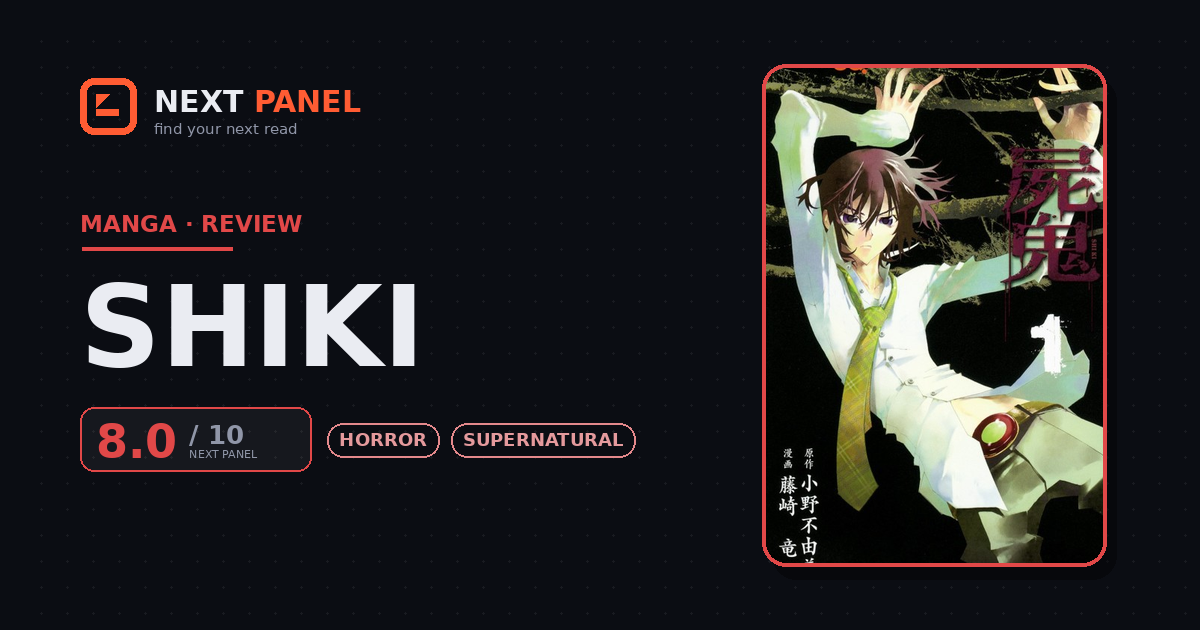
Fujisaki's art is the other big draw, though it's an acquired taste. His character designs are flamboyant — wild hair, sharp features, theatrical fashion — and his detailed, slightly unhinged style gives Sotoba and its monsters a look you won't confuse with anything else. In the tense later volumes, that intensity pays off in images that are hard to shake.
Where it falls short
The price of the slow build is a genuinely slow start. The early volumes ask for patience, juggling a big ensemble and a lot of small-town setup before the dread takes over, and some readers will bounce before it clicks. The art that makes the book distinctive is also what divides people — the exaggerated, glamorous designs don't read as "horror" to everyone, and the mismatch can undercut the mood. And while the large cast mostly works, a few characters never become more than bodies for the count. None of this sinks the book, but it does mean Shiki rewards commitment more than a casual flip-through.
Verdict
Shiki is a strong, unusually thoughtful horror manga that trades cheap scares for slow, mounting dread and a real moral knot at its center. The deliberate pace and divisive art keep it from being an instant crowd-pleaser, but for readers who like horror that gets under the skin and stays there, it more than delivers. Stick with the early volumes; the payoff is worth the wait. One note for English readers: there's no official English edition of the manga yet, only Japanese and European-language printings, so for now it's easiest to reach in those languages.
Strengths & Weaknesses
Strengths
- The core idea — a creeping wave of deaths in a sealed-off mountain village — is wrung for real dread as the body count climbs.
- It gives weight to both sides: the dying villagers and the creatures killing them are both treated as people, so the horror is moral as much as visceral.
- Fujisaki's detailed, eccentric art and bold character designs make the village and its monsters stick in your memory.
- The slow build pays off in a tense, genuinely ugly final stretch that earns its dread.
Weaknesses
- The opening volumes are slow, with a large cast to set up before the fear really takes hold.
- The art style is divisive — the exaggerated hair and faces don't land for everyone in a horror story.
- A handful of characters exist mainly to be victims and never grow past that role.
Similar Titles
Frequently Asked Questions
Is Shiki based on a novel?
Yes. It began as a horror novel by Fuyumi Ono; Ryu Fujisaki drew the manga adaptation. There's also an anime version of the story.
Is it scary or more of a drama?
Both. It's a slow burn that cares as much about the dread and moral mess of the situation as about shock scares, so the horror creeps up on you over time.
Is it finished?
Yes, the manga is complete in eleven volumes.
Is there an official English release?
Not right now. The manga has been printed in Japanese, French, and German, but there's no official English edition yet. We'll update this page if one is announced.