Is Strobe Edge Worth Reading? Review & Where to Read
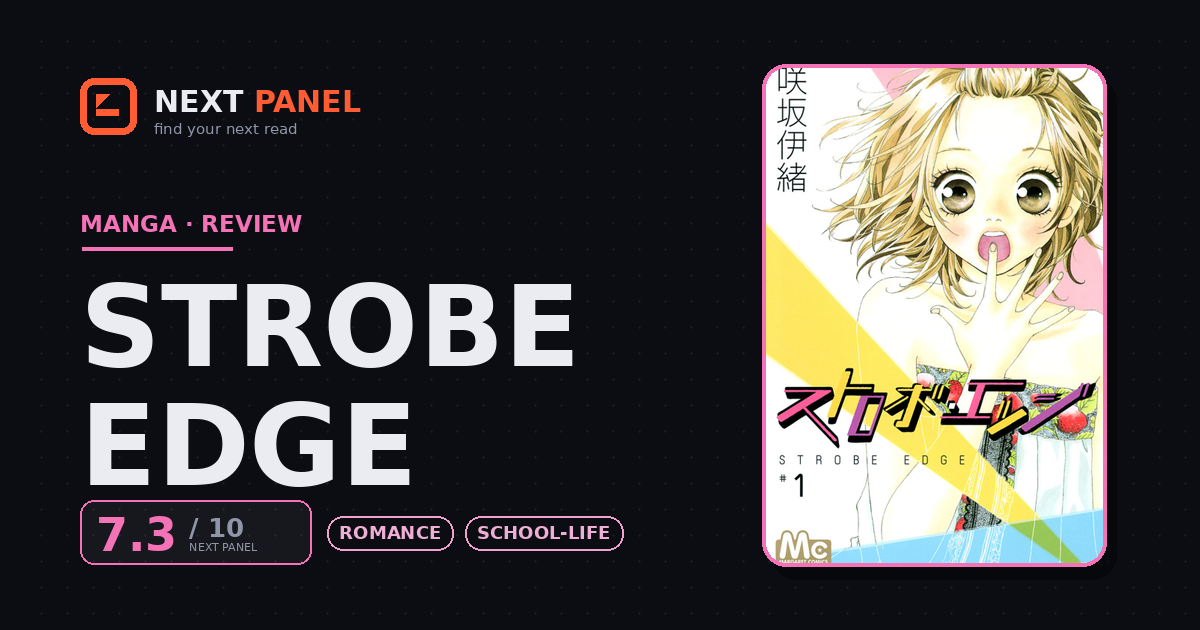
Quick Answer
If you want a gentle, grounded first-love story without any melodrama, yes. Strobe Edge is patient and sincere, though it takes its time and never really surprises you.
Quick Verdict
“The slowest of slow burns — sincere, sweet, and completely predictable, which is exactly the point for the right reader.”
Best for: Readers who want a soft, realistic first-love story and don't mind a plot that takes its time.
Not for: Readers who want fast pacing, a twisty plot, or a love triangle with real stakes and surprises.
- Type
- Manga
- Genres
- School Life, Romance
- Status
- Completed
- This review
- Minor Spoilers
- Author
- Io Sakisaka
- Publisher
- Shueisha
- Platform
- VIZ Media (Shojo Beat)
| Quick facts | |
|---|---|
| Format | Manga (shōjo), 42 chapters, 10 volumes |
| Run | 2007–2010 · completed |
| Community score | AniList 7.5 · MAL 8.0 · MangaUpdates 8.4 |
| Where to read | VIZ Media (Shojo Beat) — official |
Overview
Strobe Edge is Io Sakisaka's breakout shoujo series, and it's built around the smallest possible premise: a girl who has never been in love meets a boy everyone adores, and has to figure out what that feeling actually is. Ninako Kinoshita is the girl. Ren Ichinose is the boy, and he already has a girlfriend, Mayuka, who happens to be the older sister of one of Ninako's own friends. So Ninako does the quiet, decent thing and tries to just be his friend, while the feeling keeps growing anyway. Around that center, a second couple — Ninako's best friend Sayuri and Ren's childhood friend Daiki — works through their own on-and-off relationship, and Ren's womanizing friend Ando gets pulled into genuinely caring about Ninako too.
None of that sounds like much on paper, and that's deliberate. Sakisaka isn't interested in incident; she's interested in the texture of liking someone before anything has actually happened between you.
What it does well
The best thing here is how normal it all feels. Ninako doesn't monologue about her feelings in dramatic terms — she notices small things, gets flustered over nothing, and second-guesses herself the way an actual teenager would. Sakisaka's art carries a lot of that weight: a hand lingering near someone's sleeve, a held door, a jacket passed over without comment. Those beats do more work than the dialogue, and they're the reason the series has stuck around as a genre touchstone.
The secondary romance between Sayuri and Daiki isn't just there to pad the page count. It gets its own messy, believable arc — jealousy, an ex-girlfriend still in the picture, a friendship that has to become something else — and it's given enough room that the story never feels like it's just killing time between Ninako-and-Ren scenes.
What's most refreshing, especially if you've read a lot of romance manga, is how little the plot cheats. There's no engineered misunderstanding kept alive by two people refusing to just talk to each other. Everyone here is basically honest. The obstacle is genuinely just timing and circumstance, which makes the eventual payoff feel earned rather than manufactured.
Where it falls short
The pacing is the real cost of that patience. The first several volumes circle the same emotional ground — Ninako likes him, he has a girlfriend, nothing changes — and if you're reading for momentum, it'll test you. This isn't a series where things happen; it's a series where feelings slowly shift, and Sakisaka asks you to sit with that for a long time before anything moves.
Ren himself is a weak point for a long stretch. He's kind to Ninako in ways that keep her hopeful while he's still attached elsewhere, and the story doesn't really hold him accountable for how that reads — it's treated as boyish obliviousness rather than something worth examining. And past the two central couples, almost nobody else has an interior life; the wider cast is scenery.
Verdict
Strobe Edge earns its reputation as a shoujo standard by doing one thing extremely well: making a slow, ordinary first love feel true. It's not going to surprise you, and the first half asks for real patience, but if you're in the mood for something gentle and sincere rather than plotty, it delivers exactly what it promises.
Strengths & Weaknesses
Strengths
- Ninako's inner voice feels like an actual teenager figuring out a feeling for the first time, not a genre archetype reciting romance beats.
- Sakisaka draws body language and small gestures — a held door, a borrowed jacket — that carry more weight than the dialogue does.
- The secondary couple gets a real arc instead of sitting in the margins as filler, which keeps the middle volumes from sagging.
- It never manufactures conflict through lying or misunderstandings; the tension comes from people being honest and still stuck.
Weaknesses
- The pace is glacial in the first half — if you want the leads to actually get somewhere, you'll be waiting a while.
- Ren spends a long stretch being kind but noncommittal, and the story lets him get away with it more than it probably should.
- The side cast outside the two couples barely registers; nobody else gets an inner life worth mentioning.
Similar Titles
Same gentle, grounded shoujo romance register, with a shyer, more introverted lead.
Another Sakisaka-adjacent slow-burn built on old feelings and bad timing.
A cozier, lower-drama high school romance for readers who want the sweetness without the triangle.
Where to Read Officially
| Platform | Format | Pricing | Region notes | Link |
|---|---|---|---|---|
| VIZ Media (Shojo Beat) | Print & digital volumes | Paid | Region availability varies | Open |
Frequently Asked Questions
Is Strobe Edge finished?
Yes. It ran in Bessatsu Margaret from 2007 to 2010 and is complete at 10 volumes.
Is there an anime?
No TV anime, but there's a 2015 live-action film and a 2025 live-action series.
Where can I read it in English?
Officially through VIZ Media's Shojo Beat imprint, in print or digitally on viz.com.