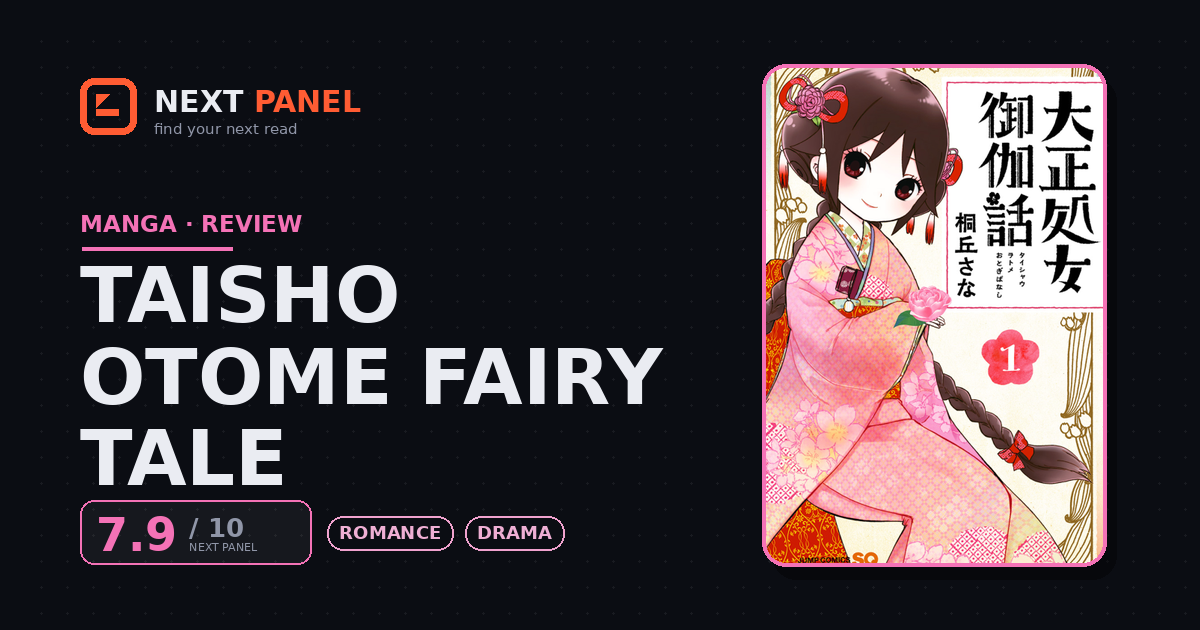
Is Taisho Otome Fairy Tale Worth Reading? Review & Where to Read
Quick Answer
Yes, if you want a gentle, character-focused period romance rather than a fast or plot-heavy read. It moves slowly and leans hard on mood and small gestures, which is either exactly what you want or a dealbreaker.
Quick Verdict
“Quiet, patient, and sincere — this is a romance that trusts small gestures to do the heavy lifting instead of drama.”
Best for: Readers who want a slow, tender period romance built on small character moments rather than plot twists.
Not for: Readers who want fast pacing, high stakes, or a story driven by external conflict rather than internal change.
- Type
- Manga
- Genres
- Romance, Drama
- Status
- Completed
- This review
- Minor Spoilers
- Author
- Sana Kirioka
- Publisher
- Shueisha
| Quick facts | |
|---|---|
| Format | Manga (shōnen) |
| Run | completed |
Overview
Taisho Otome Fairy Tale opens with Tamahiko Shima, the second son of a wealthy family, exiled to a rural estate after a traffic accident kills his mother and leaves his arm impaired. Written off by his father as useless, he's living in bitter isolation until Yuzuki Tachibana arrives, a countryside girl essentially bought as his bride to settle her family's debt. What follows isn't a dramatic love story so much as a quiet character study of two people slowly repairing each other, set against the backdrop of 1920s Japan.
What it does well
The romance is the clear strength here, and it works because Sana Kirioka refuses to rush it. Tamahiko doesn't have a sudden change of heart; his shift from suicidal resentment to genuine warmth happens in increments, through Yuzuki's persistence and a string of small, specific moments rather than one big turning point. That patience makes the relationship feel earned instead of assumed, which is rarer than it should be in arranged-marriage romance.
The period setting pulls real weight too. Taisho-era Japan, caught between traditional class structures and encroaching modernization, gives the story a specific texture beyond generic "old Japan" dressing. Clothing, social expectations, and the class gap between Tamahiko's family and Yuzuki's are all treated as real pressures on the characters rather than backdrop.
The art matches the tone: soft linework, careful attention to period clothing and interiors, and quiet paneling that gives emotional beats room to breathe instead of rushing past them.
Where it falls short
The pacing that makes the romance feel sincere also means long stretches where not much happens externally. If you need a story that's constantly moving forward, this will test your patience more than once — plenty of chapters are built around a single small gesture or conversation rather than plot progression.
The side cast also gets short shrift. Characters around Tamahiko and Yuzuki, including his siblings, mostly exist to react to or comment on the central couple rather than carrying their own arcs, so the emotional world of the story stays narrow. And when the plot does escalate, like during the arc built around the 1923 earthquake, the tonal shift from quiet domestic drama to disaster and separation lands a little abruptly after so much stillness.
Verdict
Taisho Otome Fairy Tale is a patient, sincere romance that earns its emotional payoffs by refusing to rush them. It won't work for readers who need constant plot movement, and the narrow supporting cast keeps the story's world feeling small. But if you want a period romance that trusts small, human gestures over melodrama, this delivers exactly that.
Strengths & Weaknesses
Strengths
- The central romance develops through small, believable gestures instead of grand declarations, which gives it a lived-in, sincere feel.
- The 1920s Taisho-era setting is rendered with real texture — clothing, class tension, and the period's mix of tradition and modernization all feel considered rather than decorative.
- Tamahiko's arc from bitter and suicidal to genuinely hopeful is handled with care and doesn't rush the emotional work.
- The art leans soft and detailed in a way that suits the period setting and quieter emotional beats.
Weaknesses
- The pacing is slow enough that readers looking for plot momentum may find long stretches uneventful.
- Side characters get comparatively little development next to the two leads, so the emotional world can feel narrow.
- A few dramatic turns, like the earthquake arc, shift tone abruptly after a long stretch of quiet character work.
Similar Titles
Another slow-burn romance built on small, sincere gestures rather than melodrama.
Similar interest in period detail and a quiet, patient central relationship.
Frequently Asked Questions
Is there an official English translation?
Not yet — this one doesn't currently have a licensed English digital or print release, so there's no official link here. That will be revisited if a license is announced.
Is this the same story as the anime?
The anime covers the manga's early volumes closely, so the manga mostly continues past where the anime stops rather than diverging.
Does this end happily?
Without spoiling specifics, the tone throughout is hopeful and the series is more interested in healing than tragedy.