Is The Cafe Terrace and Its Goddesses Worth Reading?
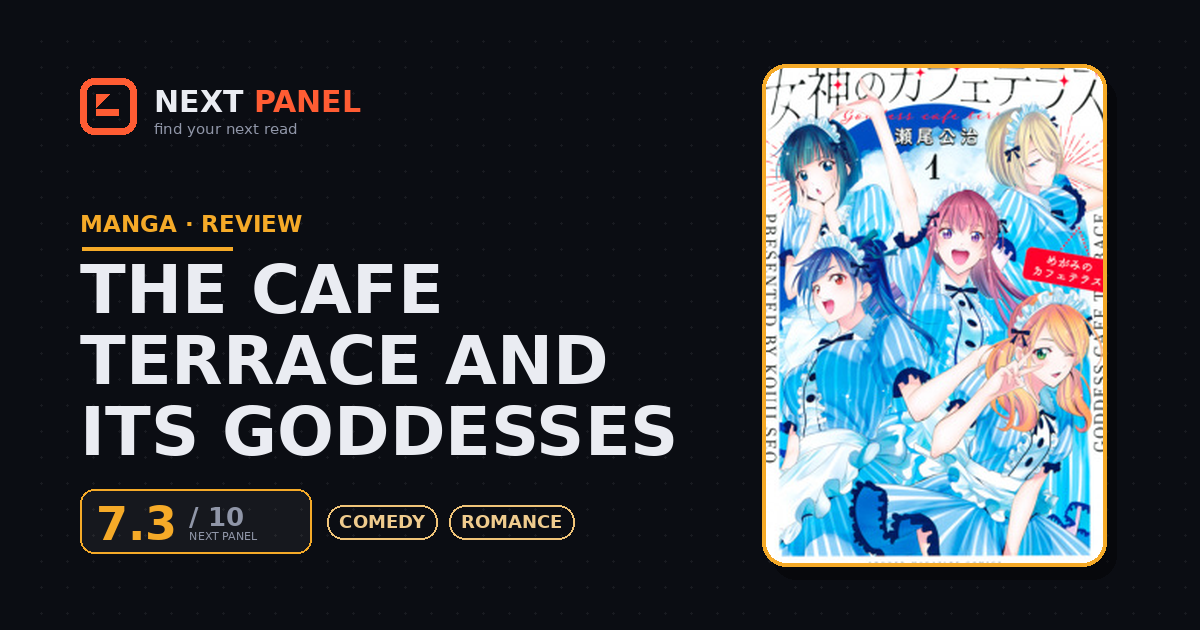
Quick Answer
Worth reading if you're already a harem rom-com fan: the five leads are genuinely distinct and the ending pays off, but the repetitive arc structure and constant fanservice will wear on anyone lukewarm on the genre.
Quick Verdict
“Solid, formulaic harem rom-com where the character writing outperforms the premise, and one of the rare entries in the genre that actually sticks the landing.”
Best for: Readers who enjoy crowded harem rom-coms and want one that actually commits to an ending instead of stalling forever.
Not for: Readers who find fanservice-heavy art or repetitive arc structures tiresome over a long series.
- Type
- Manga
- Genres
- Romance, Slice of Life, Comedy
- Status
- Completed
- Author
- Kouji Seo
- Publisher
- Kodansha
- Platform
- Kodansha
| Quick facts | |
|---|---|
| Format | Manga, 22 volumes |
| Run | completed |
| Community score | MangaUpdates 6.8 |
| Content | fanservice/ecchi content throughout |
| Where to read | Kodansha — official |
Overview
Hayato Kasukabe just wants to sell his dead grandmother's rundown seaside cafe and move on with his life. That plan lasts about five minutes once he finds out the place already has five live-in residents: young women who all call his grandmother "family" and have nowhere else to go. Guilt-tripped and outnumbered, he agrees to keep Cafe Terrace open, which means running a business with five near-strangers who each come loaded with their own history, baggage, and very telegraphed feelings for him.
Kouji Seo, the creator behind Suzuka and Fuuka, isn't hiding what this is: a harem rom-com dressed up as a slice-of-life workplace comedy. Weekly Shonen Magazine ran it for almost five years, 217 chapters across 22 volumes, and it wrapped in late 2025 with an actual ending. The story picks a winner instead of leaving things unresolved forever, which more harem manga should manage and don't.
What it does well
The five leads aren't interchangeable. Seo gives each one a distinct voice, a specific reason she's clinging to the cafe, and a personal arc that gets real chapter-count investment instead of a token backstory dump. That's the thing Seo's known for from his earlier work, and it holds up here. Even readers who bounce off harem as a genre tend to admit the character writing is doing more work than the premise requires.
The cafe itself is a decent narrative engine too. Instead of just cycling through beach episodes and hot spring chapters, though there's plenty of that, each arc usually ties a girl's personal crisis to something threatening the business, so the will-they-end-up-together plot and the will-the-cafe-survive plot move together. The last stretch, once the cast stops expanding and the story commits to closing out its central relationships, gets noticeably more character-driven and less interested in fanservice than the middle third. Several longtime readers single out the final chapters as the strongest part of the run.
Where it falls short
The structure repeats itself. A girl's problem surfaces, Hayato gets pulled in, the other girls interrupt before anything can actually happen between them, he fixes it, there's a fanservice beat, then it's the next girl's turn. Once you've read four or five arcs you can see the gears turning, and 22 volumes of that pattern is a lot to sit through if the formula doesn't click for you early.
The ecchi content is constant, not occasional. If fanservice-heavy art is a dealbreaker, nothing about the writing quality changes that calculus. And the cast doesn't stay at five: new girls keep entering the "competition" well past the point where you'd expect the field to be set, which dilutes the tension around who actually has a shot and can make the pacing feel like it's stalling rather than building.
Verdict
This is a solid, formulaic harem rom-com that's better at character work than its premise suggests, and it's rare among the genre for actually finishing what it starts. Worth reading if you already know you like this specific shape of story. If the repetitive arc structure and heavy fanservice sound exhausting on paper, they won't read any better on the page.
Strengths & Weaknesses
Strengths
- Five sharply differentiated female leads instead of interchangeable harem stereotypes
- Actually finishes with a real ending and a chosen pairing, unlike a lot of long-running harem manga
- Final stretch of the series gets noticeably more character-driven than the fanservice-heavy middle
- Kouji Seo's character writing pedigree (Suzuka, Fuuka) shows in how each girl's backstory lands
Weaknesses
- Arc structure repeats the same beats (crisis, interruption, resolution, fanservice) for most of the run
- Ecchi content is constant rather than occasional, which won't work for every reader
- New girls keep joining the cast late into the story, diluting tension around the central pairing
Similar Titles
Another crowded rom-com harem that actually commits to picking a winner instead of stalling forever.
The Quintessential Quintuplets
Same five-girls-one-guy structure, with a similarly strong finish once the field narrows.
Wotakoi: Love is Hard for Otaku
A calmer, one-couple alternative if a five-person harem cast feels like too much.
Where to Read Officially
| Platform | Format | Pricing | Region notes | Link |
|---|---|---|---|---|
| Kodansha | Digital | Paid | Region availability varies | Open |
Frequently Asked Questions
Is The Cafe Terrace and Its Goddesses finished?
Yes. It's completed at 217 chapters across 22 volumes, serialized in Weekly Shonen Magazine from February 2021 to November 2025.
Is there an anime adaptation?
Yes, the manga has been adapted into two TV anime seasons.
Where can I read it in English?
Kodansha USA publishes it digitally, and it's also available as a simulpub through K Manga.