Is The Devil Is a Part-Timer! Worth Reading? Review & Where to Read
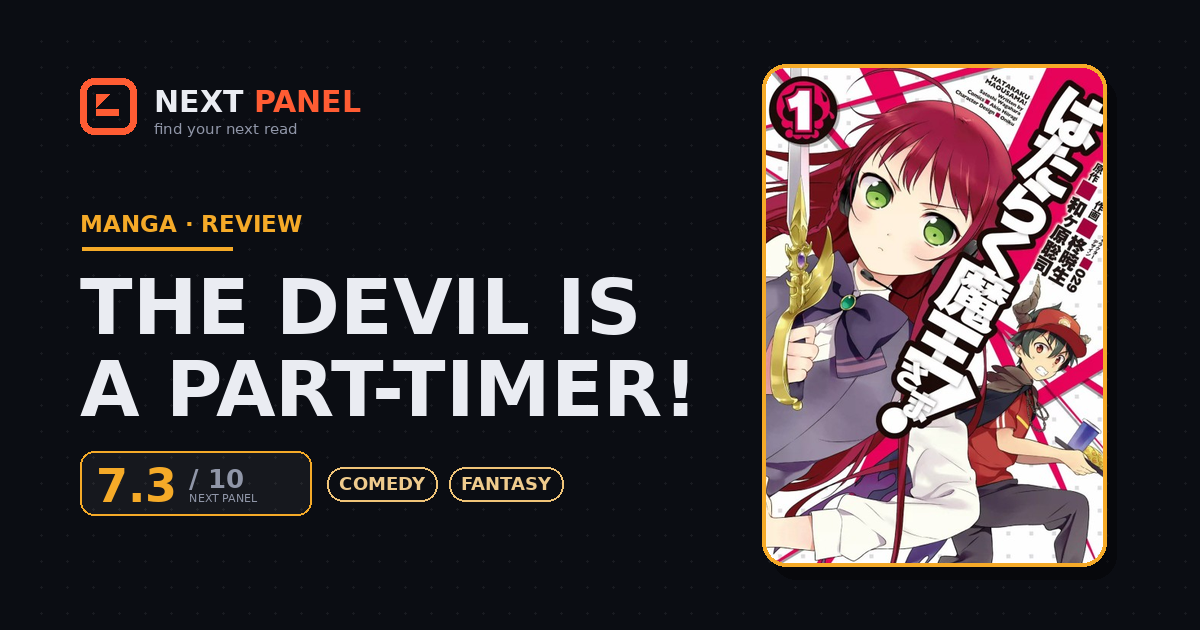
Quick Answer
Yes, if you want a low-stakes comedy that plays its absurd premise completely straight. It's not going to blow you away, but it's consistently funny and easy to binge.
Quick Verdict
“The fish-out-of-water joke never really escalates past 'demon lord worries about his part-time shift schedule' — and that's fine, because the joke was always going to be the whole show.”
Best for: Readers who want a breezy, low-stakes comedy they can pick up without tracking a dozen subplots.
Not for: Readers who want escalating stakes, big power-fantasy fights, or a story that takes its fantasy elements seriously.
- Type
- Manga
- Genres
- Fantasy, Comedy
- Status
- Completed
- This review
- Minor Spoilers
- Author
- Satoshi Wagahara
- Artist
- Akio Hiiragi
- Publisher
- Yen Press
- Platform
- Yen Press / BookWalker / comiXology
| Quick facts | |
|---|---|
| Format | Manga, 147 chapters, 24 volumes |
| Run | 2011–2025 · completed |
| Community score | AniList 7.5 · MangaUpdates 7.9 |
| Where to read | Yen Press / BookWalker / comiXology — official |
Overview
The Devil Is a Part-Timer! opens with the most extreme fantasy premise it can muster — the demon lord Satan, cornered and about to lose an apocalyptic war, flees through a dimensional portal — and then immediately deflates it. He lands in modern Tokyo with no magic, no army, and no money, so he takes a job at a fast-food chain to survive. That's the whole engine of the story: a being who used to command armies now stresses about getting his shift schedule right and earning a raise.
The manga, drawn by Akio Hiiragi from Satoshi Wagahara's light novels, runs the gag for 24 volumes without it ever feeling like a stretch, mostly because it never abandons the joke to chase bigger stakes. Sadao (his human alias) still wants to conquer the world eventually — he just also really wants that promotion first.
What it does well
The comedy works because everyone commits. Sadao approaches minimum-wage customer service with the same tactical seriousness he'd bring to a siege, and the manga plays that completely straight instead of constantly reminding you how absurd it is. That restraint is what makes the joke last — it trusts the premise to keep generating laughs on its own rather than escalating into parody.
The cast around him earns its keep too. Emi, the hero who chased Sadao to this world specifically to kill him, ends up working alongside him and grudgingly relying on him for rent money — their prickly, unresolved rivalry gives the comedy some real bite. Ashiya, Sadao's demon general turned live-in homemaker, gets just as much comic mileage playing an overbearing housemate obsessed with grocery coupons. Hiiragi's art sells both halves of the story: the demon-realm flashbacks have real weight and scale, while the Tokyo scenes are drawn with the mundane specificity of an actual convenience-store slice-of-life series. That contrast is doing a lot of the comedic heavy lifting.
The pacing also holds up well for a long-runner. Arcs are short enough that you're never stuck in a single joke for too many chapters, and the manga is content to let side characters — coworkers, neighbors, a very confused real-estate agent — carry entire chapters without derailing the main throughline.
Where it falls short
The demon-realm politics and war backstory get more attention as the series goes on, and that's where it's weakest. The stakes are supposed to matter, but after volumes of watching Sadao worry about closing shifts, it's hard to take a return to epic fantasy conflict seriously — the tonal gears don't always mesh. Some of the side cast also exists mostly to react to Sadao rather than pursue their own goals, which flattens a few group scenes. And if you've already watched the anime, the manga's opening volumes will feel familiar territory before new material kicks in.
Verdict
This isn't a manga chasing big emotional payoffs or dense worldbuilding — it's a comfort-food comedy that knows exactly what its joke is and refuses to overcomplicate it. If you want something you can read in short bursts that's reliably funny without demanding much investment, it delivers consistently across all 24 volumes.
Strengths & Weaknesses
Strengths
- The core joke — an apocalyptic demon lord grinding a fast-food job to make rent — stays funny because the manga plays it completely straight instead of winking at the reader.
- Akio Hiiragi's art nails the tonal whiplash, drawing Sadao's demon-lord flashbacks with real menace and his day-to-day Tokyo life with warm, ordinary-looking backgrounds.
- The supporting cast pulls their weight — Emi's stubborn hero-turned-coworker dynamic with Sadao and Ashiya's fussy demon-butler-as-roommate routine both carry entire chapters on their own.
- It's genuinely easy to pick up and put down; each arc resolves cleanly enough that you're never lost coming back after a break.
Weaknesses
- The fantasy-war backstory gets more page time in the later volumes, and it's the weakest part of the story — the stakes never feel as real as the comedy does.
- A few side characters exist mainly to react to Sadao rather than do anything themselves, so the cast can feel lopsided in busier arcs.
- If you've seen the anime, the manga's first stretch covers almost identical ground before it pulls ahead with new material.
Similar Titles
Same trick of undercutting fantasy tropes with everyday absurdity and a deadpan lead.
Another fantasy-comedy that gets more mileage from its cast bickering than from actual stakes.
The Great Jahy Will Not Be Defeated!
A defeated dark-lord figure grinding a mundane part-time job for a similar fish-out-of-water gag.
Where to Read Officially
| Platform | Format | Pricing | Region notes | Link |
|---|---|---|---|---|
| Yen Press / BookWalker / comiXology | Digital chapters & print volumes | Paid | Region availability varies | Open |
Frequently Asked Questions
Do I need to read the light novels first?
No. The manga adapts the novels' story in full and reads fine on its own.
Is the manga finished?
Yes, the main series wrapped at 24 volumes, and there's a separate High School! spin-off if you want more.
Is this the same story as the anime?
The anime only covers the earliest arcs. The manga continues well past where the anime stops.