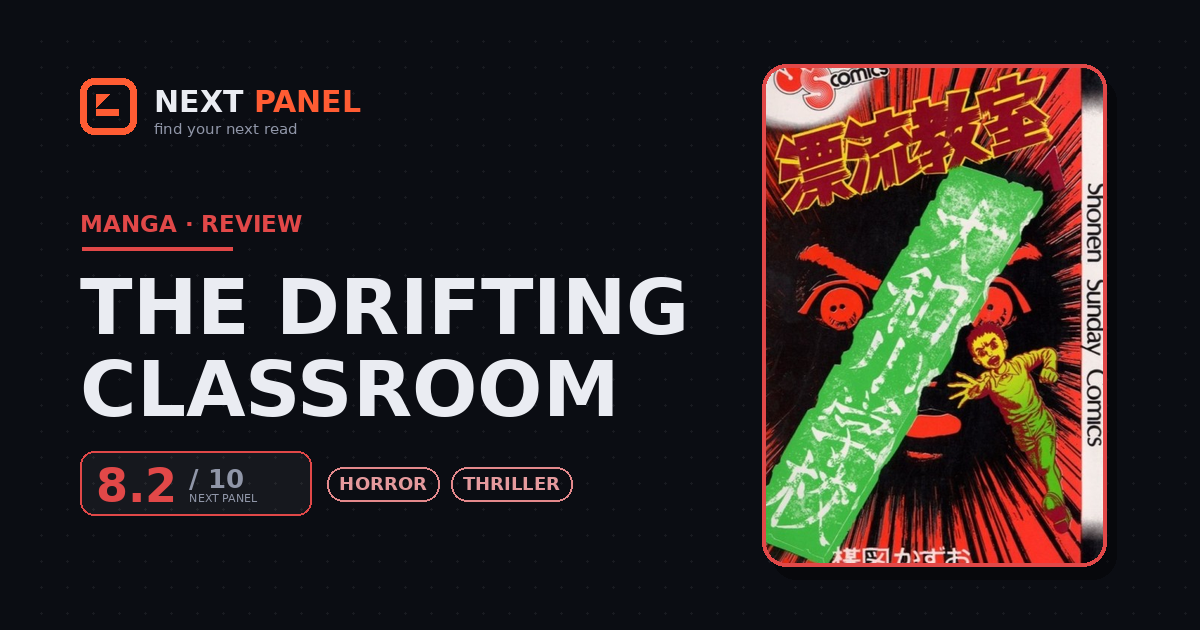
Is The Drifting Classroom Worth Reading? Review & Where to Read
Quick Answer
Yes, if you want foundational, no-mercy horror. The Drifting Classroom drops an entire elementary school into a barren wasteland and watches the kids try to survive starvation, sickness, monsters, and each other. It's relentless, genuinely upsetting, and hugely influential. The 1970s art and constant melodrama are dated, but its raw power still hits hard.
Quick Verdict
“Fifty years on, it's still one of the most relentless, upsetting survival-horror manga ever made — dated melodrama and all.”
Best for: Readers who want bleak, relentless survival horror and don't mind dated, melodramatic 1970s excess.
Not for: Readers who want polished modern art, subtle restraint, or a hopeful, easy read.
- Type
- Manga
- Genres
- Horror, Thriller
- Status
- Completed
- This review
- Minor Spoilers
- Author
- Kazuo Umezu
- Publisher
- Shogakukan / VIZ Media
- Platform
- VIZ
| Quick facts | |
|---|---|
| Format | Manga (shōnen), 44 chapters, 11 volumes |
| Run | 1972–1974 · completed |
| Community score | AniList 7.1 · MAL 7.4 · MangaUpdates 7.6 |
| Content | Graphic violence, child death, and disturbing imagery |
| Where to read | VIZ — official |
Overview
The Drifting Classroom has one of the great horror hooks. One ordinary morning, a massive tremor hits an elementary school — and when it stops, the entire building, hundreds of children and a handful of teachers, has vanished from the world. Outside the windows is nothing: a vast, barren wasteland under an empty sky. No parents, no city, no help. The story follows the kids, led by sixth-grader Sho, as they try to survive in this dead place while figuring out what happened to them. Kazuo Umezu wrote and drew it in the early 1970s for Weekly Shonen Sunday, and it's been a touchstone of survival horror ever since. VIZ publishes it in English.
What it does well
It is relentless, in the best and worst ways. Umezu piles catastrophe on catastrophe — starvation, plague, monsters, injury, madness — and never lets the kids or the reader catch a breath. The result is a genuine sense of dread that builds and builds; you stop assuming anyone is safe, and the constant pressure makes the horror feel real even when the events turn surreal.
Its sharpest idea is that the worst monster is people. Stripped of adults and structure, the children fracture into mobs, tyrants, and scapegoats, and the collapse of their tiny society into violence and hysteria is more frightening than anything outside the walls. It's a brutal look at how thin the veneer of civilization is, decades before that became a horror cliche.
And it's hugely influential. You can draw a straight line from this to countless survival stories that followed. For all its age, it still feels primal — the fear of being a child, powerless and abandoned in a world that suddenly wants you dead, is timeless.
Where it falls short
It's dated, and you'll feel it. The 1970s art is exaggerated and rubbery, the dialogue is histrionic, and characters spend a lot of time screaming exposition at each other. The melodrama is cranked to the absolute maximum at all times, which can tip from terrifying into unintentionally funny if you're not on its wavelength.
It's also exhausting by design. The nonstop misery and the repetitive cycle of a new disaster every chapter can wear you down, and some plot turns are wild even by horror standards. This is a blunt instrument, not a subtle one — it goes for the throat over and over, and a little restraint would have made some of the gut-punches land harder.
Verdict
The Drifting Classroom is a foundational horror classic that still earns its reputation — bleak, relentless, and genuinely upsetting, with a central idea about people-as-monsters that's never stopped being relevant. You have to meet it where it is: the 1970s art and wall-to-wall melodrama take adjusting to, and it's a punishing read by intent. But if you want to see where modern survival horror came from, and you've got the stomach for it, it's essential.
Strengths & Weaknesses
Strengths
- It's relentless — catastrophe piled on catastrophe with no breathing room — and builds a genuine, mounting sense of dread.
- Its sharpest idea is that people are the real monster: the kids' society fractures into mobs and tyrants, scarier than anything outside.
- It's hugely influential; you can trace a straight line from it to decades of survival horror that followed.
- The core fear — being a powerless child abandoned in a hostile world — is primal and still lands.
Weaknesses
- It's very dated: rubbery 1970s art, histrionic dialogue, and characters who scream exposition at each other.
- The melodrama is cranked to the max at all times, which can tip from terrifying into unintentionally funny.
- It's exhausting by design, and the nonstop new-disaster-every-chapter cycle plus some wild plot turns wear you down.
Similar Titles
Kids forced into a survival nightmare where the breakdown of trust is the real horror.
Modern kids-and-apocalypse horror that owes a clear debt to this one.
Grounded, serious survival horror if you want the dread without the 1970s melodrama.
Where to Read Officially
| Platform | Format | Pricing | Region notes | Link |
|---|---|---|---|---|
| VIZ | Print & digital volumes | Paid | Region availability varies | Open |
Frequently Asked Questions
Is The Drifting Classroom completed?
Yes. It ran from 1972 to 1974 and is complete. VIZ collects it in a three-volume hardcover Perfect Edition (it was earlier an 11-volume paperback).
Is it actually scary?
It's more disturbing than jump-scary — relentless dread, body horror, and the horror of kids turning on each other under pressure. It earned its reputation.
Is the old art a problem?
It's very 1970s — exaggerated faces, heavy melodrama — and that takes adjusting to. But Umezu uses it for raw, expressive terror, and it grows on you.