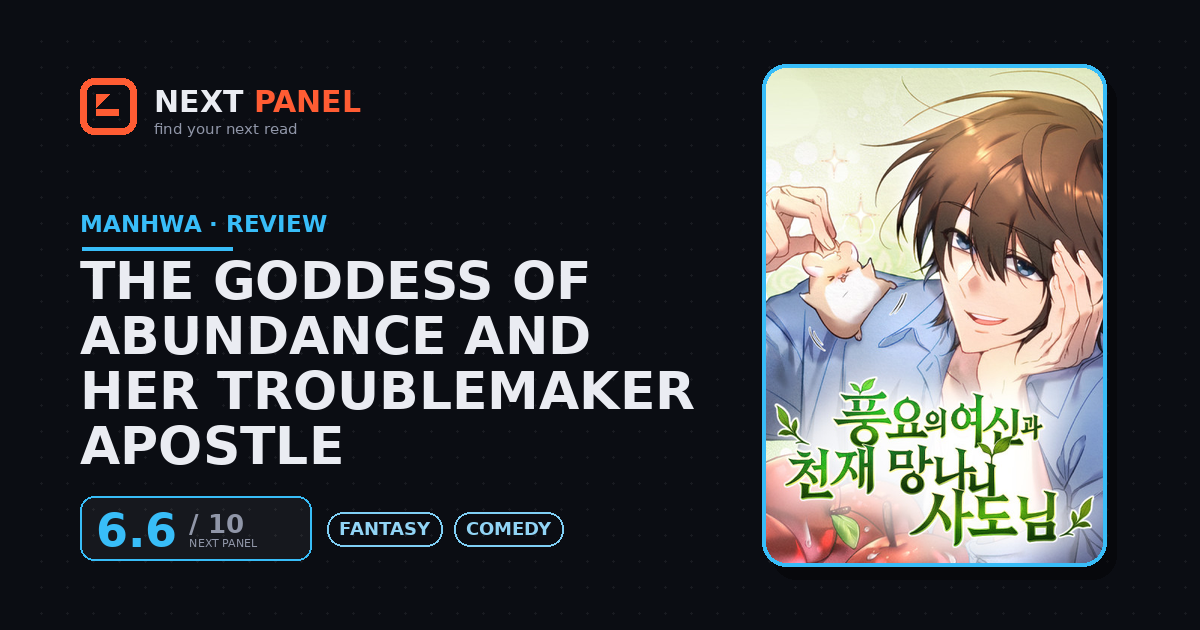
Is The Goddess of Abundance and Her Troublemaker Apostle Worth Reading? Review & Where to Read
Quick Answer
If you want a gentler, farming-and-territory-rebuilding isekai over a fast-paced power fantasy, it's a solid pick, though the plot is still finding its footing this early on.
Quick Verdict
“Quieter and slower-burn than its premise suggests, with more slice-of-life and worldbuilding than raw power-fantasy spectacle.”
Best for: Readers who enjoy a slower, territory-rebuilding isekai with real emotional stakes over a fast-escalating power fantasy.
Not for: Readers who want their overpowered-protagonist isekai to move quickly into big fights rather than gradual world- and character-building.
- Type
- Manhwa
- Genres
- Fantasy, Comedy
- Status
- Ongoing
- This review
- Minor Spoilers
- Author
- Gomsanta / Sung Gu
- Artist
- Sung Gu
- Publisher
- Naver
- Platform
- WEBTOON
| Quick facts | |
|---|---|
| Format | Manhwa (shounen), 53 chapters |
| Run | 2025–present · ongoing |
| Community score | AniList 6.4 · MangaUpdates 6.5 |
| Content | Fantasy violence |
| Where to read | WEBTOON — official |
Overview
The Goddess of Abundance and Her Troublemaker Apostle is an ongoing Korean manhwa by Gomsanta and Sung Gu, with art by Sung Gu, officially published in English on WEBTOON. Earth's life force is dying, and humanity's only hope is the Dispatchers — heroes sent into otherworldly realms to harvest energy for survival. Chansu Oh is one of them, but despite being the son of a legendary Dispatcher, he has essentially no talent of his own. When he's sent to a block-style territory-expansion world, he becomes the Apostle of a forgotten, nearly powerless Goddess of Abundance, and the two of them set out to rebuild her territory — and his own reputation — one block at a time.
It's a familiar isekai premise on the surface, but the execution leans gentler and slower than the setup suggests.
What it does well
The strongest element is Chansu himself. Rather than defaulting to the stoic, overpowered archetype common to this genre, he's written with genuine, relatable emotion — readers specifically point out that he reacts to pressure and danger like an actual person rather than a power-fantasy cipher. The block-by-block territory rebuilding gives the story a clear, satisfying structure too: progress feels earned and visible rather than handed over all at once, which suits the story's more grounded pacing. The relationship between Chansu and his weakened Goddess gives the plot real emotional stakes beyond simple power accumulation, and the full-color art handles both the comedic and the more sincere character beats well.
Where it falls short
The pacing is the clearest trade-off here: this is a slower, more slice-of-life-leaning isekai than the "talentless hero gets a second chance" premise might suggest, and readers expecting fast escalation into big fights and power growth may find the rhythm too gradual. At just over 50 chapters in, the larger plot threads — what happened to Chansu's parents, the Goddess's full backstory — are still mostly unexplored. Reader reception reflects that in-progress state, landing as mixed and engaged rather than strongly enthusiastic, which is fair for a series still building toward its bigger reveals.
Verdict
This is a gentler, more grounded isekai than its setup promises, built on a genuinely likable, emotionally real protagonist and a satisfying block-by-block sense of progress. It won't satisfy readers chasing fast power-fantasy escalation, but if a slower-burn territory-rebuilding story with real character work appeals to you, it's worth following.
Strengths & Weaknesses
Strengths
- Chansu is written with real, believable emotion rather than the stone-faced overpowered archetype the premise might suggest — readers specifically note he reacts to danger and pressure like an actual person, not a power fantasy stand-in.
- The block-by-block territory rebuilding gives the story a satisfying, grounded structure — progress is visible and earned rather than handed to the protagonist all at once.
- The dynamic between Chansu and his weakened, barely-surviving Goddess gives the story real emotional stakes beyond simple power accumulation.
- The full-color art is clean and expressive, suited to both the story's comedic beats and its slice-of-life-adjacent worldbuilding stretches.
Weaknesses
- The pacing leans more toward slice-of-life and worldbuilding than fast power-fantasy escalation, which may not match what readers expect from the "talentless hero gets a second chance" setup.
- At just over 50 chapters in, the wider plot around Chansu's missing parents and the Goddess's full backstory is still mostly unexplored.
- Reader reception is currently mixed rather than strongly positive, reflecting a series that's still proving its longer-term direction.
Similar Titles
The Skull Dragon's Precious Daughter
Shares a gentler, found-family-adjacent tone built around a bond between a human and a weakened, otherworldly figure.
Similar low-key, character-first approach to an isekai premise without leaning hard into apocalyptic stakes.
Where to Read Officially
| Platform | Format | Pricing | Region notes | Link |
|---|---|---|---|---|
| WEBTOON | Digital chapters (WEBTOON, free) | Free | Region availability varies | Open |
Frequently Asked Questions
Is Chansu overpowered from the start?
No — he's introduced as a Dispatcher with essentially no talent despite his legendary father, and his growth into a capable Apostle happens gradually through the territory-reclaiming plot.
Is this more action-focused or slice-of-life?
It leans closer to slice-of-life and worldbuilding, with a steady block-by-block progression rather than fast, escalating action.
Where can I read it officially?
It's free to read on WEBTOON.