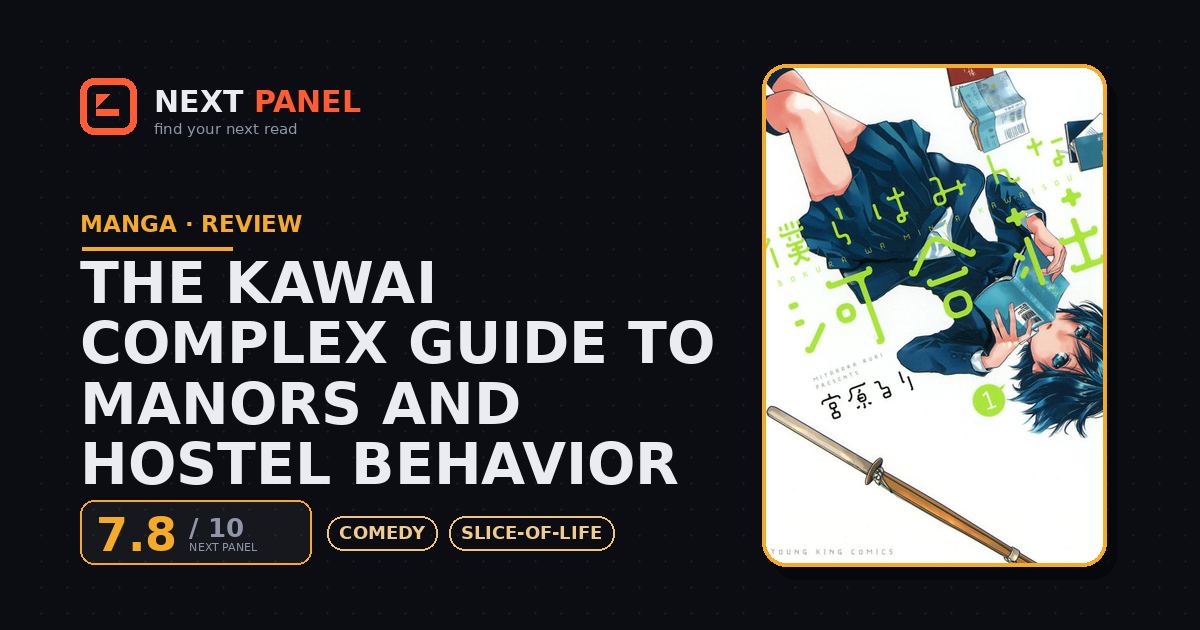
Is The Kawai Complex Guide to Manors and Hostel Behavior Worth Reading? Review & Where to Read
Quick Answer
Yes, especially if you're tired of the usual harem-comedy dorm setup — this one is more interested in its characters' actual problems than in fanservice.
Quick Verdict
“Looks like a stock boarding-house comedy on the cover, reads like a considerably more honest one about broke, lonely teenagers once you're a few chapters in.”
Best for: Readers who want ensemble comedy with real emotional stakes underneath the jokes, set in a lived-in, slightly rundown world.
Not for: Readers who want a fast-paced plot or a clean, upbeat tone rather than comedy that sits next to genuine sadness.
- Type
- Manga
- Genres
- Slice of Life, Comedy
- Status
- Completed
- This review
- Minor Spoilers
- Author
- Ruri Miyahara
- Publisher
- Shonen Gahosha
- Platform
- Manga Planet
| Quick facts | |
|---|---|
| Format | Manga (seinen), 94 chapters, 11 volumes |
| Run | 2010–2017 · completed |
| Community score | AniList 7.9 |
| Content | Themes of poverty, family neglect, and loneliness played alongside comedy |
| Where to read | Manga Planet — official |
Overview
The Kawai Complex Guide to Manors and Hostel Behavior is a completed seinen comedy by Ruri Miyahara, serialized from 2010 to 2017. Usa, a high schooler whose parents just got transferred overseas, ends up at Sunny Apartment, a rundown boarding house run by a strange landlady and populated by a cast of broke, socially odd tenants — including Ritsu, the upperclassman he's had a crush on for years. On the surface it reads like a standard setup for a harem comedy: one guy, a house full of girls, awkward cohabitation gags. That's not really what it turns into.
Each of Usa's new housemates is dealing with something specific and real underneath their quirks — money problems, families that don't want them around, difficulty connecting with people outside the house — and the manga treats those problems as seriously as it treats its jokes, which is more than you'd expect from the premise.
What it does well
The comedy itself is sharp. Miyahara gets a lot of mileage out of character-specific humor rather than repeating the same gag structure, and the cast is distinct enough that jokes land because of who's involved, not just what's happening. That character work pays off even harder once the manga starts layering in what each housemate is actually struggling with. This isn't backstory dropped in for a single emotional chapter and then forgotten — money trouble, absent parents, and social anxiety stay present in how characters act day to day, which makes Sunny Apartment feel like an actual found family rather than a comedy ensemble with sob stories attached.
Usa works well as the reader's way into the house. He's uncomfortable and a little clueless at first, which gives him somewhere to grow, and his crush on Ritsu develops alongside his understanding of what she and the others are actually dealing with rather than existing as a separate, disconnected plot thread. The manga's biggest achievement is tonal: it moves between genuinely funny and genuinely sad scenes without the shifts feeling jarring, which is a much harder trick to pull off than it looks.
Where it falls short
This is a hangout comedy at heart, and the plot reflects that — there's no strong driving arc pulling the story forward, just an accumulation of episodes and character moments. Readers who want momentum toward a clear goal will find it loose. A handful of gags built around a character's hardship also land a little uncomfortably next to the more careful, sincere treatment the manga gives that same material elsewhere — the tonal balance mostly works, but not every single chapter threads the needle. And with a cast this large, a few housemates inevitably get less page time and depth than the central group around Usa and Ritsu.
Verdict
This is a warmer, more honest version of a premise that usually plays out as shallow fanservice comedy, and the character work is strong enough to carry it even when the plot itself is loose. If you want an ensemble comedy willing to sit with real sadness without losing its sense of humor, it's worth seeking out.
Strengths & Weaknesses
Strengths
- The comedy is genuinely funny on a panel-to-panel level, built on well-observed character quirks rather than repeated gags or fanservice setups.
- Every housemate at Sunny Apartment turns out to be dealing with something real — money trouble, an absent family, social anxiety — and the manga takes those problems seriously instead of using them as one-off backstory.
- Usa, the newcomer forced to move in after his parents' job transfer, works well as an audience surrogate without being a blank slate — he has his own discomfort and growth to work through.
- The tonal balance between broad comedy and genuine melancholy is handled with more care than the premise suggests, and it's what elevates the manga above a standard slice-of-life ensemble comedy.
Weaknesses
- The plot is loose by design — this is a hangout comedy first, so readers looking for a driving story or clear arc will find the structure meandering.
- Some of the darker material (poverty, neglect) is handled with real care, but a few individual gags built around a character's hardship land awkwardly next to the more sincere treatment elsewhere.
- The large ensemble cast means a few housemates get noticeably less development than the core group.
Similar Titles
Same warm, character-driven small-community comedy energy, minus the shared-house setup.
Similar willingness to sit with real sadness inside an otherwise gentle, slice-of-life-adjacent story.
Where to Read Officially
| Platform | Format | Pricing | Region notes | Link |
|---|---|---|---|---|
| Manga Planet | Digital chapters | Paid | Region availability varies | Open |
Frequently Asked Questions
Is this a harem comedy?
Not really, despite the boarding-house-full-of-girls setup it resembles on paper. The focus stays on the ensemble cast's individual problems and friendships rather than romantic competition.
Is the manga complete?
Yes, it ran from 2010 to 2017 and is fully finished, so you can read it start to end without worrying about an unresolved hiatus.
How dark does it actually get?
There's real weight to some characters' backstories around poverty and family neglect, but the manga stays fundamentally warm and comedic in tone rather than becoming a drama.