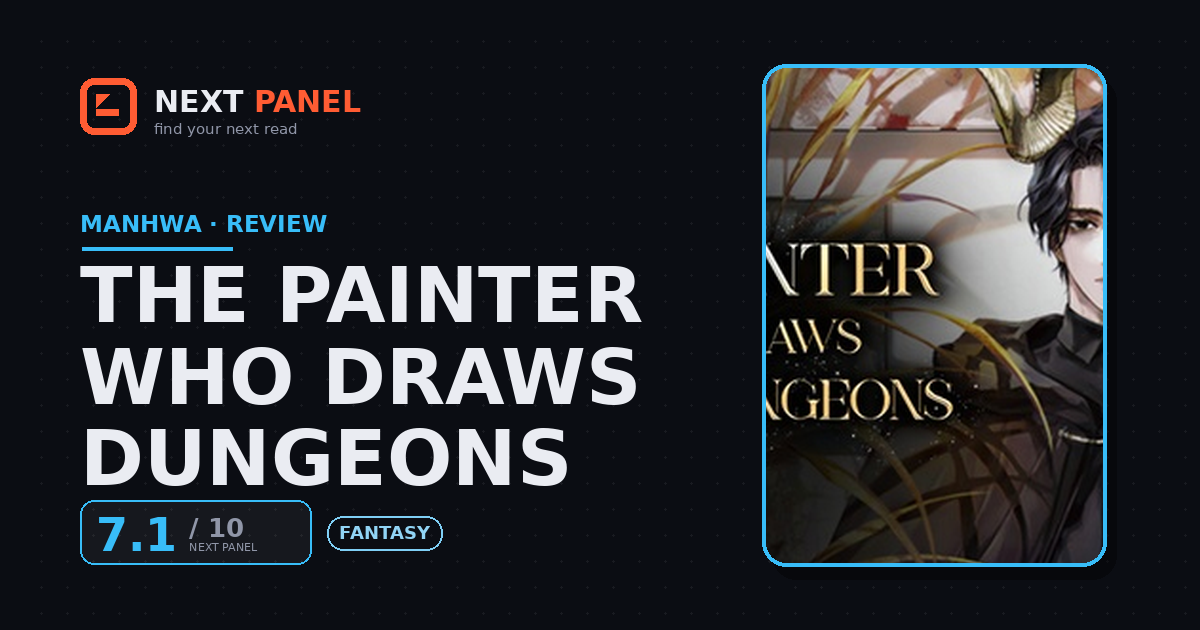
Is The Painter Who Draws Dungeons Worth Reading? Review & Where to Read
Quick Answer
Worth reading if you like anthology-style fantasy where a single grounded lead moves between other people's stories — it's more character study than power fantasy.
Quick Verdict
“Jio isn't chasing power for its own sake, he's trying to actually help people while piecing together his own death, and that gives the anthology structure real emotional throughline instead of feeling episodic for its own sake.”
Best for: Readers who like anthology-style fantasy with a consistent emotional core connecting each new story the lead steps into.
Not for: Readers who want a single continuous plotline instead of a lead who moves between different self-contained worlds and casts.
- Type
- Manhwa
- Genres
- Fantasy
- Status
- Ongoing
- This review
- Minor Spoilers
- Author
- Hobby
- Artist
- Glee
- Publisher
- BIFROST
- Platform
- Tappytoon
| Quick facts | |
|---|---|
| Format | Manhwa, 17 chapters |
| Run | ongoing |
| Community score | MangaUpdates 7.5 |
| Where to read | Tappytoon — official |
Overview
The Painter Who Draws Dungeons opens with Seo Jio, an ordinary art teacher who dies saving his students during a school fire. Instead of a normal afterlife, he wakes up trapped inside a portrait, granted strange, near-godlike abilities: he can breathe life into things he paints and open passages into other people's worlds. From there, the series becomes an anthology of sorts, with Jio moving between different lives and dimensions, using his new powers to help people caught in their own crises, all while slowly working out the truth behind his own death.
Adapted from Hobby's web novel with art by Glee, the manhwa is ongoing and published through Tappytoon.
What it does well
The anthology structure is the manhwa's best idea. Rather than locking Jio into one continuous plot and cast, the story lets him step into different self-contained worlds and situations, which keeps the pacing fresh and gives the series room to explore different tones and stakes from arc to arc. What keeps that structure from feeling scattered is Jio himself — his search for the truth behind his own death runs underneath every arc, and his sincere effort to actually help the people he meets (rather than just using them to level up or move the plot) gives the whole thing a consistent emotional center.
Glee's art earns real credit here too, handling the story's central conceit — a man who exists as a painting, moving between worlds through his own art — with a genuinely striking visual sensibility, while still grounding the human stories inside each arc in more everyday, expressive character work. The series is also refreshingly more interested in emotional resolution than power-fantasy escalation; Jio's abilities exist to solve problems and help people, not to build toward a big flashy power ceiling, which makes it feel distinct from a lot of the isekai-adjacent manhwa around it.
Where it falls short
Because the series is still relatively early in its run, the connective tissue tying Jio's individual arcs to the larger mystery of his death is still thin in places, and some questions clearly haven't been answered yet. The anthology format is also a double-edged sword: not every arc lands with the same emotional weight, and a few of the people Jio helps don't get quite enough page time to make their resolution feel fully earned. And since wide official English licensing hasn't caught up yet, readers are currently limited to Tappytoon specifically for the legitimate version.
Verdict
This is a fantasy series more interested in the people inside its premise than in flashy power fantasy, and that choice pays off in a story with real emotional variety arc to arc. If you want an anthology-style fantasy with a grounded, sincere lead holding it together, it's worth following, even if some of its bigger mysteries are still unfolding.
Strengths & Weaknesses
Strengths
- The anthology structure, Jio moving between different worlds and briefly entering other people's lives, keeps the manhwa fresh from arc to arc without losing its emotional center.
- Jio's own motivation, piecing together the truth of his death while genuinely trying to help the people he encounters, gives the episodic structure a real throughline instead of feeling like disconnected vignettes.
- Glee's art handles both the painterly, otherworldly framing device and the more grounded human stories inside each portrait-world with equal care.
- It's more interested in emotional payoffs for the people Jio helps than in flexing power-fantasy escalation, which sets it apart from a lot of its isekai-adjacent peers.
Weaknesses
- Because the story is still fairly early in its run, some of the connective tissue around Jio's overarching mystery is still thin.
- The anthology format means some arcs land more effectively than others, and a few of the people-of-the-week casts don't get enough time to fully land their emotional beats.
- As an ongoing series without wide official English distribution yet, it can be harder to find outside of Tappytoon specifically.
Similar Titles
Shares the fantasy power-progression hook, though this one is far more anthology-driven than action-driven.
Another story about someone with outside knowledge trying to genuinely help the people trapped in dangerous circumstances.
Wistoria: Wand and Sword
For readers who want another fantasy series balancing episodic problem-solving with a larger mystery underneath.
Where to Read Officially
| Platform | Format | Pricing | Region notes | Link |
|---|---|---|---|---|
| Tappytoon | Digital webtoon episodes | Free + Paid | Region availability varies | Open |
Frequently Asked Questions
Is this based on a novel?
Yes, it's adapted from Hobby's web novel of the same name, illustrated by Glee.
Is the series finished?
No, it's still ongoing with new episodes releasing regularly.
Do you need to read each arc in order?
Yes, while each arc focuses on different people, they build on Jio's overarching mystery, so reading in order matters.