Is The Rose of Versailles Worth Reading? Review & Where to Read
Quick Answer
Yes, if you're up for a full-blown historical tragedy. It's the foundational shoujo epic that set the template for a lot of what came after, following a woman raised as a military commander through the collapse of the French monarchy. It asks for patience in the early volumes, but the later chapters and the ending are worth it.
Quick Verdict
“This is the manga a huge chunk of shoujo has been quoting for fifty years, and the ending still hits as hard as its reputation says.”
Best for: Readers who want a big, dramatic historical epic with a tragic ending they can see coming from a mile off.
Not for: Readers who want fast pacing and clean, modern art from the very first chapter.
- Type
- Manga
- Genres
- Romance, Drama, Historical
- Status
- Completed
- This review
- Minor Spoilers
- Author
- Riyoko Ikeda
- Publisher
- Udon Entertainment
- Platform
- Udon Entertainment
| Quick facts | |
|---|---|
| Format | Manga (shōjo), 85 chapters, 10 volumes |
| Run | 1972–1973 · completed |
| Community score | AniList 8.3 · MangaUpdates 8.0 |
| Content | Violence, war, some sexual content, character death |
| Where to read | Udon Entertainment — official |
Overview
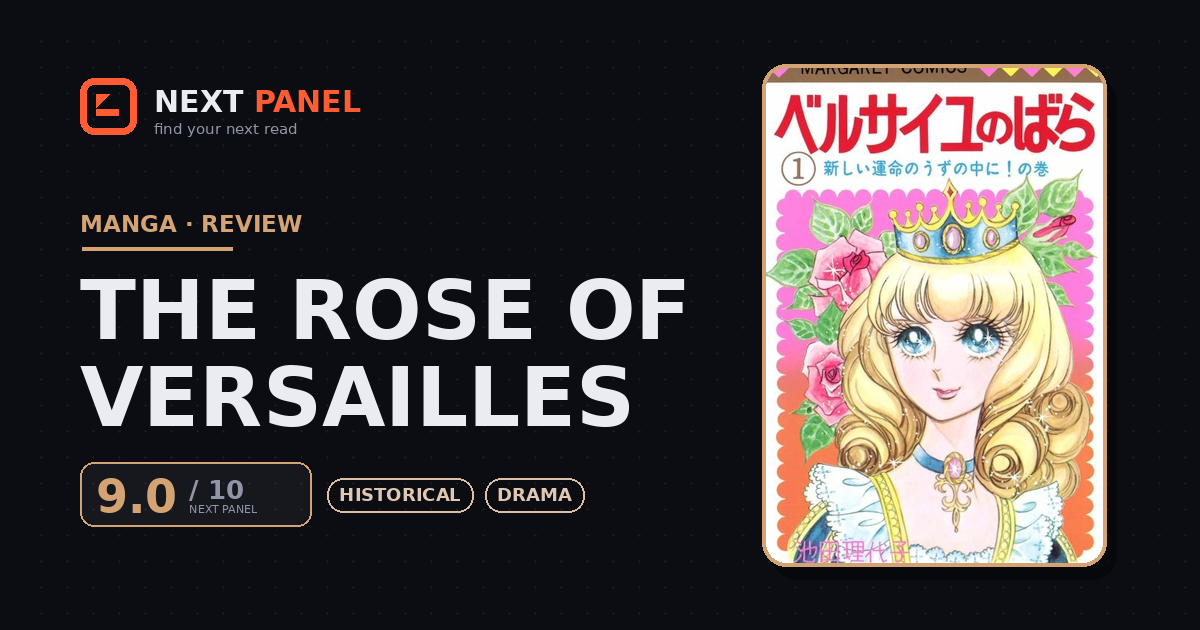
The Rose of Versailles came out in 1972, and it's the reason a huge chunk of shoujo manga looks the way it does. Riyoko Ikeda set it right before the French Revolution and split the story between two people: Marie Antoinette, married off as a teenager and slowly buried by a court that never really wanted her, and Oscar François de Jarjayes, a woman raised as a son so her father would have a male heir to hand his military command to. Oscar ends up leading the Palace Guard, defending the queen she's grown to genuinely care for as a friend, while the country underneath both of them falls apart. It's part political tragedy, part doomed romance, and it never apologizes for being both at once.
What it does well
Oscar is still one of the best character ideas manga has ever had. She's not written as a woman "acting like a man" for a gag — she commands troops, duels, and makes life-or-death calls, and the manga treats her competence completely straight. The tension in her story isn't whether a woman can do this job, it's what all that duty costs her personally, especially once her feelings for her lifelong friend and servant André start to matter more than the role she was raised to play.
The politics hold up too. Ikeda doesn't flatten the Revolution into good peasants versus bad royals. Marie Antoinette gets written with real sympathy — a girl who never asked to be the face of a rotting system — and you can feel the walls closing in on her chapter by chapter even though you already know how it ends. Pairing her slow-motion fall with Oscar's more active, soldier's-eye view of the same events gives the later volumes a weight that a single point of view wouldn't manage.
And when the ending comes, it commits. Oscar's death during the storming of the Bastille is one of the most famous scenes in manga history for a reason — the story spends hundreds of chapters building toward it and doesn't flinch when it gets there.
Where it falls short
The early volumes are rougher than the rest. Ikeda was reportedly asked to keep the story going once Oscar became the breakout character, and it shows — some of the court intrigue in the first stretch drags, and a few subplots (a diamond-necklace scandal, side nobles scheming for position) get more chapter time than they earn. The 1972 art is also very much of its era: huge sparkling eyes, dense screentone, page layouts that can be hard to track if you're used to modern paneling. And the tone is unapologetically melodramatic — gasps, tears, long internal monologues about duty and fate. If that's not your thing, it'll wear on you before Oscar's arc pulls everything together.
Verdict
This is one of those manga where the influence is so total that pieces of it feel familiar even if you've never read a page — the cross-dressing military commander, the doomed servant romance, the revolution closing in as backdrop to personal tragedy. Push through the slower opening stretch and it earns every bit of its reputation as a shoujo landmark.
Strengths & Weaknesses
Strengths
- Oscar is written as a fully competent military commander first — her gender is the source of the story's tension, never played as a joke.
- The story splits time between Oscar's soldier's-eye view and Marie Antoinette's slow fall at court, and both halves earn their weight.
- The ending commits completely — the series spends hundreds of chapters building to one moment and doesn't soften it.
- It's the direct ancestor of a huge amount of shoujo and josei that came after, so you can see where a lot of later tropes actually started.
Weaknesses
- The first stretch of court intrigue moves slowly and gives some minor scheming nobles more chapters than the plot needs.
- The 1972 art — huge eyes, dense screentone, busy layouts — takes some adjusting to if you're used to modern manga.
- The tone is fully melodramatic, with a lot of internal monologue about duty and fate; it doesn't hold back.
Similar Titles
Also set in and around the French Revolution, with the same court-intrigue-meets-tragedy energy.
Another European-period romance built around class lines and a love that isn't supposed to happen.
A different era and setting, but the same scale of historical epic anchored by one soldier's personal arc.
Where to Read Officially
| Platform | Format | Pricing | Region notes | Link |
|---|---|---|---|---|
| Udon Entertainment | Print & digital volumes | Paid | Region availability varies | Open |
Frequently Asked Questions
Do I need to know French history to follow it?
No — the manga walks you through the key events, like the queen's marriage, the necklace scandal, and the storming of the Bastille, as they happen. Knowing the broad shape of the French Revolution helps but isn't required.
Is there an anime or other adaptation?
Yes — a 1979–1980 anime series, a 1979 live-action film, a 2025 anime film, and it's also one of the most famous stage productions in the all-female Takarazuka Revue's history, which is a big part of why the manga is such a cultural landmark in Japan.
Is the romance the main focus?
It's a big part of it, but the manga splits its attention between Oscar's personal story and the political collapse of the French monarchy — it's as much a historical tragedy as a romance.