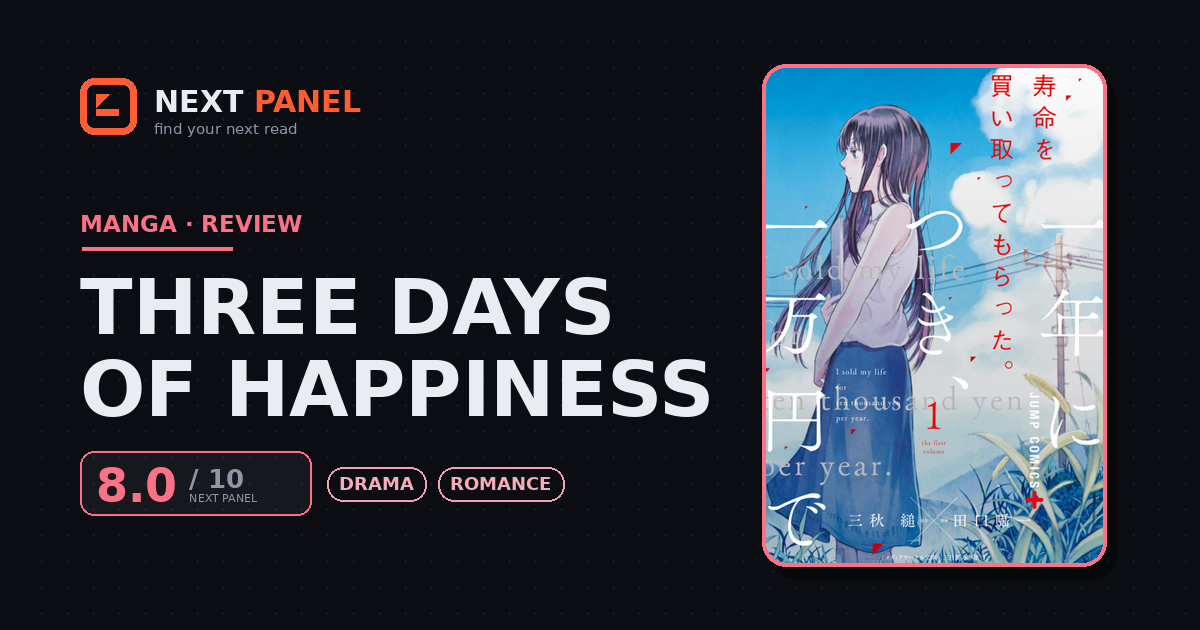
Is Three Days of Happiness Worth Reading? Review & Where to Read
Quick Answer
Yes, if you want a short, emotionally direct drama — Three Days of Happiness takes a science-fiction premise and uses it honestly, building to an ending that mostly earns the reaction it's going for.
Quick Verdict
“This three-volume gut-punch treats its premise as an excuse for real emotional honesty, not a gimmick.”
Best for: Readers who want a short, emotionally direct drama about regret and don't need a big cast to get invested.
Not for: Readers who want a sprawling cast and a long series to sink into over months.
- Type
- Manga
- Genres
- Romance, Drama
- Status
- Completed
- This review
- Minor Spoilers
- Author
- Sugaru Miaki
- Artist
- Shōichi Taguchi
- Publisher
- Shueisha
- Platform
- Yen Press
| Quick facts | |
|---|---|
| Format | Manga, 18 chapters, 3 volumes |
| Run | 2016–2017 · completed |
| Community score | AniList 8.6 |
| Content | Death and mortality themes |
| Where to read | Yen Press — official |
Overview
Kusunoki is an unremarkable college student with no direction, no money, and no real hope that his life is going to improve. When a stranger offers to buy his remaining years for cash, he takes the deal, selling off decades of a future he doesn't believe in and keeping only a handful of months to actually live. His only companion for what's left is Miyagi, an observer assigned to make sure he doesn't try to back out of the deal. Adapted from Sugaru Miaki's novel by artist Shōichi Taguchi, this compact three-volume manga takes a premise that could easily read as a gimmick and turns it into a genuinely moving character study about regret, time, and what actually makes a life worth living.
What it does well
The central conceit does real narrative work instead of just being a hook: because Kusunoki's remaining time is a literal, shrinking number, every scene carries a built-in ticking clock, and Taguchi's art leans into that tension with quiet, unshowy paneling that knows when to slow down and let a moment breathe. Kusunoki himself is written with real specificity — an ordinary, somewhat self-pitying young man who is never made more sympathetic or more pathetic than he needs to be — and his dynamic with Miyagi, prickly and reluctant at first, earns its warmth gradually instead of rushing the relationship. The story is also smart about structure: flashbacks to Kusunoki's past disappointments are doled out at exactly the moments they'll land hardest, and the compact length means nothing overstays its welcome. For a manga built around a fantastical premise, it stays remarkably grounded in ordinary, recognizable disappointment.
Where it falls short
Three volumes is a tight window to build both a believable romance and an emotionally earned ending, and the pacing occasionally shows the strain — a few supporting characters and subplots get introduced and resolved quickly enough that they read more like plot function than fully realized people. Readers who want the visual inventiveness of a more stylistically ambitious artist may find Taguchi's linework functional rather than distinctive; it serves the story well without ever being the reason to pick this up. And because the whole book is built to land one specific emotional gut-punch, a reader who sees the shape of that ending coming early will find less to be surprised by.
Verdict
Three Days of Happiness takes a premise that sounds like a thought experiment and turns it into a genuinely affecting story about regret and connection, condensed into a length that never wastes the reader's time. It's a small book that's confident about exactly what it's trying to do, and it mostly earns the ending it's building toward.
Strengths & Weaknesses
Strengths
- The shrinking-lifespan premise isn't just a hook — it structures the pacing itself, giving even quiet scenes a built-in sense of urgency.
- Kusunoki is written with real specificity: self-pitying and flawed without being written as either fully sympathetic or fully pathetic.
- The relationship with Miyagi develops gradually and earns its warmth instead of rushing toward romance.
- The compact three-volume length means the story never pads itself out or overstays a beat.
Weaknesses
- A few supporting characters and subplots are introduced and wrapped up quickly enough that they read more like plot function than full people.
- The linework is solid and legible but not especially distinctive — it serves the story rather than standing out on its own.
- Readers who see where the ending is headed early on will find less left to be surprised by.
Similar Titles
A much longer, heavier look at the same territory of regret and a life gone sideways.
Similar interest in guilt, redemption, and what a person owes the people they've hurt.
Another compact, bittersweet drama about trying to change the ending someone's story seems headed toward.
Where to Read Officially
| Platform | Format | Pricing | Region notes | Link |
|---|---|---|---|---|
| Yen Press | Complete omnibus (print & digital) | Paid | Region availability varies | Open |
Frequently Asked Questions
Is Three Days of Happiness a novel or a manga?
Both. Sugaru Miaki's original novel got a manga adaptation drawn by Shōichi Taguchi, and that manga, collected in one complete omnibus, is what this review covers.
Is Three Days of Happiness finished?
Yes. The manga ran in Shonen Jump+ from 2016 to 2017 and is complete at 3 volumes.
Where can I read Three Days of Happiness officially in English?
Yen Press has licensed the manga and publishes it as a complete omnibus in print and digitally.