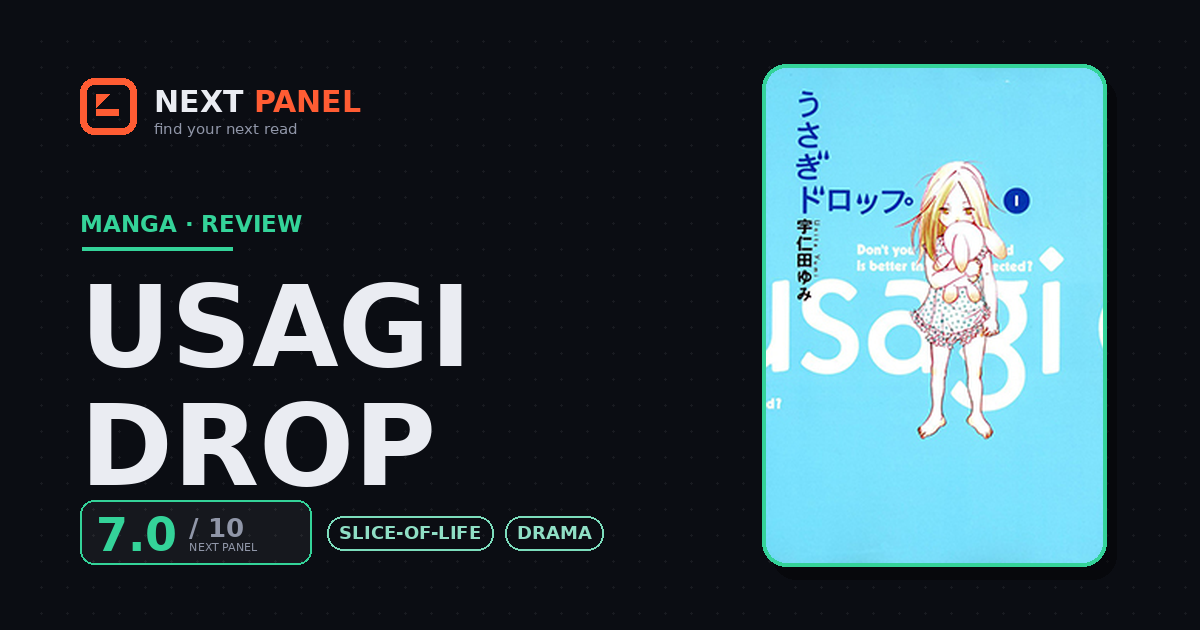
Is Usagi Drop Worth Reading? Review & Where to Read
Quick Answer
The first several volumes are genuinely excellent slice-of-life. Whether the whole series is worth reading depends on how you feel about a controversial plot direction in the back volumes — worth going in informed either way.
Quick Verdict
“Read it for Daikichi and young Rin figuring out life together — that part earns every bit of its reputation. The later stretch is the part people argue about, and you should know it's coming.”
Best for: Readers who want a grounded, unsentimental story about an unprepared adult learning to parent.
Not for: Readers who want a story that stays consistent in tone and direction all the way through.
- Type
- Manga
- Genres
- Drama, Slice of Life
- Status
- Completed
- This review
- Minor Spoilers
- Author
- Yumi Unita
- Publisher
- Shodensha
- Platform
- Yen Press
| Quick facts | |
|---|---|
| Format | Manga (josei), 62 chapters, 10 volumes |
| Run | 2005–2011 · completed |
| Community score | AniList 6.2 · MangaUpdates 7.9 |
| Where to read | Yen Press — official |
Overview
Usagi Drop opens with Daikichi, a single thirty-year-old man, discovering at his grandfather's funeral that the old man had a young daughter, Rin, born late in life. Rin's mother wants nothing to do with her, and the rest of the family is ready to write her off to an orphanage. Daikichi, more out of frustration with his relatives than any grand plan, decides to take her in himself. What follows is the day-to-day reality of a man with no parenting experience figuring out how to raise a six-year-old.
The early volumes are a slice-of-life series in the most literal sense: daycare applications, grocery shopping, sick days, and the slow work of two strangers becoming a family. It's warm without being saccharine, and it takes its two leads seriously as people rather than as a sitcom setup.
What it does well
The best thing Usagi Drop does is refuse to romanticize how hard this actually is. Daikichi isn't secretly great at parenting — he's constantly behind, constantly tired, and constantly making calls he's not sure are right. That honesty is what makes the relationship between him and Rin feel earned rather than assumed; you watch trust get built in small moments instead of being told it exists.
Rin herself avoids the trap a lot of manga fall into with child characters. She's not written to be endlessly charming — she's guarded, sometimes stubborn, and slow to open up, which tracks with a kid who's just lost the one relative who wanted her. Her small victories land because the story doesn't hand them to her easily.
The supporting cast of other single parents and daycare families adds welcome texture without pulling focus from the core relationship, and the art's soft, understated style keeps the whole thing feeling like an actual domestic life rather than a heightened drama.
Where it falls short
This is the part of the review that has to be honest: Usagi Drop changes direction in its later volumes in a way that a large share of its own readers felt contradicted everything the earlier books had built. It's a well-known enough turn that going in blind isn't doing yourself any favors — decide for yourself how you feel about it, but know it's coming.
Separately from that, a few of the side characters set up in the early volumes (other parents, some of Rin's classmates) fade out once the story narrows its focus later on, leaving some threads feeling unfinished.
Verdict
The first half of Usagi Drop is genuinely one of the better single-parent slice-of-life stories in manga, told with real honesty about how exhausting and unglamorous the work actually is. Whether you finish the series or stop partway through comes down to how you feel about where it eventually goes — either way, it's worth going in with your eyes open.
Strengths & Weaknesses
Strengths
- Daikichi's adjustment to parenthood is written with real specificity — daycare waitlists, work schedules, and exhaustion — instead of skipping to the sentimental parts.
- Young Rin is one of the more believable child characters in manga: guarded, occasionally difficult, and slow to trust rather than instantly adorable.
- The early volumes balance humor and hardship well, so it never turns into either a comedy or a misery narrative.
- The art is soft and unhurried, matching the domestic, everyday scale of the story it's telling.
Weaknesses
- The story makes a sharp tonal and direction shift in its later volumes that many longtime readers found came out of nowhere and undercut what came before.
- Some side characters introduced early on lose relevance once the story's focus narrows in the second half.
- Because of that shift, the series reads very differently depending on where you stop, which makes it hard to recommend as a single unbroken experience.
Similar Titles
Sweetness & Lightning
A gentler, more consistent take on an adult suddenly responsible for a child, with less risk of a divisive turn.
Shares an interest in found family and quiet emotional repair, in a different setting.
Similar willingness to sit with awkward, uncomfortable growth rather than rushing to resolution.
Where to Read Officially
| Platform | Format | Pricing | Region notes | Link |
|---|---|---|---|---|
| Yen Press | Print & digital volumes | Paid | Region availability varies | Open |
Frequently Asked Questions
Is Usagi Drop the same as the anime?
The anime only adapts the first several volumes, covering Rin as a young child, and stops before the manga's later, more divisive direction.
Why do people disagree about this series?
The manga takes its story in a direction in the later volumes that a large portion of its original audience felt betrayed the setup of the earlier books. It's best to know that going in rather than be blindsided.
Is it a complete story?
Yes, it's finished at 10 volumes, originally serialized from 2005 to 2011.