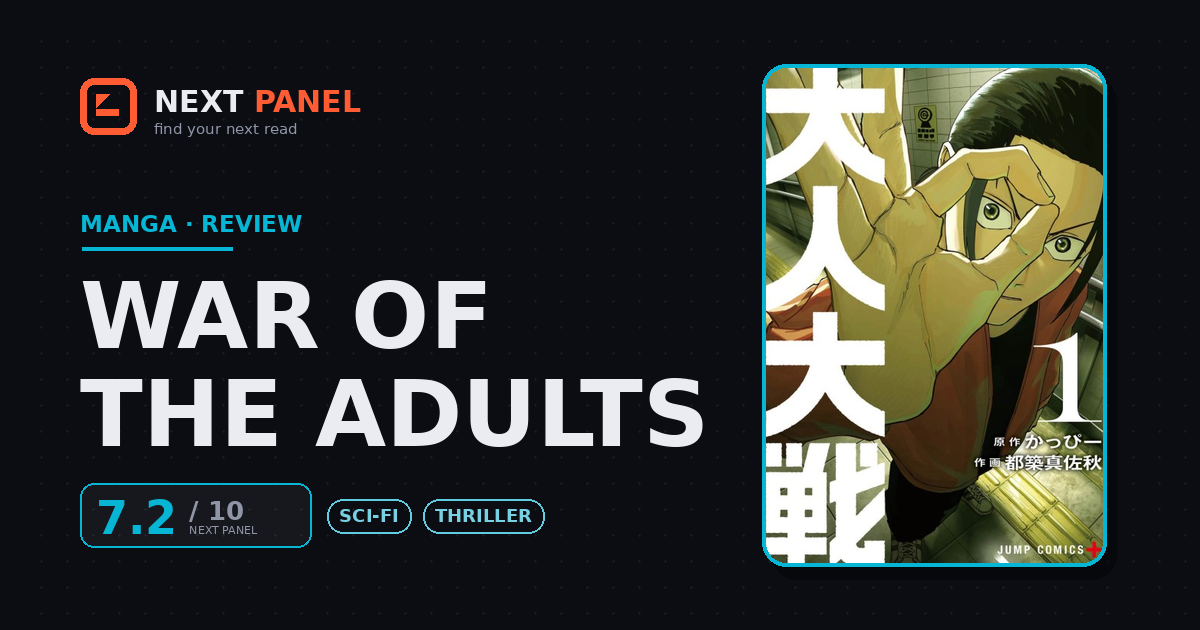
Is War of the Adults Worth Reading? Review & Where to Read
Quick Answer
Yes, if a sharp social-satire premise is enough to carry you through an early-run series. The hook — your own personal rulebook becoming a surveillance state's law — is genuinely clever and gives the story real bite.
Quick Verdict
“It's less about fights and more about how quickly a good idea curdles once an entire society is forced to live by it, and that angle is what makes it worth following.”
Best for: Readers who like dystopian social-score premises and don't mind a series that's still finding its footing.
Not for: Readers who want a large finished backlog or a story driven mainly by physical combat.
- Type
- Manga
- Genres
- Thriller, Sci-Fi
- Status
- Ongoing
- This review
- Minor Spoilers
- Author
- Kappy
- Artist
- Masaaki Tsuzuki
- Publisher
- Shueisha
- Platform
- MANGA Plus
| Quick facts | |
|---|---|
| Format | Manga (shōnen), 5 volumes |
| Run | 2025–present · ongoing |
| Community score | AniList 7.2 · MangaUpdates 6.5 |
| Content | Violence, social/psychological pressure themes |
| Where to read | MANGA Plus — official |
Overview
Yutaro Urashima is an ordinary high schooler with an unusual habit: he keeps a personal notebook of "Articles of Adulthood," his own self-written rules for how to become a proper, upstanding adult. After saving a stray cat from being hit by a truck, he ends up in a coma — and wakes up fifteen years later to find that his private rulebook has somehow become the literal foundation of society. Japan now runs on a hierarchical surveillance system where every action is tracked, scored, and used to determine a person's "Adult Rank," and the rules being enforced are word-for-word the ones a teenage Yutaro wrote for himself.
What it does well
The premise is the whole draw here, and it's a genuinely sharp one. Instead of a generic surveillance-state dystopia, War of the Adults gives its social-credit system a specific, almost embarrassing origin: it's built entirely on one kid's earnest, slightly self-righteous idea of what a "good adult" looks like, now warped and weaponized at national scale. That framing lets the manga satirize real anxieties about social scoring and public judgment without ever feeling like a lecture, because the joke and the horror are both rooted in something painfully specific and personal to its lead.
Yutaro himself is a strong choice of protagonist for that story. He's not dropped into this world as a blank-slate outsider — he's confronted with a twisted, inflated version of his own values, and has to reckon with how something he meant as private self-improvement became a tool other people use to judge and control each other. The manga doesn't let him off easy for that, either; his old ideals get treated as genuinely naive once you see what happens when an entire society is forced to live by them.
The rank-and-surveillance system also does real narrative work instead of sitting in the background. Small social interactions carry weight because everything is being scored, which keeps tension present even in scenes that aren't traditional action.
Where it falls short
The series is still relatively early in its run, and it shows in a few places — the exact mechanics of how the rank system governs daily life, enforcement, and punishment aren't always spelled out as clearly as the premise deserves. Some side characters are still mostly defined by which side of the rank debate they represent rather than feeling like fully realized people. And because the story leans on social tension and ideas more than physical conflict, readers expecting a typical fight-driven Shonen Jump+ series may find the pace slower than advertised.
Verdict
War of the Adults has one of the more genuinely clever hooks in recent Shonen Jump+ lineups, using a very personal origin for its dystopia instead of a generic one. It's not a finished, fully-proven story yet, but the idea alone makes it worth following as it develops.
Strengths & Weaknesses
Strengths
- The core idea — a teenager's private, slightly self-righteous list of 'how to be a proper adult' becoming the literal law of a surveillance society 15 years later — is a genuinely clever way to satirize social-credit anxieties without being preachy about it.
- Yutaro's disorientation waking up into a world built on his own rules gives the story a strong, specific point of view instead of a generic dystopian everyman lead.
- The score-and-rank social system is used to generate real tension in everyday interactions, not just big set-piece conflicts.
- It's willing to make its protagonist's original ideals look naive and even harmful once scaled up, instead of treating him as automatically right.
Weaknesses
- As a newer series, the worldbuilding is still filling in — some of the mechanics behind how the rank system actually governs daily life could use more clarity.
- A few supporting characters function mainly as mouthpieces for a given faction's argument rather than as people in their own right.
- Readers looking for a fight-focused shōnen series will find the pacing more talk-and-tension than action for long stretches.
Similar Titles
Similar interest in a society reorganized around an arbitrary rule system that turns everyday choices into high-stakes decisions.
Shares a focus on how ordinary people behave once a rigid, score-based system starts dictating who wins and who loses.
Where to Read Officially
| Platform | Format | Pricing | Region notes | Link |
|---|---|---|---|---|
| MANGA Plus | Digital chapters (free simulpub) | Free | Region availability varies | Open |
Frequently Asked Questions
Is War of the Adults finished?
No — it's an ongoing series serialized in Shonen Jump+, with new chapters releasing regularly since April 2025.
Where can I read War of the Adults officially in English?
It's simulpublished for free on Shueisha's MANGA Plus app and website alongside the Japanese release.
Is this a fighting-focused shōnen series?
Not really — it's closer to a social/psychological thriller. There's conflict and danger, but the tension comes mostly from the rank system and social maneuvering rather than action set pieces.