Is Welcome to Ethics Class Worth Reading? Review & Where to Read
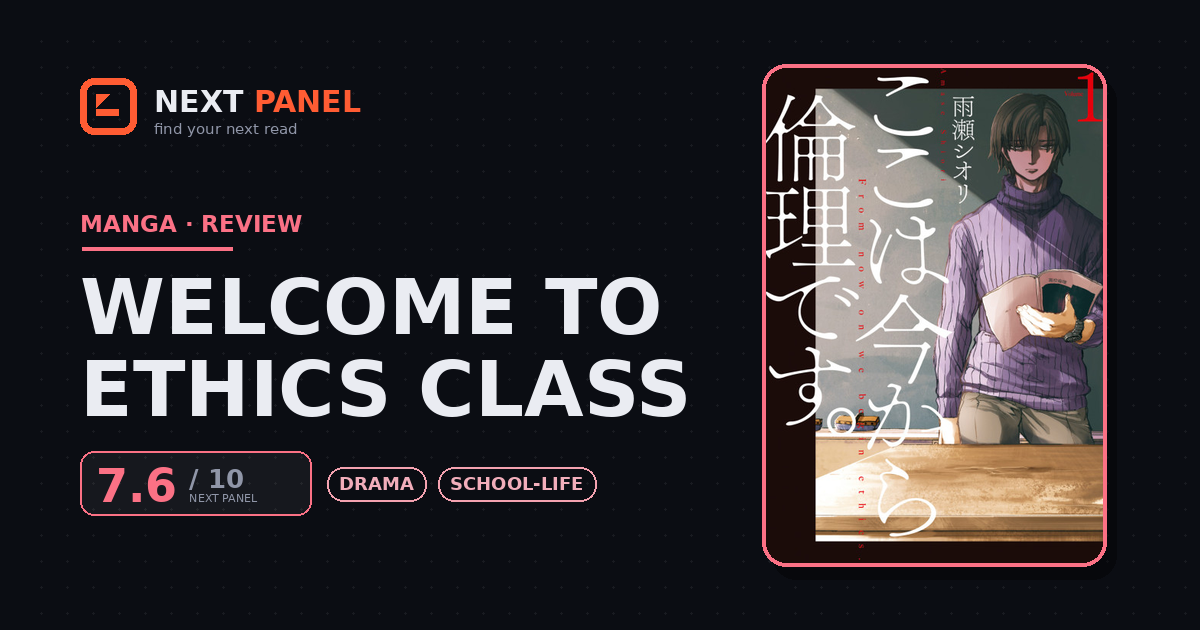
Quick Answer
If you want a slice-of-life drama that treats its students' problems with real weight instead of tidy after-school-special answers, yes. It's thoughtful and unusually mature for its setting.
Quick Verdict
“Homework is what the premise sounds like. What it actually is: one of the more quietly affecting school dramas out there.”
Best for: Readers who want grounded, issue-focused school drama that respects how messy real problems actually are.
Not for: Readers who want a fast-paced plot or a story built around one continuous central conflict.
- Type
- Manga
- Genres
- School Life, Drama
- Status
- Completed
- This review
- Minor Spoilers
- Author
- Shiori Amase
- Publisher
- Shueisha
| Quick facts | |
|---|---|
| Format | Manga (seinen), 56 chapters, 10 volumes |
| Run | 2016–2025 · completed |
| Community score | AniList 8.1 |
Overview
Welcome to Ethics Class centers on Takayanagi, a soft-spoken high school teacher running an elective ethics course that most students treat as an easy elective rather than something to take seriously. Chapter by chapter, the manga follows individual students who end up in his classroom while quietly working through something difficult in their lives, and Takayanagi's method is never to lecture them out of it. Instead, he introduces them to real ethical and philosophical frameworks and lets them use those tools to think through their own situations.
What it does well
What separates this from a standard issue-of-the-week school drama is how seriously it takes both the problems and the thinking. Amase doesn't reach for melodrama or easy resolutions; a student's arc might revolve around jealousy, family pressure, or a moral question they can't answer on their own, and the manga is willing to sit in that discomfort rather than wrap it up in a neat lesson by the end of the chapter. The philosophy isn't decoration either — Takayanagi actually uses named ethical frameworks as a lens, which gives the manga a sturdier backbone than most drama series manage.
Takayanagi himself is the other reason this works. He's written as someone genuinely thoughtful rather than a flawless wise-mentor type, with his own quiet uncertainties visible underneath the calm exterior. That keeps the student-teacher dynamic from feeling too clean or too convenient, and it makes his advice land as considered rather than scripted. The pacing, unhurried and willing to let a hard conversation take its time, is exactly what a manga about actually thinking things through needs.
Where it falls short
The anthology structure that lets each student's story breathe also means the manga doesn't build the kind of sustained momentum a single continuous plot would. Readers looking for an ongoing arc with rising stakes may find the format frustrating, since most of the wider cast resets to the background once their chapter ends. A handful of the ethics discussions also run a little long, slowing chapters down more than the emotional beat they're building toward strictly needs. And with no confirmed official English release yet, actually finding a legal way to read it is currently the biggest practical obstacle.
Verdict
Welcome to Ethics Class takes an elective nobody wants and turns it into one of the more thoughtful, patient school dramas out there. It won't grip you with plot momentum, but if you want manga that treats teenage problems, and the actual process of working through them, with real respect, it delivers.
Strengths & Weaknesses
Strengths
- Takayanagi never hands students easy answers — he uses actual philosophical frameworks to help them think through problems themselves, which keeps the manga from feeling preachy.
- Each student's arc tackles a specific, believable issue instead of a vague generic teenage problem, and the manga takes each one seriously.
- The pacing lets difficult topics breathe instead of resolving them in a single chapter for a tidy moral.
- Takayanagi himself is written with real interiority rather than as a flawless mentor figure, which keeps the teacher-student dynamic from feeling too clean.
Weaknesses
- The anthology-style, student-of-the-arc structure means the overall story has less momentum than a manga built around one continuous plot.
- A few of the philosophical discussions run long enough that they slow the pacing more than they need to.
- Because each arc largely resets with a new student's problem, long-term character growth for the wider cast is limited.
Similar Titles
Shares the same unflinching, non-preachy treatment of difficult teenage struggles.
Similar patient, thoughtful pacing around characters working through real emotional weight.
Fune wo Amu
Same quiet, adult-perspective interest in people finding meaning through careful, unglamorous work.
Frequently Asked Questions
Is Welcome to Ethics Class finished?
Yes, it's complete — the manga ran from 2017 to 2025 and was collected across 10 volumes in Japan.
Is there an official English translation?
As of this review, there's no confirmed official English release. Check back, as this will be revisited if that changes.
Do I need a background in philosophy to follow it?
No — the ethics concepts are introduced as tools to understand each student's situation, not as a lecture you need prior knowledge for.