Is Welcome to the N.H.K. Worth Reading? Review & Where to Read
Quick Answer
Yes, if you want something raw and honest rather than comfortable. Welcome to the N.H.K. follows a paranoid shut-in as a mysterious girl tries to pull him back into society, and it's one of the most unflinching looks at depression and social withdrawal in manga — darkly funny and genuinely bleak. It's a heavy, uneven read, and the manga is edgier than the anime.
Quick Verdict
“Bleak, funny, and uncomfortably honest about depression — not a fun read, but a real one.”
Best for: Readers who want a raw, darkly funny look at depression, anxiety, and social withdrawal.
Not for: Readers who want an uplifting, easy read and a likable, easy-to-root-for lead.
- Type
- Manga
- Genres
- Drama, Comedy
- Status
- Completed
- This review
- Minor Spoilers
- Author
- Tatsuhiko Takimoto
- Artist
- Kendi Oiwa
- Publisher
- VIZ Media
- Platform
- VIZ Media
| Quick facts | |
|---|---|
| Format | Manga, 40 chapters, 8 volumes |
| Run | 2004–2007 · completed |
| Community score | AniList 7.8 |
| Content | Depression, suicidal themes, drug use, sexual content |
| Where to read | VIZ Media — official |
Overview
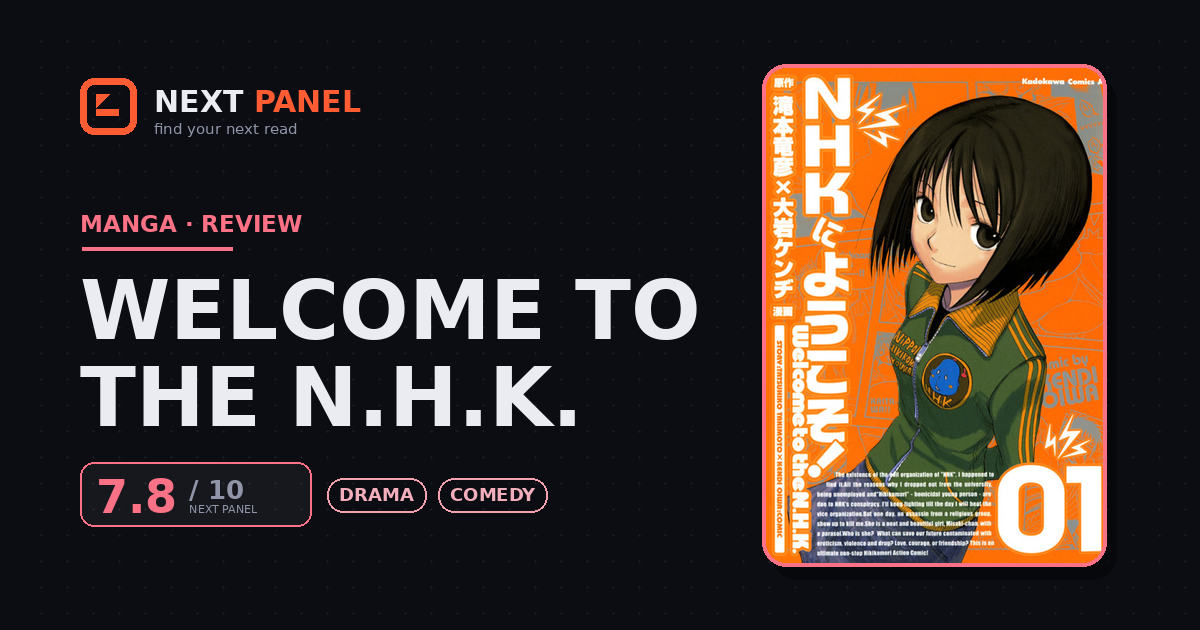
Welcome to the N.H.K. is a dark dramedy by Tatsuhiko Takimoto with art by Kendi Oiwa, based on Takimoto's semi-autobiographical novel. Its hero is Tatsuhiro Satou, a 22-year-old college dropout who's spent years as a hikikomori — a shut-in — unemployed, isolated, and convinced that a shadowy organization called the NHK engineered his miserable life. Then Misaki, a mysterious girl, shows up and offers to "cure" him through a secret nightly project. What follows is Satou's stumbling, often humiliating attempts to rejoin the world, and a frank, frequently bleak look at depression, anxiety, and escapism. VIZ Media publishes it in English.
What it does well
Its honesty is the whole point, and it cuts deep. Takimoto wrote from his own experience as a hikikomori, and it shows — the depiction of social withdrawal, self-loathing, and the small daily defeats of depression is raw and uncomfortably accurate in a way few stories manage. It never treats Satou's condition as a quirk or a joke to be solved in a chapter, and that refusal to sand off the edges is exactly why it has stuck with so many readers.
It's also genuinely funny, which is what keeps it from being unbearable. The comedy is dark and a little mean, but it captures the absurdity of Satou's spirals and the otaku world he's stuck in — eroge projects, online-game addiction, pyramid schemes, conspiracy theories. The humor and the bleakness feed each other, so the funniest moments often land hardest.
Satou and Misaki carry it. Both are messy, flawed, and more complicated than they first appear, and their strange, codependent dynamic is the emotional spine of the book. Crucially, the manga resists an easy "love cures everything" fix; it's honest about how hard real change is.
Where it falls short
It's bleak, and that's a real barrier. This is a heavy read that goes to genuinely dark places — including a harrowing arc dealing with suicide — and it can be draining rather than fun. If you want something uplifting, this isn't it.
The manga is also edgier and more explicit than the gentler anime adaptation, and it occasionally tips into feeling gratuitous or mean. Satou is deliberately frustrating, which is the point but still taxing, and some of the 2000s otaku references have dated. The tone can lurch, too, from broad comedy to real despair.
Verdict
Welcome to the N.H.K. is a raw, darkly funny, and unusually honest look at depression and isolation, and worth it if you want a story that takes those things seriously instead of tidying them up. It's bleak, uneven, and not an easy read, but it's a memorable one. Go in for honesty over comfort, and brace for the heavier turns. Heads up: it deals frankly with depression and suicide.
Strengths & Weaknesses
Strengths
- Its portrayal of hikikomori life, depression, and self-loathing is raw and uncomfortably accurate, drawn from the author's own experience.
- It's darkly, genuinely funny, which keeps the bleakness bearable and sharpens its satire of otaku and NEET culture.
- Satou and Misaki are messy, layered characters, and their codependent dynamic gives the story a real emotional spine.
- It resists easy answers — it's honest that real change is hard, with no tidy 'cure.'
Weaknesses
- It's bleak and heavy, going to genuinely dark places — including a harrowing suicide-related arc — so it can be draining.
- The manga is edgier and more explicit than the anime, and sometimes tips into feeling gratuitous or mean.
- Satou is deliberately frustrating, some 2000s otaku references have dated, and the tone lurches between comedy and despair.
Similar Titles
Another unflinching, beautifully bleak manga about depression and growing up.
A gentler but still raw story about isolation, guilt, and reconnecting.
A grounded, melancholic slice-of-life about aimless twenty-somethings figuring out life.
Where to Read Officially
| Platform | Format | Pricing | Region notes | Link |
|---|---|---|---|---|
| VIZ Media | Digital volumes | Paid | Region availability varies | Open |
Frequently Asked Questions
Is the manga different from the anime?
Yes. The manga is darker, edgier, and more explicit than the gentler anime, and it has its own arcs and ending. Both come from Takimoto's novel.
Is it a hard read emotionally?
It can be. It deals frankly with depression, isolation, addiction, and suicide, balanced with dark comedy — powerful but heavy.
Where can I read it officially in English?
VIZ Media publishes it in English, available digitally.