Is Wolf Children: Ame & Yuki Worth Reading? Review & Where to Read
Quick Answer
Yes — it's a faithful, well-drawn companion to the film rather than a lesser retelling, and it stands on its own even if you've never seen Hosoda's movie.
Quick Verdict
“Quiet, unhurried, and more interested in the exhaustion of parenting than in spectacle — exactly what it needs to be.”
Best for: Readers who want a grounded family drama with a light fantasy hook, told with patience rather than melodrama.
Not for: Readers who want fast pacing and a story built around action rather than everyday life.
- Type
- Manga
- Genres
- Drama, Slice of Life
- Status
- Completed
- This review
- Minor Spoilers
- Author
- Mamoru Hosoda
- Artist
- Yu
- Publisher
- Kadokawa (Young Ace)
- Platform
- Yen Press
| Quick facts | |
|---|---|
| Format | Manga (seinen), 16 chapters, 3 volumes |
| Run | 2012–2013 · completed |
| Community score | AniList 8.0 |
| Content | Death of a parent, themes of isolation and grief |
| Where to read | Yen Press — official |
Overview
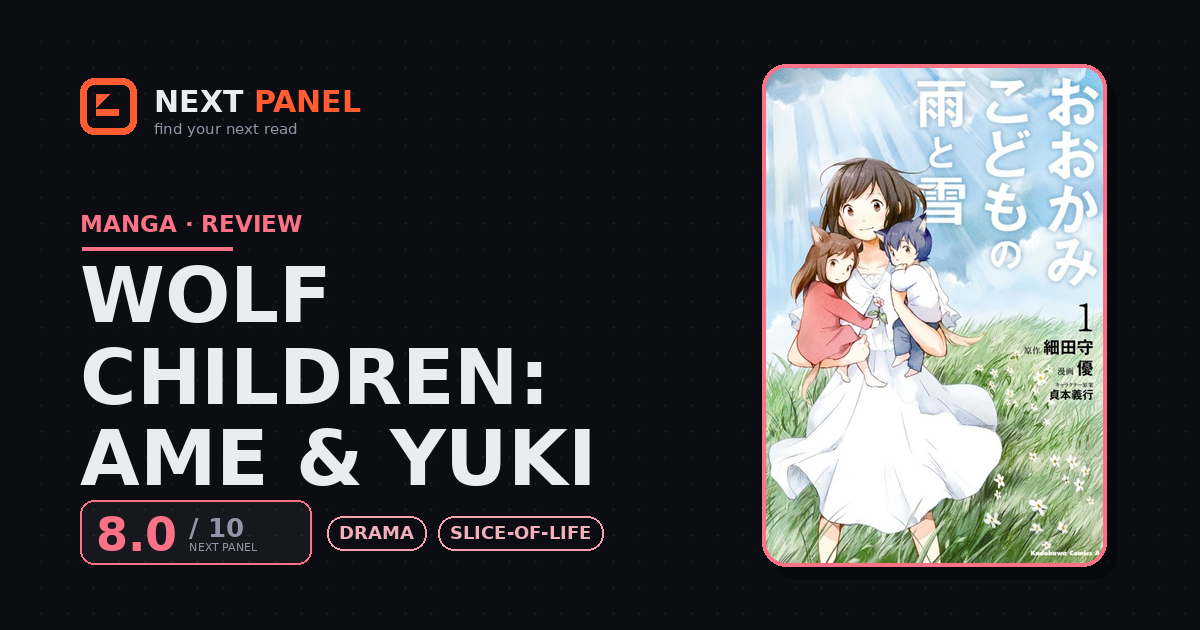
Wolf Children: Ame & Yuki is the manga adaptation of Mamoru Hosoda's 2012 animated film, written by Hosoda himself with art by Yu and character designs originally by Yoshiyuki Sadamoto. The story follows Hana, a college student who falls for a man who turns out to be the last of his kind — able to shift into a wolf — and who has two children with him before he dies suddenly, leaving her to raise Yuki and Ame alone. Both kids inherit their father's ability, and the manga follows the family from the city out to a rundown house in the countryside, where Hana tries to give her children space to grow up and eventually choose, each in their own way, which half of themselves they want to live as.
It's a quiet story, more interested in the exhausting, unglamorous work of solo parenting than in fantasy spectacle. If you've seen the film, the manga hits the same beats; if you haven't, it works perfectly well as its own thing.
What it does well
The manga's biggest strength is restraint. Hana's loneliness — raising two children whose most basic needs (are they hungry as a wolf or a kid today? can the neighbors hear them?) require constant improvisation — never gets a big dramatic monologue. It just accumulates, panel by panel, through small domestic details: patched clothes, a garden that keeps failing, the sound of a house that's too quiet. Yu's art matches that mood, leaning into soft linework and seasonal backgrounds rather than sharp, dynamic layouts, which suits a story about slowly building a life more than it would an action series.
The two kids get real, distinct arcs. Yuki, the older sister, starts off wild and wolf-leaning before pulling toward an ordinary human life; Ame goes the opposite direction, drifting from a timid kid into someone who feels more at home in the mountains than anywhere else. The manga doesn't frame either choice as the correct one — it just follows both kids toward whatever they turn out to need, which gives the final chapters a surprising amount of weight for something so understated.
Where it falls short
The pacing won't work for everyone. This is a story told in remembered fragments rather than a driving plot, and because it's compressing a two-hour film into manga form, a few time skips happen fast enough to feel a little disorienting — you'll go from one school year to several years later without much transition. Side characters, especially some of the rural neighbors who matter a lot in smaller ways, don't get as much development as the central family. And because the emotional tone stays fairly consistent throughout — melancholy but gentle — readers hoping for a big climactic scene won't get one; the ending is quiet, in keeping with everything before it.
Verdict
This is a faithful, well-illustrated companion to one of the more understated family dramas in modern anime, and it holds up as a manga in its own right rather than feeling like a cash-in tie-in. It won't grab you with plot momentum, but if you want a patient, grounded story about raising kids who don't fully belong to either of the worlds available to them, it delivers exactly that.
Strengths & Weaknesses
Strengths
- Hana's exhaustion and loneliness as a single parent raising two kids who can't ever be fully human or fully wolf comes through clearly without the manga ever having to state it outright.
- Yu's art keeps the family's rural setting soft and lived-in — the same quiet, seasonal beauty that made the film distinctive translates well to still panels.
- The two kids, Yuki and Ame, are given genuinely different arcs about which half of themselves they want to grow into, and the manga lets both choices feel earned instead of picking an obvious 'right' answer.
- It never leans on the fantasy premise for spectacle — the wolf transformations are treated as a practical, dangerous secret to manage, which keeps the story grounded in the family drama instead of turning into an action piece.
Weaknesses
- The pacing is deliberately slow and episodic, closer to a series of remembered moments than a plotted story, which can feel aimless if you're expecting rising stakes.
- Because it's adapting a two-hour film into manga form, a few time jumps land abruptly, and some side characters get less room to breathe than the leads.
- The emotional register stays fairly even throughout — readers wanting a big climax or dramatic confrontation won't find one here.
Similar Titles
Same Kyoto Animation-adjacent, emotionally patient approach to a heavy subject, built around quiet character work rather than plot twists.
Sweetness & Lightning
Another gentle, grounded story about a parent figuring out how to raise a child alone, minus the fantasy element.
Where to Read Officially
| Platform | Format | Pricing | Region notes | Link |
|---|---|---|---|---|
| Yen Press | Print & digital volumes | Paid | Region availability varies | Open |
Frequently Asked Questions
Do I need to watch the Wolf Children movie first?
No. The manga tells the same story as Mamoru Hosoda's 2012 film but works as a standalone read — if anything, reading it first and watching the film after works just as well.
Is Wolf Children ongoing or finished?
It's complete. The manga is a self-contained adaptation of the film's story, published in English by Yen Press as a single omnibus volume.
Is this more of a fantasy story or a family drama?
Family drama first. The wolf-shifting premise is the setup, but the actual story is about a mother raising two kids and each child deciding which part of their identity to live as — there's very little of what you'd call traditional fantasy plotting.