Is Yugami-kun ni wa Tomodachi ga Inai Worth Reading? Review & Where to Read
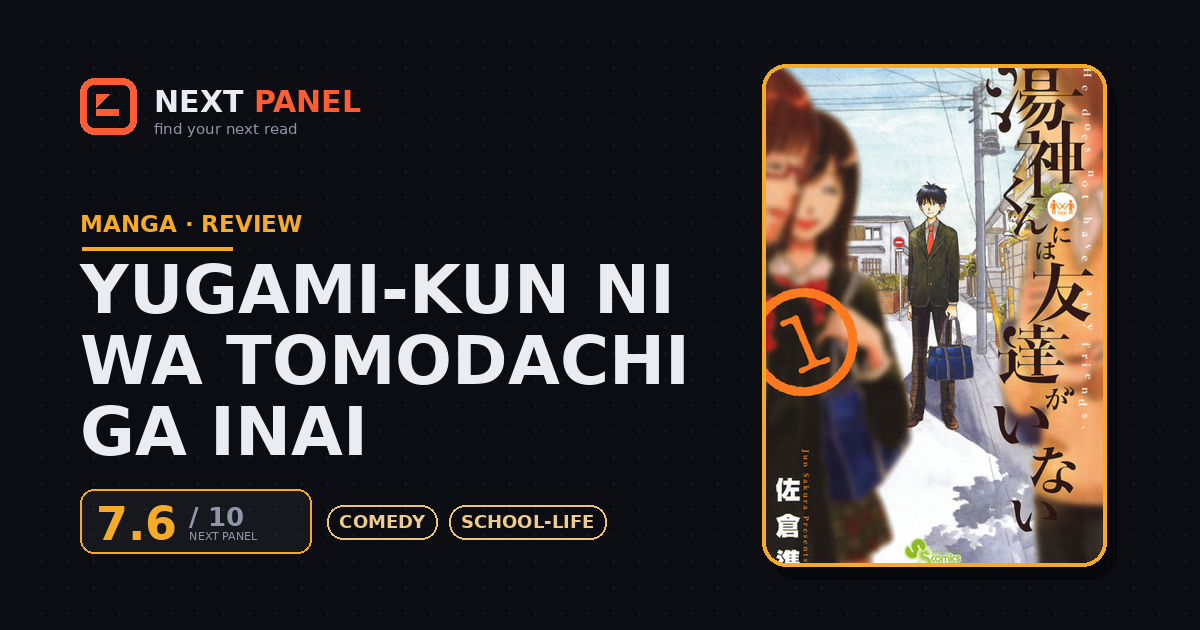
Quick Answer
Yes, if you want a sharply written, character-driven school comedy that never got the English release it deserves. It's low on plot and high on personality, and that trade works in its favor.
Quick Verdict
“Two completely opposite philosophies about friendship keep colliding in the same classroom, and the comedy never runs out of new angles to hit that collision from.”
Best for: Readers who want a character-driven school comedy built on contrasting personalities rather than a strong ongoing plot.
Not for: Readers who want serialized story stakes or a large-scale plot progressing across volumes.
- Type
- Manga
- Genres
- School Life, Comedy
- Status
- Completed
- This review
- Minor Spoilers
- Author
- Jun Sakura
- Publisher
- Shogakukan
| Quick facts | |
|---|---|
| Format | Manga (shōnen), 81 chapters, 16 volumes |
| Run | 2012–2019 · completed |
| Community score | AniList 8.0 · MangaUpdates 8.5 |
Overview
Watanuki Chihiro has switched schools so many times that she's never managed to hold onto real friendships, and she arrives at Kamihoshi High School determined to fix that. Her seating assignment puts her next to Yugami Yuuji, a boy who has built an entire personal philosophy around not needing friends at all — he avoids anything that doesn't directly benefit or teach him something, friendship included. Chihiro's sincere desire for connection crashing into Yugami's stubborn self-sufficiency is the engine of the whole series, and it's a lot funnier than it sounds on paper.
Written and drawn by Jun Sakura, the manga ran in Shogakukan's Shonen Sunday S and then Weekly Shonen Sunday from 2012 to 2019, wrapping up at 16 volumes without ever picking up an official English release.
What it does well
Yugami's philosophy is the funniest thing about the book, and it holds up because the manga treats it as a real, internally consistent belief system rather than a one-note gag. He has reasons for everything he refuses to do, and watching those reasons get tested — by Chihiro, by circumstance, by his own occasional slip-ups — gives the comedy a foundation sturdier than most odd-couple setups manage.
Chihiro is doing just as much work on her side of the pairing. Her drive to make friends isn't played as naive or pathetic; it's sincere, and that sincerity is what keeps her scenes with Yugami from feeling like a simple straight-man-versus-weirdo dynamic. There's real warmth underneath the bickering, and it's what makes their eventual, grudging rapport satisfying rather than just a foregone conclusion.
As more classmates get pulled into their circle, the manga does a good job giving each one their own distinct comic voice instead of just padding out the cast for volume count. And because the jokes tend to follow from who these specific characters are rather than existing as standalone gags, the comedy holds up even when you've been reading for a while.
Where it falls short
This is slice-of-life through and through — there's very little serialized plot pulling you from volume to volume, and readers who want an arc with real forward momentum or stakes should know that going in. The appeal here is entirely about spending time with these specific characters.
A few supporting characters introduced in later arcs don't get quite the same depth as the core cast, which can make some stretches feel less essential than the Yugami-and-Chihiro chapters. And practically speaking, the lack of any official English release means actually reading this one takes more effort than picking up something already sitting on a shelf or storefront.
Verdict
Yugami-kun ni wa Tomodachi ga Inai is a sharply written, character-first school comedy that never got the international attention its writing deserves. If a slow-paced, personality-driven comedy about two opposite philosophies of friendship sounds appealing, it's well worth tracking down; if you need serialized plot stakes to stay engaged, this isn't built to give you that.
Strengths & Weaknesses
Strengths
- Yugami's rigid, almost philosophical refusal to need friends is a genuinely funny character hook, and the manga keeps finding new ways to test that philosophy without repeating the same joke twice.
- Chihiro works well as a foil precisely because her desire for connection is sincere rather than a simple straight-man setup, which gives their dynamic real warmth under the comedy.
- The supporting cast that gradually gets pulled into their orbit each brings a distinct personality, so the ensemble grows without diluting what makes the core pairing work.
- The comedy is built on character logic rather than random gags, so jokes tend to land because they follow naturally from who these people are.
Weaknesses
- There's very little serialized plot momentum — this is a slice-of-life comedy through and through, which will frustrate readers who want an arc with real stakes.
- Some later-arc supporting characters get less development than the strength of the core cast would suggest they deserve.
- With no official English release, reading it currently requires more effort to track down than most manga on this list.
Similar Titles
Gekkan Shoujo Nozaki-kun
Another character-driven school comedy built on a mismatched pair and a large, distinct supporting cast.
A different flavor of odd-couple school comedy, with more serialized romantic plot alongside the humor.
A gentler, more romance-focused school comedy if you want something adjacent but softer around the edges.
Frequently Asked Questions
Is Yugami-kun ni wa Tomodachi ga Inai finished?
Yes, it's complete at 16 volumes, serialized in Shogakukan's Shonen Sunday S and then Weekly Shonen Sunday from 2012 to 2019.
Is there an official English translation?
Not currently. There's no confirmed official English digital or print edition as of this review — worth re-checking down the line in case that changes.
Does the title translate to something in English?
Roughly, "Yugami-kun Has No Friends" — which is also the show's whole comedic premise.