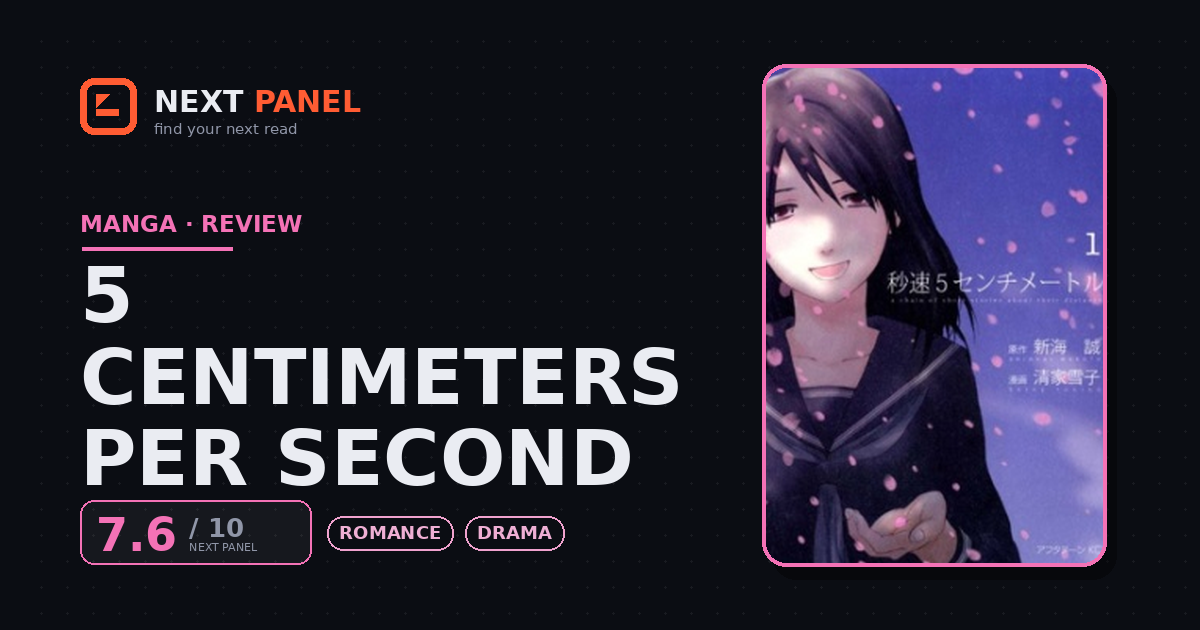
Is 5 Centimeters per Second Worth Reading? Review & Where to Read
Quick Answer
Yes, if you want a short, melancholy meditation on lost connection rather than a conventional romance with a tidy resolution. It's over quickly and the ending won't satisfy everyone, but the mood it builds is genuinely affecting.
Quick Verdict
“Nothing dramatic happens here except the slow, ordinary erosion of a relationship over years, and that's exactly why it lingers.”
Best for: Readers who want a quiet, bittersweet meditation on distance and lost connection and are fine with an unresolved, melancholy ending.
Not for: Readers who want a conventional romance with a clear, satisfying resolution or a faster-moving plot.
- Type
- Manga
- Genres
- Romance, Drama
- Status
- Completed
- This review
- Minor Spoilers
- Author
- Makoto Shinkai
- Artist
- Yukiko Seike
- Publisher
- Kodansha
- Platform
- Kodansha
| Quick facts | |
|---|---|
| Format | Manga, 11 chapters, 2 volumes |
| Run | 2010–2011 · completed |
| Community score | AniList 7.4 |
| Content | Melancholy themes |
| Where to read | Kodansha — official |
Overview
Takaki Tono and Akari Shinohara are childhood friends who share a quiet, unspoken closeness — the kind that feels permanent when you're young. Then Akari's family moves away, and the story follows Takaki across the years that follow: a long-distance train journey to see her one more time, a high school chapter where a classmate's unrequited feelings for him go mostly unanswered, and an adult chapter where the weight of that first, unfinished connection still hasn't quite let go of him.
The manga adapts Makoto Shinkai's 2007 film, with Shinkai credited for the original story and Yukiko Seike drawing the two-volume Japanese release, collected into a single English edition by Kodansha (originally released via Vertical). It's a short, quiet read that trades incident for atmosphere.
What it does well
The three-chapter structure is the smartest choice the story makes. Instead of one continuous romance arc, it shows the same relationship from three different distances in time, and lets the reader feel the gap widening chapter by chapter — not through any single dramatic event, but through the accumulation of ordinary things: missed letters, new cities, other people, the slow drift of growing up. That's a harder thing to dramatize than a breakup, and the manga does it with real restraint.
Yukiko Seike's art matches that restraint. The linework stays quiet and understated even in the story's most emotional moments, which keeps the manga from tipping into melodrama the way a lesser adaptation might. The honesty of the writing is its biggest strength: this isn't a story about a dramatic betrayal or a clean villain keeping two people apart, it's about how ordinary life is often enough on its own to pull people away from each other, and that feels truer than most romance stories are willing to admit.
Because the whole thing runs so short, there's very little wasted space. Almost every scene is contributing to the mood or the throughline, which makes the read efficient even when the pacing itself is deliberately slow.
Where it falls short
The ending is intentionally unresolved, and readers hoping for a clear romantic payoff — happy or sad — will likely find it frustrating rather than poignant. That ambiguity is the point, but it's worth knowing going in.
The middle chapter introduces a new character whose own feelings drive a good chunk of that section, but she gets noticeably less development than the story's actual focus on Takaki and Akari, and the story moves past her fairly quickly. And the slow, quiet pacing that builds the story's mood so effectively can also read as uneventful if you're not already on board with what it's going for.
Verdict
5 Centimeters per Second is a small, deliberately understated story about how distance and time can wear down even a bond that felt unbreakable, and it earns its melancholy rather than performing it. If a quiet, bittersweet meditation on lost connection sounds like what you want, this is a fast, effective version of it; if you need your romance to resolve cleanly, the ending will likely leave you cold.
Strengths & Weaknesses
Strengths
- The three-chapter structure lets the story show the same relationship at very different distances in time, and the accumulation of small, ordinary changes hits harder than one big dramatic turn would.
- Yukiko Seike's art keeps the quiet, understated tone of the original film intact rather than pushing for bigger, more melodramatic beats.
- The story is honest about how distance and time actually erode closeness — through neglect and circumstance rather than any one big betrayal — which feels truer than most romance manga are willing to be.
- Its short length means every chapter is doing real work; there's very little filler between the emotional beats that matter.
Weaknesses
- The ending is deliberately unresolved and melancholy, which will frustrate readers hoping for a clear romantic payoff.
- The middle chapter's new character gets comparatively little development before the story moves on from her perspective.
- The slow, quiet pacing that gives the story its mood can also make it feel uneventful if you're not already invested in the tone.
Similar Titles
Another short, quietly bittersweet Shinkai story if this one's mood works for you.
A different kind of quiet, melancholy relationship story, with more focus on guilt and reconnection.
A longer, more hopeful take on the same idea of a childhood bond disrupted by time and distance.
Where to Read Officially
| Platform | Format | Pricing | Region notes | Link |
|---|---|---|---|---|
| Kodansha | Print & digital volume | Paid | Region availability varies | Open |
Frequently Asked Questions
Is this the same story as the anime film?
Yes, it adapts the same 2007 Makoto Shinkai film, with art by Yukiko Seike, condensed into a single English volume.
Do I need to watch the movie first?
No, the manga tells the complete story on its own, though fans of the film will recognize its key scenes and mood.
Is the ending happy?
It's intentionally ambiguous and bittersweet rather than a clean happy or sad ending — that ambiguity is part of the point.