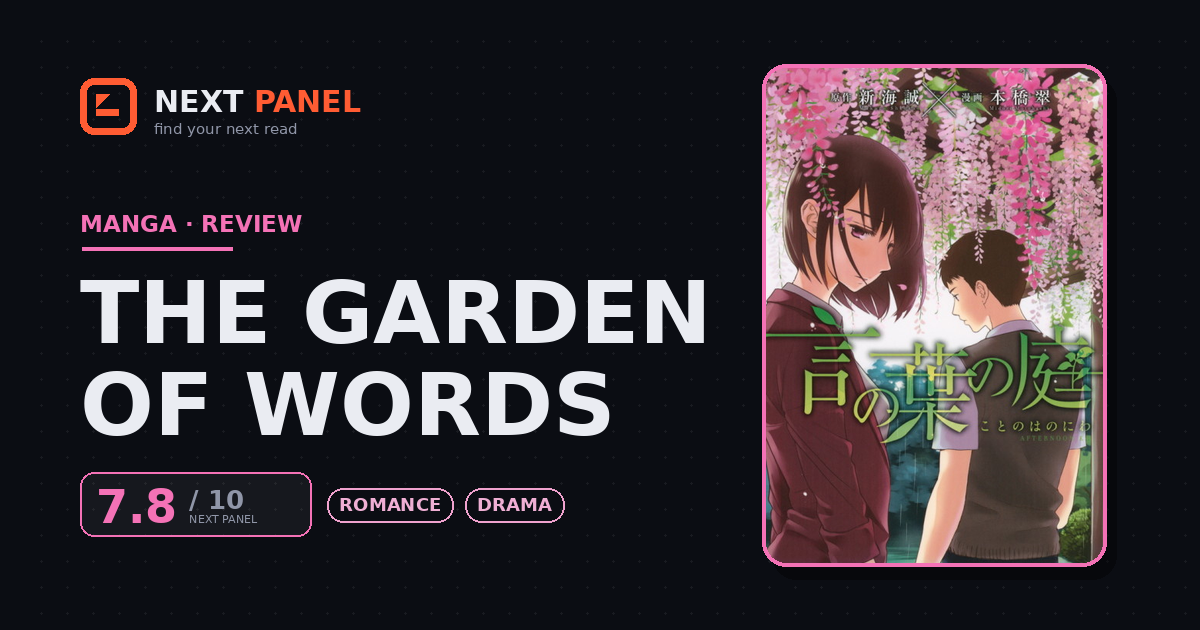
Is The Garden of Words Worth Reading? Review & Where to Read
Quick Answer
Yes, if you want a short, gentle, emotionally mature story about two people helping each other through a rough patch without forcing it into a conventional romance shape. It's over almost as soon as it starts, which is both the charm and the limitation.
Quick Verdict
“Two strangers quietly repairing each other in a rain-soaked garden shouldn't work this well in this few pages, and yet it does.”
Best for: Readers who want a short, quiet, emotionally mature story about connection between two people at different points in life and don't need a conventional romantic arc.
Not for: Readers who want a longer series with a large cast or a straightforward same-age teen romance.
- Type
- Manga
- Genres
- Romance, Drama
- Status
- Completed
- This review
- Minor Spoilers
- Author
- Makoto Shinkai
- Artist
- Midori Motohashi
- Publisher
- Kodansha
- Platform
- Kodansha
| Quick facts | |
|---|---|
| Format | Manga, 7 chapters, 1 volumes |
| Run | 2013–2013 · completed |
| Community score | AniList 7.2 · MangaUpdates 7.2 |
| Content | Themes of loneliness and an age-gap relationship, handled without explicit content |
| Where to read | Kodansha — official |
Overview
Takao Akizuki is a high schooler who skips his first class on rainy mornings to sketch shoes in a quiet garden pavilion — he wants to become a shoemaker, and the rain gives him an excuse to slow down. Yukari Yukino is an older woman who keeps showing up at the same pavilion during the same hours, drinking beer and eating chocolate instead of going to work. Neither one asks the other too many questions at first. Over a series of rainy mornings, that changes, and what starts as two strangers sharing a bench becomes something neither of them expected.
The manga adapts Makoto Shinkai's 2013 film of the same name, with Shinkai credited for the original story and Midori Motohashi handling the art, collected into a single English volume by Kodansha.
What it does well
The setting is doing a lot of quiet work. A rain-soaked garden pavilion gives two people a believable, recurring reason to keep meeting without contriving a series of coincidences, and it gives the manga a strong, consistent visual mood to return to chapter after chapter. Motohashi's art leans into that atmosphere without simply tracing the film's most famous shots, which keeps the manga feeling like its own version of the story rather than a redundant copy.
The relationship itself is the real achievement. Rather than rushing Takao and Yukino toward a conventional romantic arc, the story stays patient about what each of them is actually getting from these meetings — a reason to slow down, a person who doesn't demand an explanation, a small pocket of normalcy in an otherwise difficult stretch of life. That restraint is what keeps the age gap between them from feeling exploitative; the story is interested in what they need from each other emotionally, not in melodrama.
The short length is also a genuine strength rather than just a limitation. The story knows exactly how much time it needs to make its point about loneliness and connection, says it, and ends — there's very little padding standing between the reader and the emotional payoff.
Where it falls short
That same brevity means neither character gets much life outside the garden. Yukino's circumstances in particular stay mostly off-page, sketched in through hints rather than shown directly, which can leave her feeling more like a catalyst for Takao's story than a fully realized person in her own right.
The age-gap premise, however carefully handled, is still going to be a sticking point for some readers regardless of how restrained the execution is. And because so much of the story is built on quiet mood and unhurried conversation, readers looking for clear plot momentum may find the pace too slow to hold their attention.
Verdict
The Garden of Words is a small, carefully restrained story about two people helping each other through a hard stretch of life, and it earns its quiet, rain-soaked mood instead of just borrowing it from the source film. If a short, emotionally mature story about connection sounds appealing, this delivers it efficiently; if you want a longer series or a conventional same-age romance, this isn't built for that.
Strengths & Weaknesses
Strengths
- The rainy-morning garden setting does double duty as both a beautiful recurring visual and a believable reason two strangers would keep running into each other without it feeling contrived.
- The relationship between Takao and Yukino stays grounded and restrained rather than rushing toward romance, which lets the story explore what each of them actually needs from the other.
- Midori Motohashi's art captures the quiet, rain-heavy mood of Shinkai's original film without simply copying it panel for panel.
- The short length works in its favor here — the story says what it needs to say about loneliness and connection and then ends before it can overstay its welcome.
Weaknesses
- The brief page count means both leads get only a sketch of a life outside their garden meetings, especially Yukino's off-page circumstances.
- The age gap between the two leads is handled with real care, but it's still a premise that won't sit comfortably with every reader.
- Because so much of the story rests on mood and quiet conversation, readers who want clear plot momentum may find it too slow.
Similar Titles
Another short, quietly bittersweet Shinkai manga adaptation, for more of the same restrained mood.
A later, more plot-driven Shinkai adaptation if you want a similar tone with higher stakes.
A different quiet, mature relationship story, this one built around guilt and reconnection instead of loneliness.
Where to Read Officially
| Platform | Format | Pricing | Region notes | Link |
|---|---|---|---|---|
| Kodansha | Print & digital volume | Paid | Region availability varies | Open |
Frequently Asked Questions
Is this the same story as the anime film?
Yes, it adapts Makoto Shinkai's 2013 short film, with art by Midori Motohashi, in a single English volume from Kodansha (originally released via Vertical).
How long is it?
It's a single volume, a short read you can finish in one sitting.
Is the age gap between the two leads a major plot point?
Yes, it's central to the story, but it's handled with restraint rather than played for shock or melodrama.