Is Weathering with You Worth Reading? Review & Where to Read
Quick Answer
Yes, if you want a fast, emotionally direct fantasy romance with real weight behind its central choice. It compresses a visually driven film into page form well, even if some of that spectacle inevitably gets lost in translation.
Quick Verdict
“This is a story that eventually asks its two leads to choose each other over saving the world, and it commits to that choice instead of chickening out of it.”
Best for: Readers who want a fast-moving fantasy romance with real emotional and moral stakes behind its central relationship.
Not for: Readers who want a slower, more grounded story without supernatural elements or a large ensemble cast.
- Type
- Manga
- Genres
- Romance, Supernatural
- Status
- Completed
- This review
- Minor Spoilers
- Author
- Makoto Shinkai
- Artist
- Wataru Kubota
- Publisher
- Kodansha
- Platform
- Kodansha
| Quick facts | |
|---|---|
| Format | Manga, 13 chapters, 3 volumes |
| Run | 2019–2020 · completed |
| Community score | AniList 7.5 |
| Content | Peril, mild violence, themes of self-sacrifice |
| Where to read | Kodansha — official |
Overview
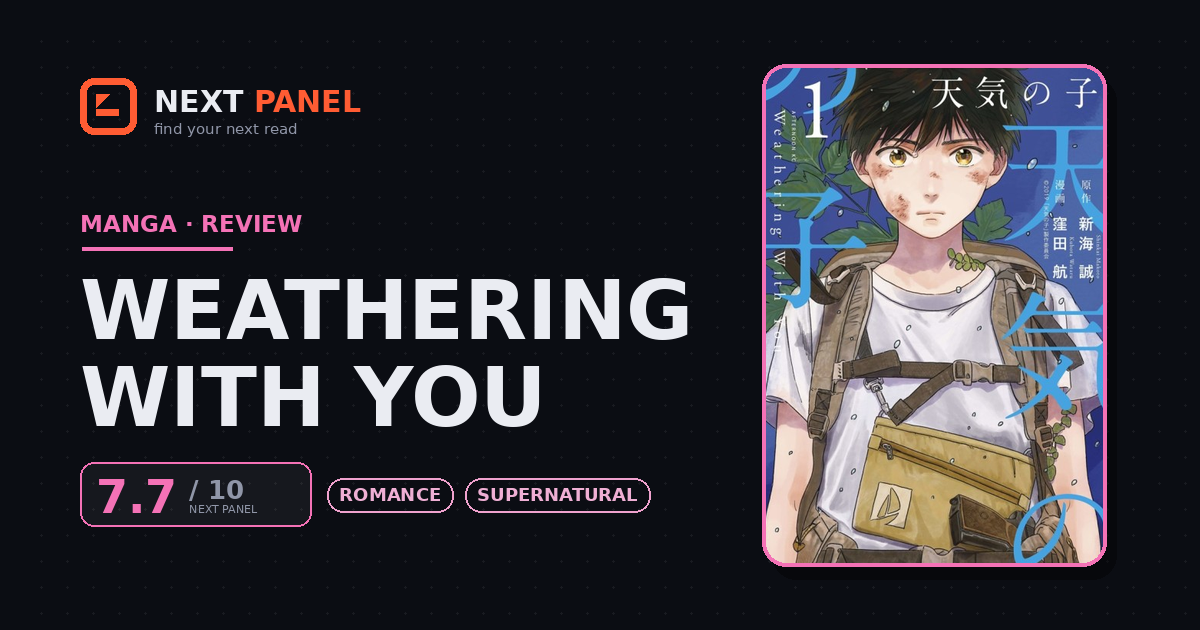
Hodaka Morishima runs away from his home on a remote island to Tokyo with barely any money and no plan, and survival in the city turns out to be harder than he expected. Then he meets Hina Amano, a girl with a strange, private ability: she can pray away the rain and clear the sky, at least for a little while. What starts as a small, almost magical party trick becomes a business — Tokyo's rainy season is relentless, and people will pay for clear skies — but the more Hina uses her gift, the more it becomes clear that it's taking something from her that she can't easily get back.
The manga adapts Makoto Shinkai's 2019 film, with Wataru Kubota handling the art across a compact run for Kodansha's Afternoon, and it was licensed in English shortly after its Japanese release.
What it does well
The way Hina's ability is introduced is the story's smartest structural choice. It starts small and almost sweet — a girl who can make the sun come out — before gradually revealing the real cost behind it, and that patience makes the eventual stakes land as an actual gut-punch rather than a twist pulled out of nowhere.
Hodaka's situation does a lot of quiet work too. He's not a chosen-one type dropped into a fantasy plot; he's a broke teenage runaway trying to survive in a city that doesn't care about him, and that grounded desperation gives the more fantastical elements of the story something real to push against. Kubota's art rises to the occasion for a story that's famously about weather — rain, light, and sky get real attention on the page, which keeps the atmosphere from getting lost in the shift from screen to print.
What elevates the story past a simple romance is its willingness to commit to an uncomfortable choice near the end, between what's conventionally "right" for the world and what Hodaka wants for the one person he cares about most. The manga doesn't soften that choice to make everyone comfortable, and that follow-through is what makes the ending stick with you.
Where it falls short
Some of the film's most famous sequences depended heavily on motion, music, and scale, and those moments inevitably lose some of their impact translated into still panels — this is a stronger read if you're not directly comparing it to the movie scene for scene.
The supporting cast around Hodaka and Hina, while likeable, doesn't get as much room to develop as the two leads, and mostly exists to keep the plot moving rather than to matter as fully realized people. The story's pace also accelerates noticeably in its final stretch, which can make some major turns feel more rushed than the patient early chapters would suggest.
Verdict
Weathering with You is a fast, visually minded fantasy romance that earns its emotional stakes by taking its central choice seriously instead of dodging it. If a compact story about weighing the world against one person sounds appealing, this delivers it with real conviction; if you'd rather have a slower, more grounded story, the fantasy elements and brisk pace won't be what you're looking for.
Strengths & Weaknesses
Strengths
- Hina's weather-clearing ability is introduced as something small and almost whimsical before the story reveals exactly what it's costing her, and that slow reveal gives the fantasy premise real emotional teeth.
- Hodaka's situation as a runaway with no money and no support system grounds the more fantastical elements in something believable and immediate.
- Wataru Kubota's art handles the story's weather-heavy visuals well, translating a famously rain-soaked film into still panels without losing the atmosphere.
- The story's central choice — between a conventional "greater good" and choosing one specific person — is treated with real seriousness instead of being softened at the last minute.
Weaknesses
- Some of the film's biggest visual set pieces inevitably lose impact translated to the page, since so much of the original's power came from motion and sound.
- The supporting cast, while likeable, gets less development than the two leads and can feel like they're mainly there to move the plot along.
- The pace picks up sharply in the back third, which can make some of the story's biggest turns feel rushed compared to the more patient opening chapters.
Similar Titles
An earlier, quieter Shinkai adaptation if you want the same author's more restrained register.
A more melancholy Shinkai story about distance and connection, for a different emotional register from the same creator.
Shinkai's best-known work, for readers who want another high-concept fantasy romance with major stakes.
Where to Read Officially
| Platform | Format | Pricing | Region notes | Link |
|---|---|---|---|---|
| Kodansha | Print & digital volumes | Paid | Region availability varies | Open |
Frequently Asked Questions
Is this the same story as the anime film?
Yes, it adapts Makoto Shinkai's 2019 film, with art by Wataru Kubota, across a short multi-volume run from Kodansha.
Do I need to watch the movie first?
No, the manga tells the complete story on its own, though the film's visuals are a big part of its reputation and worth seeking out separately.
How long is the manga?
It's a short, complete series collected in a handful of volumes, a quick read compared to most ongoing manga.