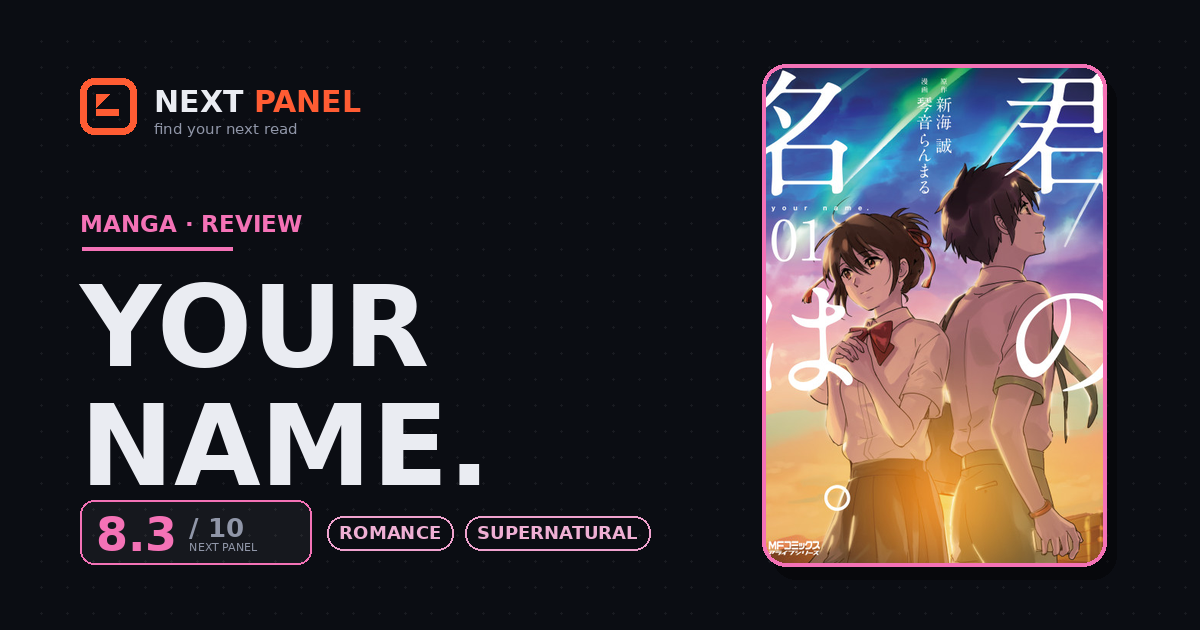
Is Your Name. Worth Reading? Review & Where to Read
Quick Answer
Yes, especially as a fast, faithful way to experience one of the most acclaimed anime stories of the last decade in comic form. The manga compresses some of the film's biggest moments, but the core mystery and relationship still land.
Quick Verdict
“This body-swap gimmick turns into a genuinely moving story about missing someone you haven't technically met yet, and the manga gets there efficiently even with less room to breathe than the film.”
Best for: Readers who want a tightly plotted supernatural romance with a real mystery underneath the body-swap premise.
Not for: Readers who want a long series to sink into or who'd rather experience the story through its original film first.
- Type
- Manga
- Genres
- Romance, Supernatural
- Status
- Completed
- This review
- Minor Spoilers
- Author
- Makoto Shinkai
- Artist
- Ranmaru Kotone
- Publisher
- Kadokawa
- Platform
- Yen Press
| Quick facts | |
|---|---|
| Format | Manga, 9 chapters, 3 volumes |
| Run | 2016–2017 · completed |
| Community score | AniList 8.0 |
| Content | Peril, disaster-related themes |
| Where to read | Yen Press — official |
Overview
Mitsuha Miyamizu is a teenager stuck in Itomori, a small mountain town she's desperate to leave. Taki Tachibana is a teenager buried in part-time jobs and city life in Tokyo. Neither has met the other — until they start waking up, at random, living inside each other's bodies for a day at a time. What begins as confusion and slapstick (Taki fumbling through Mitsuha's small-town life, Mitsuha causing chaos in Taki's Tokyo routine) gradually reveals itself to be tied to something much bigger, and much more urgent, than either of them expected.
The manga adapts Makoto Shinkai's massively acclaimed 2016 film, with Ranmaru Kotone providing the art across a three-volume run originally serialized in Monthly Comic Alive and released in English by Yen Press.
What it does well
The body-swap premise earns its keep here instead of just being a gimmick. Because Mitsuha and Taki are literally living each other's days, they end up understanding each other's pressures, relationships, and small daily frustrations from the inside, which gives their eventual connection real substance instead of being built on a few chance meetings.
The mystery layered underneath the swapping is patiently constructed, and the manga's more compact format actually works in its favor here — the clues and turns come at a pace that keeps the pages moving without losing the thread. Ranmaru Kotone handles the tonal balancing act well too, letting the early chapters be genuinely funny about the logistics of waking up in someone else's life before shifting convincingly into the story's more serious, higher-stakes later chapters.
What makes the story stick, on the page as much as on screen, is its central emotional idea: searching for someone specific that you've never actually met face to face. That's a strange thing to try to sell a reader on, and the manga sells it anyway, carrying real emotional weight even without the film's score and motion behind it.
Where it falls short
Some of the film's signature sequences relied heavily on visual scale and music, and inevitably lose some of that impact condensed into still panels — this works best as its own experience rather than a scene-for-scene comparison to the movie.
The supporting cast on both sides — Mitsuha's friends and family in Itomori, Taki's coworkers and classmates in Tokyo — gets noticeably less room than the film gives them, a natural consequence of adapting a full feature into three volumes. And a few of the story's later plot mechanics move quickly enough that a reader coming in cold may need to slow down to keep track of what's happening and why.
Verdict
Your Name. is a tightly constructed supernatural romance that earns its acclaim by using a strange premise to build something genuinely moving, and the manga is an efficient, faithful way to experience it. If a fast-moving mystery-romance with real emotional stakes sounds appealing, this delivers it well even in a shorter format; if you want the full experience, the original film is still the version most people mean when they talk about this story.
Strengths & Weaknesses
Strengths
- The body-swap premise is used to build real character insight rather than just comedy — Mitsuha and Taki learn each other's problems and priorities by literally living inside them.
- The mystery underneath the swapping is patiently seeded, and the manga's condensed format actually keeps the pacing brisk without losing the clues.
- Ranmaru Kotone's art handles both the comedic body-swap chapters and the story's more serious later turns without the tone ever feeling inconsistent.
- The central emotional hook — searching for someone you've never technically met in person — stays effective on the page even without the film's music and motion.
Weaknesses
- Some of the film's most visually driven sequences are necessarily compressed, and readers who've seen the movie first may notice the shorthand.
- Side characters from both Mitsuha's and Taki's lives get less development than the film affords them, given the manga's shorter three-volume length.
- A few late plot mechanics move quickly enough that a first-time reader unfamiliar with the story may need a moment to catch up.
Similar Titles
Shinkai's follow-up film and manga, for more of the same high-concept romantic fantasy with real stakes.
A quieter, more grounded Shinkai story if you want his more restrained register next.
An earlier, more melancholy Shinkai manga about distance and connection, for a bittersweet counterpoint to this one's more hopeful arc.
Where to Read Officially
| Platform | Format | Pricing | Region notes | Link |
|---|---|---|---|---|
| Yen Press | Print & digital volumes | Paid | Region availability varies | Open |
Frequently Asked Questions
Is this the same story as the anime film?
Yes, it adapts the 2016 film, with art by Ranmaru Kotone, across three volumes published by Yen Press in English.
Should I watch the movie or read the manga first?
Either works, but the film is generally considered the definitive version given how much of its impact comes from music and animation; the manga is a solid, faster way to revisit or preview the story.
Is the manga finished?
Yes, it's complete at three volumes.