Is Ace of the Diamond Worth Reading? Review & Where to Read
Quick Answer
Yes, if you want a sports manga that treats competition within your own team as seriously as competition against opponents. It's a long commitment, but it earns its length.
Quick Verdict
“Eijun spends more time fighting for a spot on his own bench than pitching against rivals, and somehow that's the more compelling story.”
Best for: Readers who want a sports manga built around internal team competition and steady, believable skill growth.
Not for: Readers who want a short series or a plot that moves past its central sport into other genres.
- Type
- Manga
- Genres
- School Life, Sports
- Status
- Completed
- This review
- Minor Spoilers
- Author
- Yuji Terajima
- Publisher
- Kodansha
- Platform
- Kodansha (K MANGA / Kodansha.us)
| Quick facts | |
|---|---|
| Format | Manga (shōnen), 418 chapters, 47 volumes |
| Run | 2006–2015 · completed |
| Community score | AniList 8.2 |
| Where to read | Kodansha (K MANGA / Kodansha.us) — official |
Overview
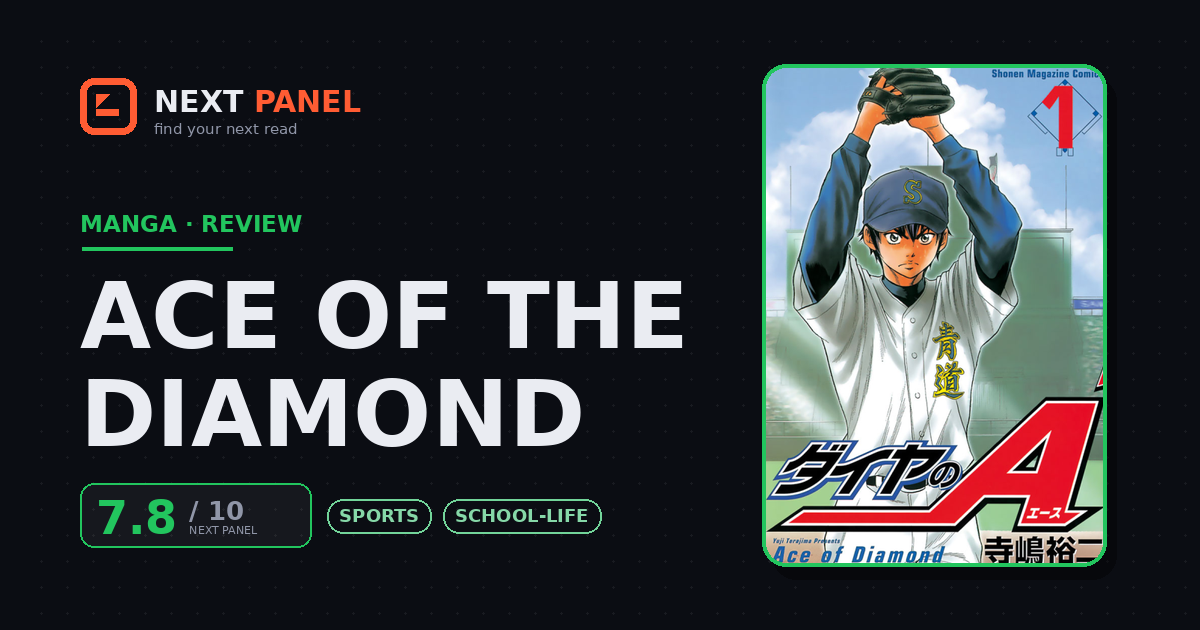
Ace of the Diamond follows Eijun Sawamura, a pitcher from rural Nagano with an unconventional throwing form, as he enrolls at Seidou, a national powerhouse baseball school in Tokyo. He isn't the ace the moment he arrives — he's competing against Kazuya Miyuki's demanding standards and against Satoru Furuya, another first-year pitcher with far more natural talent, just to earn a spot on the mound at all.
That's the structural trick that sets this apart from a lot of sports manga: the story spends as much time on the fight for a starting position within Eijun's own team as it does on games against outside rivals.
What it does well
The internal-competition angle is the series' best idea. Furuya isn't a villain — he's a teammate with different strengths, and watching the coaching staff and catcher Miyuki weigh which pitcher gives the team the best chance in a given game creates tension that doesn't need an outside antagonist to work. That structure keeps stakes high even during stretches without an actual tournament game.
The baseball itself is explained well. You don't need to already understand pitch counts, defensive positioning, or the value of a specific pitch sequence — the manga walks you through why a given decision matters in the moment, which makes the games readable even if you've never followed the sport.
Eijun's growth is handled with real patience. He doesn't suddenly develop a new signature pitch to solve a problem; instead you see him work through a specific mechanical or mental issue over many chapters; sometimes over several volumes, which makes his improvement feel like the result of actual effort rather than a plot convenience.
The supporting roster also gets enough individual attention that the team feels like a group of specific people rather than a backdrop for the two leads. Injuries, position battles, and personal stakes for secondary players carry real weight when they come up.
Where it falls short
This is an enormous commitment. Between the original series and its continuing sequels, it's one of the longest-running sports manga still going, and the pacing of individual games — some spanning many volumes — will frustrate readers who want faster resolution. A handful of games slow down significantly in their middle innings as the story cycles through internal monologue and flashback.
The formula of building rivalry tension followed by a decisive, hard-fought game repeats often enough across the series that by the later stretches it can start to feel like a template being executed rather than something new each time.
Verdict
Ace of the Diamond is a long haul, but it's one of the more thoughtfully structured baseball manga out there, thanks to making the fight for a roster spot as compelling as any external rivalry. If you're willing to commit to its length, it delivers consistently satisfying sports storytelling.
Strengths & Weaknesses
Strengths
- The central conflict is against Eijun's own teammate for the starting pitcher role, which keeps tension high even in chapters without an actual game.
- Baseball strategy is explained clearly enough that you don't need prior knowledge of the sport to follow why a given pitch or call matters.
- Growth is incremental and earned — Eijun doesn't suddenly unlock a new pitch out of nowhere, he works specific, visible problems out over many chapters.
- The supporting cast of teammates gets real development beyond being scoreboard filler, so the team feels like an actual roster rather than a backdrop.
Weaknesses
- It's an extremely long series, and the sheer number of games and practice arcs will test the patience of readers who want a tighter story.
- Some individual games run long enough that momentum stalls in the middle innings of a given match.
- The formula of tension-building rivalry followed by a hard-fought game repeats often enough that it can feel familiar by the later stretches.
Similar Titles
Haikyuu!!
Same focus on team dynamics and internal competition for playing time, in volleyball instead of baseball.
A much more aggressive, individualist take on competing for a roster spot, if you want the intensity turned up further.
Another baseball manga worth reading, with a quieter, more character-driven approach than Ace of the Diamond's tournament structure.
Where to Read Officially
| Platform | Format | Pricing | Region notes | Link |
|---|---|---|---|---|
| Kodansha (K MANGA / Kodansha.us) | Digital chapters (free on K MANGA) | Digital volumes | Free + Paid | Region availability varies | Open |
Frequently Asked Questions
Do I need to understand baseball to enjoy it?
No. The manga explains strategy and rules as they come up, so newcomers to the sport can follow along without prior knowledge.
How long is the series?
The original run is 47 volumes across roughly a decade of serialization, and it's since continued into further story acts.
Is the anime a good alternative?
The anime covers the same story fairly faithfully, but the manga is where the story is furthest along if you want to keep going past what's animated.