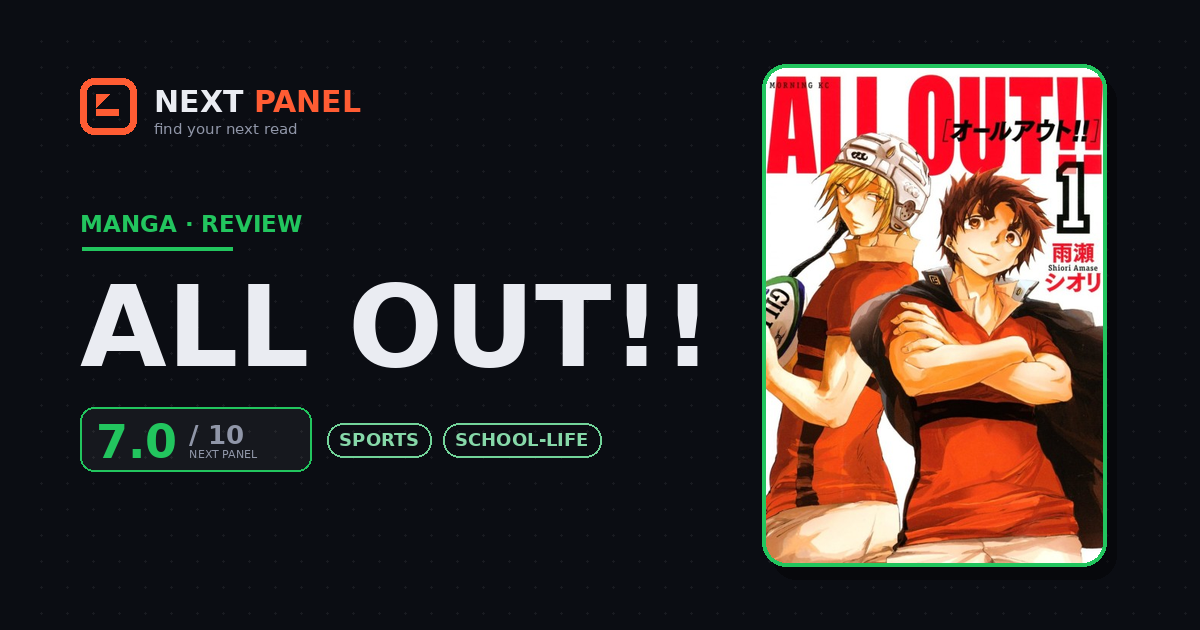
Is All Out!! Worth Reading? Review & Where to Read
Quick Answer
Yes, especially if you already like sports manga. All Out!! isn't reinventing the genre, but it draws rugby clearly, gives a big cast real personality, and earns its emotional beats instead of just going through the motions.
Quick Verdict
“It follows the sports-manga formula closely, but Amase draws rugby specifically and clearly enough that you actually understand what's happening on the field, which a lot of sports manga can't manage.”
Best for: Readers who like team-based sports manga with a big cast and want a sport they probably don't know much about explained clearly.
Not for: Readers who want a small, tight cast or a sport with faster, more individual highlight moments.
- Type
- Manga
- Genres
- School Life, Sports
- Status
- Completed
- Author
- Shiori Amase
- Publisher
- Kodansha (Monthly Morning Two)
- Platform
- Kodansha
| Quick facts | |
|---|---|
| Format | Manga (shōnen), 126 chapters, 17 volumes |
| Run | 2012–2019 · completed |
| Community score | AniList 6.6 · MangaUpdates 7.0 |
| Content | Sports injuries, some bullying |
| Where to read | Kodansha — official |
Overview
All Out!! starts with a pretty familiar setup: Kenji Gion, short and hot-tempered, and Sumiaki Iwashimizu, tall and painfully mild-mannered, both join their high school's rugby club on the same day, for very different reasons. From there, Shiori Amase spends seventeen volumes building out the whole team around them — captains, coaches, rivals, and a rotating cast of teammates who each get a chapter or two to become more than a jersey number. It ran in Kodansha's Monthly Morning Two from 2013 to 2020 and got a 25-episode anime adaptation in 2016.
What it does well
The biggest thing All Out!! gets right is clarity. Rugby is not an easy sport to explain visually — it's chaotic, physical, and full of rules casual readers won't know going in — and Amase draws it in a way that actually tracks: you can follow who has the ball, why a play worked or didn't, and what the stakes of a given tackle are. That's a real skill, and a lot of sports manga just fall back on speed lines and dramatic close-ups instead of doing this work.
The cast is the other strength. Gion and Iwashimizu's opposite-personality pairing is a simple hook, but Amase doesn't lean on it forever — both characters get real growth past their introductory quirks, Gion learning to use his height instead of resenting it, Iwashimizu unpacking some genuinely heavy baggage from his past. And because the story keeps cutting away to give side characters their own focus chapters, the team starts to feel like an actual team instead of a hero and his backup dancers. Rugby's team-first structure gets taken seriously here — the manga is skeptical of any character who wants individual glory, and that skepticism is baked into the plot, not just stated.
Where it falls short
None of this reinvents the sports-manga formula, and it's not trying to. You get the newcomer struggling with a weakness, a breakthrough that fixes it just in time for a big match, a scarier rival team, and the cycle repeats. If you've read a handful of sports manga already, you'll see most of the beats coming. The wide cast is also a double-edged sword: giving so many characters their moment means the actual plot slows down in stretches while a side arc gets resolved, and not every one of those detours is as compelling as the Gion/Iwashimizu core relationship. And because so much page time goes to explaining rugby mechanics, readers who don't care about the sport itself may find some of it feels more instructional than dramatic.
Verdict
All Out!! isn't reaching for anything new, but it executes the sports-manga formula with real craft — a rugby-literate art style, a cast that earns its size, and emotional beats that land because the team dynamics behind them are actually built out. If you like this genre already, it's an easy, satisfying read. If you've never cared for team sports manga, this one probably won't be the exception.
Strengths & Weaknesses
Strengths
- The rugby itself is drawn clearly — plays, formations, and tackles read as understandable game action instead of an abstract blur of motion lines, which is rarer in sports manga than it should be.
- The cast is large but distinct: Amase gives even side characters on the team a specific look and a specific personality, so the roster doesn't blur together the way ensemble sports casts often do.
- Gion and Iwashimizu's opposite-personalities pairing (short and hot-headed vs. tall and gentle) gives the early volumes an easy hook, and the story lets both of them grow past their starting-point flaws instead of running the same joke forever.
- It takes rugby's team-first nature seriously — individual glory keeps getting undercut by the reality that nobody wins alone, which fits the sport and keeps the drama grounded.
Weaknesses
- It follows the standard sports-manga shape closely — newcomer struggles, gets a breakthrough, faces a bigger rival, repeat — and doesn't do much to subvert that structure.
- With this many characters getting focus chapters, momentum on the actual plot slows down in the middle stretch while side arcs get their turn.
- If you're not at least a little interested in learning how rugby works, some of the tactical explanation pages will feel like homework.
Similar Titles
Same team-sports-underdog structure, different sport, similarly big and distinct cast.
Another sport explained clearly through the manga itself, with a similar focus on team play over individual stardom.
A louder, more exaggerated take on a similarly unfamiliar-to-most-readers Western sport.
Where to Read Officially
| Platform | Format | Pricing | Region notes | Link |
|---|---|---|---|---|
| Kodansha | Digital volumes | Paid | Region availability varies | Open |
Frequently Asked Questions
Do I need to know anything about rugby before reading All Out!!?
No. The manga explains the rules as the characters learn them, so it works fine as a first introduction to the sport.
Is All Out!! finished?
Yes, it's complete at 17 volumes, and all 17 are available in English.
Is the manga different from the anime?
They tell the same story, but the manga moves a bit tighter — the anime adds some extra material to fill out its episode count that isn't in the original chapters.