Is And Yet the Town Moves Worth Reading? Review & Where to Read
Quick Answer
Yes, if you like slow, character-driven comedy, this is one of the most quietly clever slice-of-life manga around. Just know going in that it barely has a plot and jumps around its own timeline, and that there's no reliable official English release right now.
Quick Verdict
“Give it a few volumes and the scattered gags turn out to be a carefully built puzzle, one of the sharpest slice-of-life comedies going, if you don't mind a book that's all hangout and no plot.”
Best for: Readers who love slow, character-driven comedy and don't mind piecing a story together across a jumbled timeline.
Not for: Readers who want a strong central plot, fast pacing, and a story told in order.
- Type
- Manga
- Genres
- Slice of Life, Comedy
- Status
- Completed
- This review
- Minor Spoilers
- Author
- Masakazu Ishiguro
- Publisher
- Shonen Gahosha
| Quick facts | |
|---|---|
| Format | Manga (seinen), 138 chapters, 16 volumes |
| Run | 2005–2016 · completed |
| Community score | AniList 8.2 · MangaUpdates 8.1 |
Overview
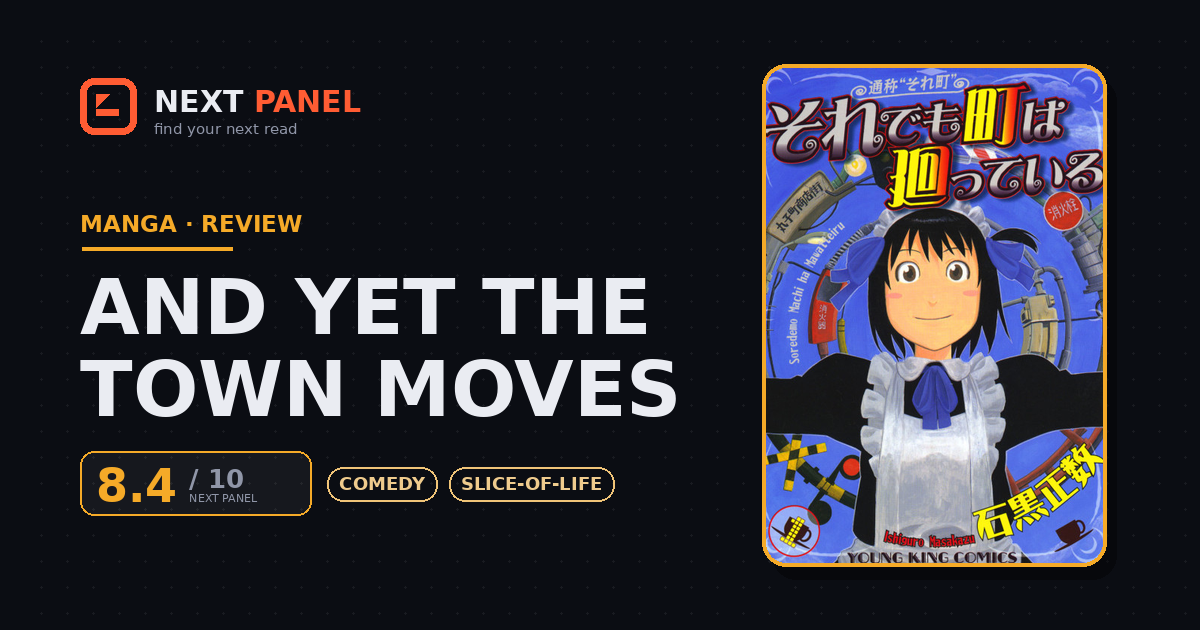
And Yet the Town Moves (you'll also see it as SoreMachi) is a comedy from Masakazu Ishiguro about Hotori Arashiyama, a scatterbrained high schooler who works at a run-down "maid cafe" in an old Tokyo shopping district. The cafe isn't really a maid cafe. The owner is an ancient woman who slapped the theme onto her curry shop to keep up with the times, and that mismatch sets the tone for the whole book. Hotori is obsessed with detective novels and keeps trying to solve mysteries that mostly aren't there. Around her is a tight cast of neighbors, classmates, and shopkeepers, and the story just follows their days.
Two things make it more than a plain gag manga. First, it isn't told in order. Chapters jump around the timeline, drop hints early that pay off dozens of chapters later, and reward you for remembering small details. Second, the everyday stuff regularly bumps into ghosts, aliens, time loops, and actual mysteries, played straight enough to catch you off guard. It ran from 2005 to 2016, got a Shaft anime in 2010, and won the Seiun Award. In English it's been passed between a few now-closed digital services, so it's oddly hard to read officially for something this well regarded.
What it does well
The craft is the headline. Ishiguro plants setups and lets them sit. A throwaway line in an early chapter turns out to be the answer to a mystery much later, and the shuffled order makes those clicks feel earned instead of cheap. Read a volume, then read it again, and you notice how much was hiding in plain sight. Very few comedies are built this tightly.
The humor is dry and character-driven rather than loud. Hotori is a great lead, dim in some ways and weirdly sharp in others, and always likable, so even the dumb bits work because you're on her side. The supporting cast pulls real weight too: her blunt best friend Toshiko, the childhood friend who can't manage to confess, the deadpan upperclassman. Everyone has an inner life, and the running gags grow because the people do.
Then there's the range. One chapter is a small joke about a school festival; the next is a genuinely clever locked-room puzzle or a ghost story with a lump-in-your-throat ending. Ishiguro moves between funny, spooky, and touching without it ever feeling like a different manga. The art backs it up, with clean expressive faces, a strong sense of place, and page layouts that know exactly when to hold on a silent panel.
Where it falls short
This is a slow burn with almost no overarching plot. If you want a clear goal or forward drive, you won't find one here. It's a hangout book, and it asks you to enjoy the company. Some readers bounce right off that.
The shuffled structure also asks for patience. Early on it can read like scattered episodes with no thread, and the best payoffs come late, so you have to trust it for a while before the design shows itself. The big cast takes time to sort out too, and a few side characters blur together at first. And the honest catch for English readers: there's no dependable official release at the moment, which is a real barrier for a book that's otherwise easy to recommend.
Verdict
Give it three or four volumes before you judge it. That's when the loose episodes start snapping together and you realize how carefully the whole thing was put together. It's one of the best slice-of-life comedies out there, funny and clever and quietly moving, held back mainly by how hard it is to read in English right now. If a low-plot hangout manga with sharp writing sounds good to you, it's worth tracking down.
Strengths & Weaknesses
Strengths
- The writing is unusually tight for a comedy: jokes and mysteries set up early pay off much later, so rereads keep turning up details you missed the first time.
- Hotori is a genuinely great lead, dim and sharp at the same time and likable enough that even the silliest chapters land.
- It swings between deadpan humor, ghost and mystery stories, and quiet emotional beats without ever feeling tonally messy.
- Clean, expressive art with a strong sense of place and layouts that know exactly when to sit on a silent panel.
Weaknesses
- There's almost no overarching plot, so readers who need momentum or a clear goal may lose patience with it.
- The non-linear structure and large cast make the opening feel scattered, and the payoffs come late enough that you have to trust the book for a while.
- There's no dependable official English release right now, which makes an easy recommendation harder to actually act on.
Similar Titles
Another absurd, deadpan everyday comedy that finds huge laughs in ordinary small-town life.
Deadpan ensemble comedy with the same dry humor and a lovable, oblivious cast.
For the flip side, quiet episodic stories where ordinary Japan keeps brushing up against the uncanny.
Frequently Asked Questions
Is And Yet the Town Moves finished?
Yes. It ran from 2005 to 2016 and wraps up in 16 volumes, so you can read the whole thing start to finish.
Do I need to watch the anime first?
No. The 2010 Shaft anime adapts a selection of chapters out of order and works as a taster, but the manga stands on its own and goes much deeper.
Can I read it officially in English?
Not reliably at the moment. It has had several digital English releases over the years (JManga, Crunchyroll, BookWalker, Manga Planet), but those services have since closed, so there's no dependable official English edition right now. We'll re-check as licenses change.