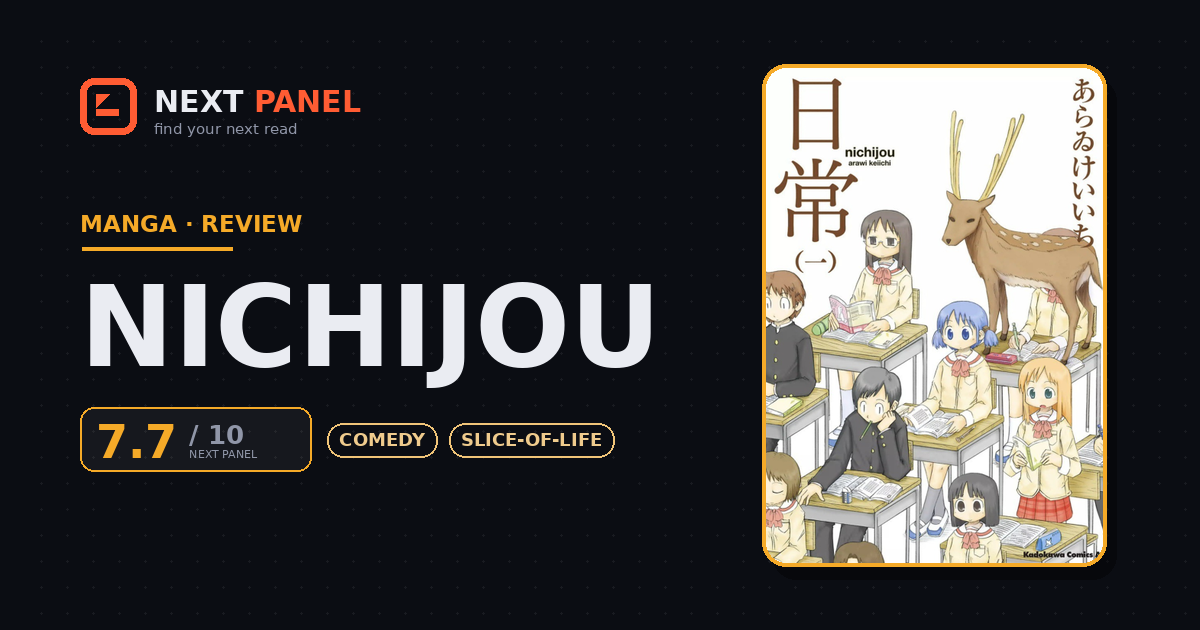
Is Nichijou Worth Reading? Review & Where to Read
Quick Answer
Yes, if you like absurd, plotless gag comedy and don't need a story to hold it together. Nichijou throws a huge range of jokes at you — when they land they're brilliant, and it's fine to read a few pages at a time.
Quick Verdict
“Pure absurd gag comedy with no plot and no brakes — when it's funny it's some of the funniest stuff on the shelf, and it whiffs about as often as it connects.”
Best for: Readers who love rapid-fire absurd comedy and don't need a story to follow.
Not for: Readers who want a plot, real character arcs, or jokes that land every single time.
- Type
- Manga
- Genres
- Slice of Life, Comedy
- Status
- Ongoing
- Author
- Keiichi Arawi
- Publisher
- Vertical
- Platform
- Vertical
| Quick facts | |
|---|---|
| Format | Manga (shōnen), 12 volumes |
| Run | 2006–present · ongoing |
| Community score | AniList 8.3 · MangaUpdates 8.1 |
| Where to read | Vertical — official |
Overview
Nichijou — "My Ordinary Life" — is a gag comedy about the very not-ordinary daily lives of a few high schoolers and the strange people around them. On paper it's slice-of-life: girls go to school, buy snacks, cram for tests. But every few pages it detours straight into the absurd — a principal suplexing a deer, a robot girl with a wind-up key in her back trying to pass as normal, a genius child professor and her talking cat. There's no real plot. It's a string of skits, and the whole joke is the gap between "ordinary life" and how insane it actually gets. It's written and drawn by Keiichi Arawi.
What it does well
The humor is the reason to read it, and it's genuinely inventive. Nichijou will build a whole page around something tiny — dropping a wiener on the floor, mishearing a word — and blow it up into a life-or-death set piece, then cut to something completely unrelated. That willingness to swing for the fences on any premise is what makes it special. When a gag connects, it's laugh-out-loud funny in a way very few comedies manage.
The art does a lot of the work. Arawi draws with a loose, springy style that snaps into huge exaggerated reactions exactly when a joke needs them. His timing on the page — the pause panel, the sudden giant closeup — is sharp, and it's the difference between a bit landing and dying. It's expressive without being messy.
The cast helps too. Yuuko, Mio, and Mai anchor the "normal" school side, while the Professor, the robot Nano, and the cat Sakamoto run a parallel household of pure nonsense. Even minor characters who show up for one gag tend to be memorable. You get attached to these weirdos even though almost nothing happens to them.
Where it falls short
The catch with any gag comedy is that it's hit-or-miss, and Nichijou misses plenty. It swings so hard and so often that a good chunk of the bits don't land, and you'll page through a few flat ones to get to a great one. How much that bothers you depends on your patience for that ratio.
There's also no story here at all. This is a pile of skits with no arc, no stakes, and no momentum — by design, but it means the book never builds toward anything. And a handful of jokes rely on rapid timing or wordplay that's simply harder to pull off in still panels than others.
Verdict
Nichijou is one of the sharpest absurd comedies out there when it's on, and it's on often enough to be worth it. Just go in knowing what it is: no plot, no throughline, just a firehose of jokes that range from brilliant to whatever. If you like your comedy weird and relentless and don't need a story to carry it, it's an easy one to keep by your bed and open to any page.
Strengths & Weaknesses
Strengths
- The humor is wildly inventive — a page can go from a boring school morning to the principal wrestling a deer without warning, and those swings are the whole point.
- Arawi's art is loose and elastic, and it nails the exaggerated reaction faces and comic timing that make the jokes work.
- The cast is a great pile of oddballs — a wind-up robot girl, a tiny genius professor, a talking cat — and even the walk-on gags stick with you.
- It's episodic in the best way: you can flip to almost any page and get a self-contained laugh.
Weaknesses
- Gag comedy is hit-or-miss by nature, and Nichijou swings hard, so a fair number of bits fall flat between the great ones.
- There's essentially no plot or momentum — it's a run of skits, and if you want any throughline, there isn't one.
- A few jokes lean on rapid timing or wordplay that's just harder to land in still panels than others.
Similar Titles
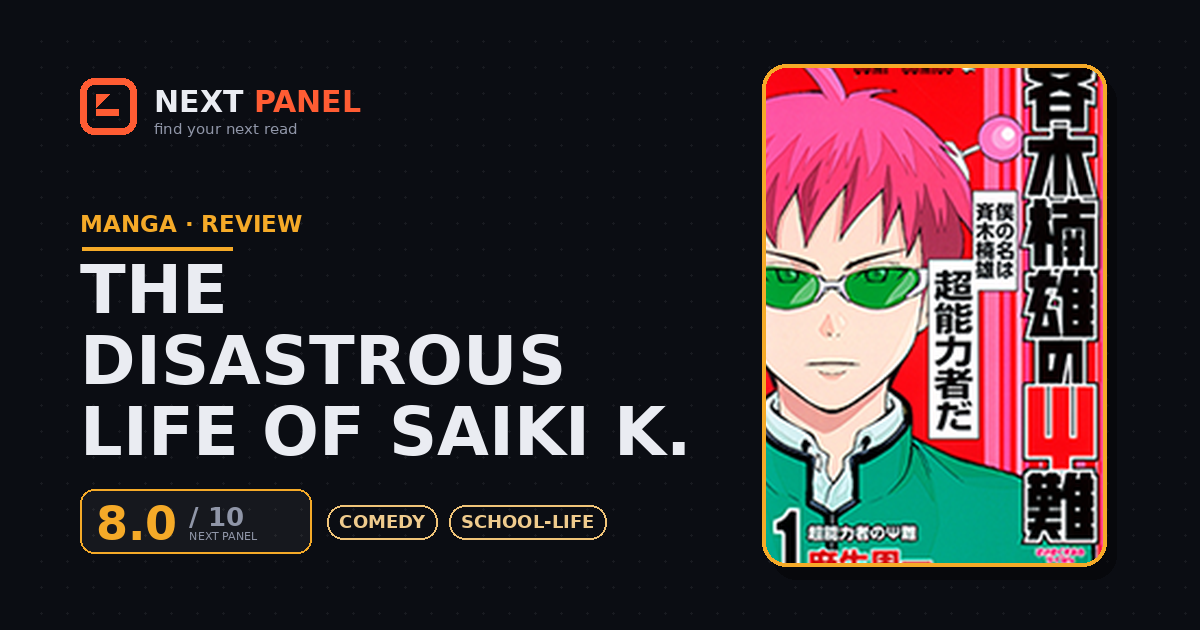
The Disastrous Life of Saiki K.
Deadpan, rapid-fire gag comedy that mines absurdity out of everyday situations.
Daily Lives of High School Boys
Plotless everyday comedy that turns dumb, ordinary moments into big bits.
Another absurd school comedy that starts cute and goes completely unhinged.
Where to Read Officially
| Platform | Format | Pricing | Region notes | Link |
|---|---|---|---|---|
| Vertical | Print & digital volumes | Paid | Region availability varies | Open |
Frequently Asked Questions
Do I need to watch the anime first?
No. The manga is the original and stands on its own. It's a collection of gags, so you can jump in anywhere without missing context.
Is there an official English release?
Yes. Vertical (Kodansha) publishes the manga in English in print and digital.
Is there an actual story?
Not really. It's a gag comedy built from short skits about a handful of students and a robot-girl household. The fun is the jokes, not a plot.