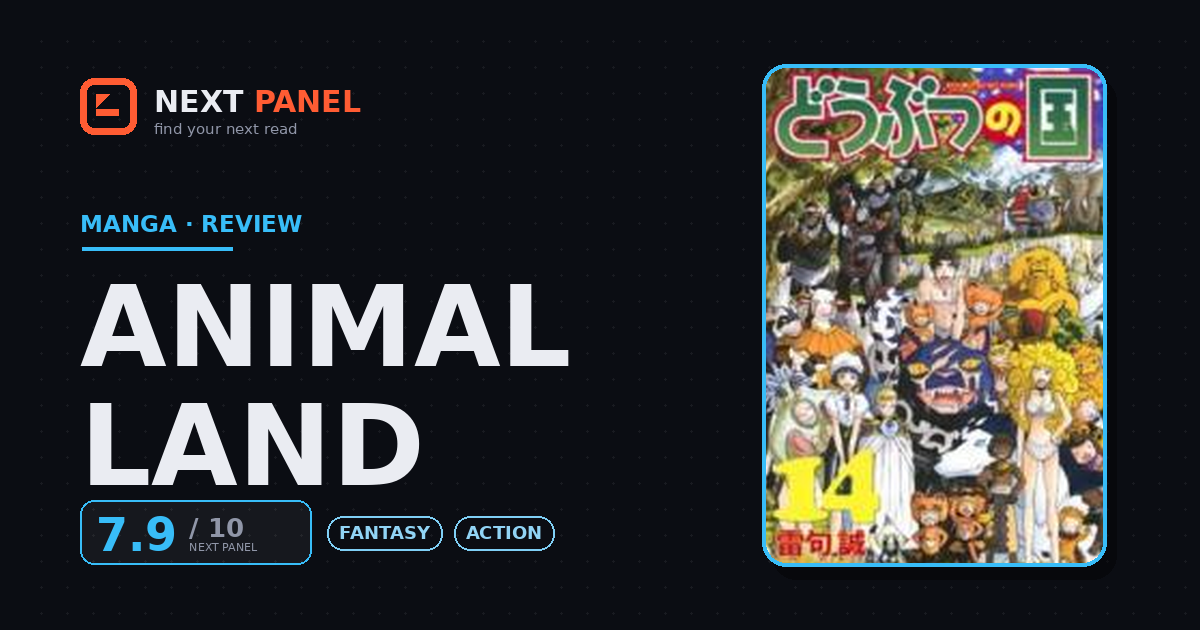
Is Animal Land Worth Reading? Review & Where to Read
Quick Answer
Yes, if you want a fantasy adventure that treats its found-family premise as seriously as its worldbuilding. It comes from the creator of Zatch Bell, and it's a more mature, more ambitious work than that pedigree might suggest.
Quick Verdict
“Every animal in this world has learned to fear humans on sight, which makes it a strange place to set a story about unconditional love -- and that friction is exactly what makes Animal Land work.”
Best for: Readers who want a found-family fantasy adventure with real emotional stakes and a fully thought-out animal-run world.
Not for: Readers who want a lighthearted, kid-focused story throughout -- this gets considerably darker and more complex as it goes.
- Type
- Manga
- Genres
- Fantasy, Action
- Status
- Completed
- This review
- Minor Spoilers
- Author
- Makoto Raiku
- Publisher
- Kodansha
- Platform
- Kodansha Comics
| Quick facts | |
|---|---|
| Format | Manga, 56 chapters, 14 volumes |
| Run | 2009–2014 · completed |
| Community score | AniList 7.7 |
| Where to read | Kodansha Comics — official |
Overview
In a world where humans have all but disappeared and every remaining animal species has learned, generation after generation, to fear and avoid them on sight, a tanuki named Monoko stumbles across something none of them are supposed to find: an abandoned human infant. She has no family of her own and every reason to leave the baby where it lies. She raises it anyway. Animal Land follows that decision outward, from a single act of unconditional care into a sprawling story about what the baby -- and the world around him -- grows into.
What it does well
The premise does real work instead of just being a cute hook. Setting the found-family story inside a world actively built to fear and reject humans gives Monoko's choice genuine narrative stakes -- she's not just being kind, she's defying the deepest instinct her entire species carries. Makoto Raiku backs that up with worldbuilding that takes animal society seriously: there's real internal logic to how different species organize, govern, and relate to the handful of remaining humans, rather than treating 'animals but sapient' as a surface-level gimmick.
What's most striking, especially if you know Raiku primarily from Zatch Bell, is how willing this manga is to get dark and morally complicated as its protagonist grows up. The story doesn't stay in its gentle, cute opening register -- it goes places that are genuinely heavy, and it earns the shift rather than lurching into it for shock value. That range is exactly why it picked up the Kodansha Manga Award for Children's Manga in 2013: the craft here is a clear step up in ambition from Raiku's earlier work.
Where it falls short
That same tonal range is a real adjustment for some readers. The gap between the gentler early volumes and the considerably darker later volumes is wide enough that anyone who came in expecting a consistently cute, all-ages adventure will feel the whiplash. The large cast of animal factions and surviving humans also means development isn't evenly distributed -- a handful of side characters and groups get noticeably thinner attention than the strong central bond between Monoko and the baby she raises.
Verdict
Animal Land takes a found-family premise and grounds it in a genuinely thought-out, actively hostile world, then has the nerve to let the story get as dark and complicated as that premise implies. It's not the lighthearted read its early chapters suggest, but the ambition and craft on display -- backed up by a real award to prove it wasn't just a fluke -- make it well worth the read.
Strengths & Weaknesses
Strengths
- Monoko's decision to raise an abandoned human baby in a world where humans are an object of instinctive fear gives the found-family premise real narrative stakes instead of just sentiment.
- The worldbuilding takes animal society seriously -- there's an actual internal logic to how different species interact, govern themselves, and relate to the surviving handful of humans.
- Makoto Raiku is willing to let the story get genuinely dark and morally complicated as the protagonist grows up, which gives it more range than its cute opening chapters suggest.
- It won the Kodansha Manga Award for a reason -- the craft is a clear step up from Raiku's earlier, more straightforwardly comedic work.
Weaknesses
- The tonal shift from the gentler early volumes to the darker later chapters is significant enough that some readers who came for the former will be caught off guard by the latter.
- A large ensemble of animal factions and human survivors means some characters get thinner development than the strong central Monoko/baby relationship.
Similar Titles
Similar interest in a fully realized animal society with real internal politics and tension.
Same willingness to let a strange premise get genuinely dark and morally complicated.
Where to Read Officially
| Platform | Format | Pricing | Region notes | Link |
|---|---|---|---|---|
| Kodansha Comics | Digital chapters & print volumes | Paid | Region availability varies | Open |
Frequently Asked Questions
Is this the same creator as Zatch Bell?
Yes, Makoto Raiku created both, though Animal Land is a more mature, darker work than Zatch Bell's shonen-comedy tone.
Is it appropriate for kids despite the cute art style?
The early volumes are gentler, but the story gets considerably darker and more morally complex as it goes -- it's best approached as an all-ages-to-teen read rather than strictly for young kids.
Is it finished?
Yes, it's a complete 14-volume series.