Is BEASTARS Worth Reading? Review & Where to Read
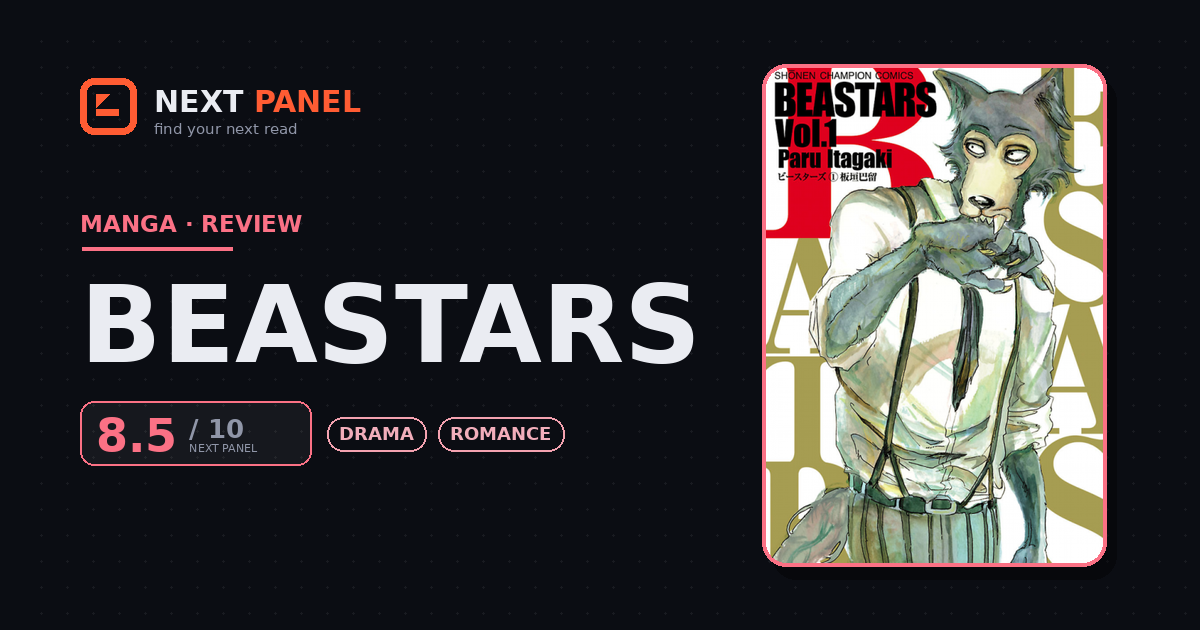
Quick Answer
Yes. BEASTARS uses its predator-prey premise as a genuine lens on desire, shame, and self-control rather than a gimmick, and it backs that up with some of the most distinctive art in modern manga.
Quick Verdict
“Talking-animal high school drama sounds like a hard sell for anything serious, but BEASTARS turns predator-and-prey biology into a real, uncomfortable metaphor for desire and repression, and commits to it completely.”
Best for: Readers who want a genuinely strange premise used to say something real about shame, attraction, and self-control, with standout art to match.
Not for: Readers who want a straightforward high school romance without an underlying layer of biological horror and social allegory.
- Type
- Manga
- Genres
- Romance, Drama
- Status
- Completed
- This review
- Minor Spoilers
- Author
- Paru Itagaki
- Publisher
- Akita Shoten
- Platform
- Viz
| Quick facts | |
|---|---|
| Format | Manga, 196 chapters, 22 volumes |
| Run | 2016–2020 · completed |
| Community score | AniList 8.1 · MangaUpdates 8.0 |
| Content | Violence, Mature Themes |
| Where to read | Viz — official |
Overview
In a society where carnivores and herbivores live together under an uneasy truce, Legoshi is a wolf, a member of his high school's drama club, quiet and self-conscious about the predatory instincts he works constantly to suppress. When he meets Haru, a small white rabbit with a reputation she didn't ask for, his feelings for her collide directly with everything he's been taught about controlling himself around prey. BEASTARS, by Paru Itagaki, ran in Weekly Shonen Champion from 2016 to 2020 and won the 2018 Manga Taisho Award.
What it does well
BEASTARS could have played its premise for cute animal-crossing gimmicks, but instead it takes the biology completely seriously, and that commitment is what makes the series work. Legoshi's attraction to Haru is tangled up with real fear of his own instincts — the possibility that wanting her could mean wanting to hurt her — and the manga treats that tension as genuinely frightening rather than glossing over it. It's an unusual, uncomfortable way to talk about desire and self-control, and BEASTARS commits to it fully instead of softening it for easier reading.
Itagaki's art carries a huge amount of that weight. Her character designs are sharp and slightly off in a way that keeps the animal cast feeling genuinely alien rather than cute, and her sense of layout and page composition is some of the most distinctive in modern shonen manga. The supporting cast helps too — Louis, the ambitious deer struggling with his own status anxieties, and Juno, direct and unwilling to play the passive love interest, both get enough space to feel like they're carrying their own stories rather than just orbiting Legoshi.
Where it falls short
The central metaphor is intense by design, and that's not going to land for every reader — the show doesn't flinch from the uncomfortable overlap between hunger and desire, and some scenes sit right at the edge of what a squeamish reader will want to engage with. Later arcs widen the story's scope in ways that occasionally dilute the tighter, more claustrophobic focus of the earlier volumes, and the worldbuilding raises social and biological questions about this society that the manga doesn't always follow through on completely.
Verdict
BEASTARS takes a premise that could have been a gimmick and turns it into something genuinely strange and affecting. If you're open to a story willing to sit in real discomfort to say something true, it's one of the more distinctive manga of the last decade.
Strengths & Weaknesses
Strengths
- The carnivore/herbivore premise is used as a real, sustained metaphor for desire and repression, not just a novelty hook for a high school drama.
- Itagaki's art is genuinely distinctive — sharp, angular character design and layouts that make the animal cast feel unsettling and alive rather than cute.
- Legoshi's arc, wrestling with his own predatory instincts alongside his feelings for Haru, gives the series real psychological depth underneath the premise.
- The wider cast — Louis, Juno, and the drama club members — get enough room that the world feels bigger than just its two leads.
Weaknesses
- The central metaphor is intense and occasionally uncomfortable by design, which won't sit well with every reader.
- Some later arcs widen the scope of the story in ways that dilute the tighter focus of the earlier volumes.
- The animal-society worldbuilding raises questions it doesn't always follow all the way through.
Similar Titles
different genre entirely, but shares Itagaki-adjacent commitment to distinctive, angular character art
similar interest in a central romance carrying real emotional and psychological weight
Where to Read Officially
| Platform | Format | Pricing | Region notes | Link |
|---|---|---|---|---|
| Viz | Print / digital volumes | Paid | Region availability varies | Open |
Frequently Asked Questions
Is BEASTARS finished?
Yes, it's completed at 22 volumes, serialized in Weekly Shonen Champion from 2016 to 2020.
Did BEASTARS win any awards?
Yes, it won the 2018 Manga Taisho Award, one of Japan's most prestigious manga prizes.
Is there an anime adaptation?
Yes, an anime adaptation streams on Netflix, though the manga's ending goes further than the anime covers.