Is Asadora! Worth Reading? Review & Where to Read
Quick Answer
Yes, if you trust Naoki Urasawa to turn a strange premise into a sprawling, character-driven epic -- because that's exactly what he does here. It's not Monster or 20th Century Boys, but it's built from the same careful, patient storytelling instincts.
Quick Verdict
“Urasawa spends his whole career proving that the biggest, strangest ideas land hardest when they're grounded in one overlooked kid's specific, ordinary life -- and Asadora! is that same trick, done again, still working.”
Best for: Readers who want a sprawling, decades-spanning historical drama built on Urasawa's patient, character-first style of storytelling.
Not for: Readers who want a tightly-paced single-arc story rather than a slow-building, multi-decade saga with real gaps between updates.
- Type
- Manga
- Genres
- Drama, Historical
- Status
- Ongoing
- This review
- Minor Spoilers
- Author
- Naoki Urasawa
- Publisher
- Shogakukan
- Platform
- VIZ Media
| Quick facts | |
|---|---|
| Format | Manga, 9 volumes |
| Run | 2018–present · ongoing |
| Community score | AniList 7.6 · MangaUpdates 7.2 |
| Where to read | VIZ Media — official |
Overview
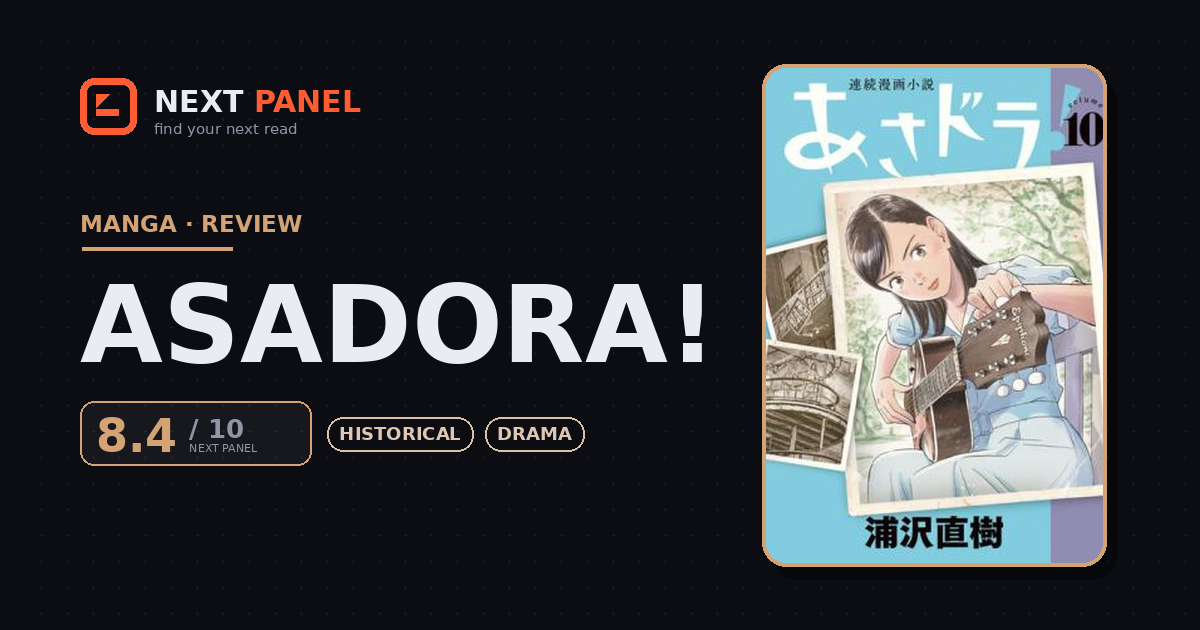
Asa Asakura has spent her whole childhood being forgotten. She's one of many children in a family too overwhelmed to notice her, and on the night her mother goes into labor yet again, nobody notices when she runs off into an approaching storm to find a doctor -- and nobody notices when she doesn't come back. What follows pulls her into an unlikely alliance with a burglar, a series of increasingly strange events across postwar Japan, and eventually something much larger and stranger than either of them expected: a story Naoki Urasawa builds, chapter by chapter, out of small, specific human moments.
What it does well
Asa is an excellent way into this story. Her defining trait -- being perpetually, infuriatingly overlooked -- gives her real motivation and real edge, and it means the escalating strangeness around her always has a grounded emotional throughline to follow. That's Urasawa's signature move across his career: take a huge, strange premise and root it in one specific, believable person's life, and Asadora! does that as confidently as anything else in his body of work.
The postwar Japan setting gets the same careful attention. Urasawa isn't using history as wallpaper here -- the period detail gives the story's more fantastical elements something concrete and textured to push against, which is a big part of why the tonal shifts between grounded drama and outright strangeness work as well as they do. It's serious, patient craft, and it's exactly the kind of ambitious plotting that earned the manga a Lucca Comics Award for Best Series rather than just riding on its creator's name.
Where it falls short
The honest downside here is real-world: this is a manga that has gone on genuine multi-month hiatuses during its run, so anyone picking it up expecting a steady release schedule should adjust expectations accordingly. The storytelling itself is also deliberately slow to reveal its hand -- Urasawa's patient, drip-fed approach to mystery is a strength for readers willing to sit with it, but it will frustrate anyone hoping for quick answers about where the story's stranger elements are actually headed.
Verdict
Asadora! is Urasawa doing what he does best: taking a big, strange hook and grounding it in a specific, compelling character's ordinary life until the extraordinary stuff actually lands. It's not as tightly wound as his most famous work, and the hiatuses are a real practical drawback, but the craft and patience on display make it well worth following, gaps and all.
Strengths & Weaknesses
Strengths
- Asa herself is a terrific lead -- resourceful and quietly furious at being overlooked her whole life, which gives the story's escalating strangeness a grounded emotional anchor.
- Urasawa's slow-build structure pays off here the same way it has in his best work: small, specific character moments early on keep paying dividends chapters and volumes later.
- The historical postwar Japan setting is rendered with real texture, giving the more fantastical elements something concrete to push against.
- It won the Lucca Comics Award for Best Series, recognition that reflects genuinely ambitious, confident plotting rather than just riding on Urasawa's reputation.
Weaknesses
- The series has gone on real, multi-month hiatuses during its run, so anyone reading as it's released should expect gaps rather than a steady schedule.
- Urasawa's slow-burn approach means the central mystery unfolds gradually -- readers wanting fast answers about the story's stranger elements will need patience.
Similar Titles
Pluto
Same Urasawa strength: turning a high-concept premise into a patient, character-driven mystery.
Similar sprawling, decades-spanning scope built around ordinary people swept into extraordinary events.
Vinland Saga
Same commitment to grounding a big historical canvas in specific, personal character arcs.
Where to Read Officially
| Platform | Format | Pricing | Region notes | Link |
|---|---|---|---|---|
| VIZ Media | Digital chapters & print volumes | Paid | Region availability varies | Open |
Frequently Asked Questions
Do I need to have read Urasawa's other manga first?
No -- Asadora! is a standalone story with its own cast and setting, unconnected to Monster, Pluto, or 20th Century Boys.
Has the series finished?
No, it's still ongoing and has had multiple hiatuses during serialization, most recently resuming in early 2026.
Is there a monster in this story?
Yes, a giant creature is central to the plot, though the manga treats it as one thread in a much larger, historically-grounded story rather than the entire point.