Is Ascendance of a Bookworm Worth Reading? Review & Where to Read
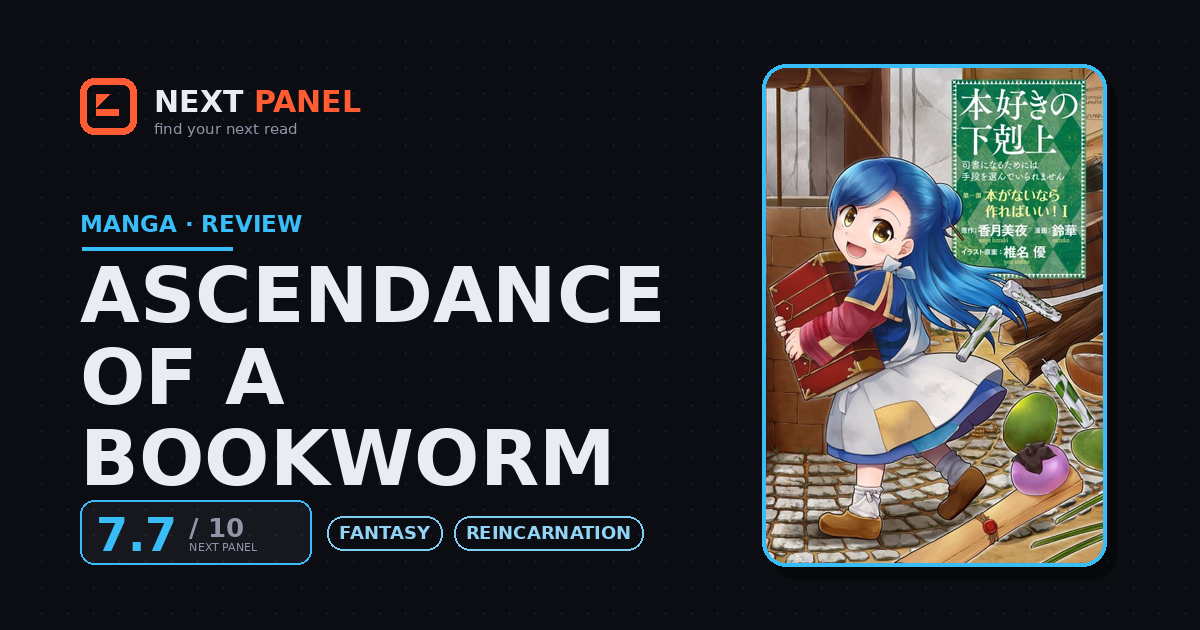
Quick Answer
Yes — if you want isekai built on infrastructure instead of combat, this is one of the best. A dying book lover claws her way toward printing presses through medieval-level poverty and constant physical setbacks. It's slow and detail-heavy by design, and the official manga adaptation is a faithful, easy way in.
Quick Verdict
“No sword, no magic-school power trip — just papermaking, guild politics, and one woman's obsessive, believable climb toward books. Patient readers get one of isekai's smartest premises.”
Best for: Readers who want a patient, detail-rich isekai about building an industry from nothing, not fighting monsters.
Not for: Readers who want fast pacing, combat, or a straightforward power fantasy.
- Type
- Manga
- Genres
- Fantasy, Reincarnation
- Status
- Ongoing
- This review
- Minor Spoilers
- Author
- Miya Kazuki
- Artist
- Suzuka
- Publisher
- TO Books
- Platform
- J-Novel Club
| Quick facts | |
|---|---|
| Format | Manga (shōjo), 42 chapters, 7 volumes |
| Run | 2015–2018 · ongoing |
| Community score | AniList 7.7 |
| Content | Depictions of chronic illness |
| Where to read | J-Novel Club — official |
Overview
A young woman who lived for books dies in an accident and wakes up as Myne, a sickly five-year-old in a poor family, in a world where books barely exist and what few there are cost a fortune. Rather than mourn her old life, Myne sets a goal: if there aren't books, she'll make them herself. That simple, stubborn decision drives everything that follows — papyrus experiments, clay tablets, papermaking, guild registration, and eventually a printing industry, all built from nothing by a girl whose body keeps failing her at the worst possible moments.
What it does well
The premise is what makes this stand out in a crowded genre. Most isekai protagonists get power fantasies — magic, swords, cheat skills. Myne gets a research problem: how do you reinvent industrial processes with medieval materials and zero budget? Watching her fail at papyrus, fail at clay tablets, and slowly work her way toward actual paper is oddly gripping, because the story treats the process seriously instead of skipping to the payoff.
Her illness, known as the Devouring, is the other smart choice. It's not a plot device that appears once for drama — it's a constant limiter that collapses plans, costs her consciousness at bad times, and forces her to solve problems around her own physical limits. That constraint gives the story real stakes even without combat.
The worldbuilding earns its density. Guild hierarchies, class boundaries, and the sheer social weight of literacy in a world without printing are all worked out with real specificity, and the story clearly wants you to understand how this economy functions, not just gesture at it. Suzuka's art keeps all of that legible — clean layouts, expressive character work, and a good eye for making mundane craft processes visually interesting.
Where it falls short
The pace asks for patience. Multiple early chapters are spent on Myne's papermaking failures before she gets anywhere close to success, and readers expecting isekai's usual momentum may find the opening stretch slow going.
Once the story moves into noble politics and magic systems later on, the information density spikes, and keeping track of factions, titles, and rules takes real attention. And because Myne carries a full adult's knowledge and drive into a child's body, her problem-solving sometimes outpaces the people around her in a way that can flatten tension — she's usually a step ahead, and the story knows it.
Verdict
Ascendance of a Bookworm succeeds by taking its own premise seriously: this is isekai as an industrial history project, carried by a heroine whose stubbornness and physical fragility both feel real. It's slower and denser than most of its genre, but if you want a fantasy about building something from nothing instead of fighting your way up, few series commit to that idea as fully as this one does.
Strengths & Weaknesses
Strengths
- The core hook is genuinely novel for isekai: instead of magic or combat, Myne's obsession is reinventing papermaking and printing from first principles in a world that has neither.
- Her physical frailty is a constant, real obstacle, not a throwaway detail — her illness derails plans and forces creative workarounds throughout.
- The worldbuilding is grounded and specific: guild politics, class boundaries, and the sheer cost of literacy in a pre-print society all feel researched rather than decorative.
- Suzuka's adaptation translates the novels' dense detail into clean, readable panels without losing the source's careful pacing.
Weaknesses
- The pace is genuinely slow — early volumes spend real time on failed material experiments before anything resembling paper exists.
- The larger political and magical systems introduced later take patience to track, and the info density picks up noticeably once nobility enters the story.
- Myne's modern-adult knowledge occasionally makes her problem-solving feel a step ahead of the people around her, which some readers find flattens the tension.
Similar Titles
Another gentle, low-stakes isekai more interested in daily life and craft than combat.
Slower, detail-focused fantasy that takes its world's mechanics as seriously as Bookworm takes its industries.
Mushoku Tensei: Jobless Reincarnation
Another isekai built around patient, methodical self-improvement rather than instant power.
Where to Read Officially
| Platform | Format | Pricing | Region notes | Link |
|---|---|---|---|---|
| J-Novel Club | Digital chapters | Paid | Region availability varies | Open |
Frequently Asked Questions
Is the Ascendance of a Bookworm manga finished?
No, it's ongoing. Multiple manga adaptations cover different parts of Miya Kazuki's original light novels, and new volumes are still being released and translated.
Do I need to read the light novels too?
No — the manga is a faithful, complete adaptation on its own. Some readers do move to the novels afterward for extra detail, but it's not required.
Is this the same story as the anime?
Yes, same source material. The manga and anime cover the same overall story, though the manga is the more complete, ongoing version as of now.