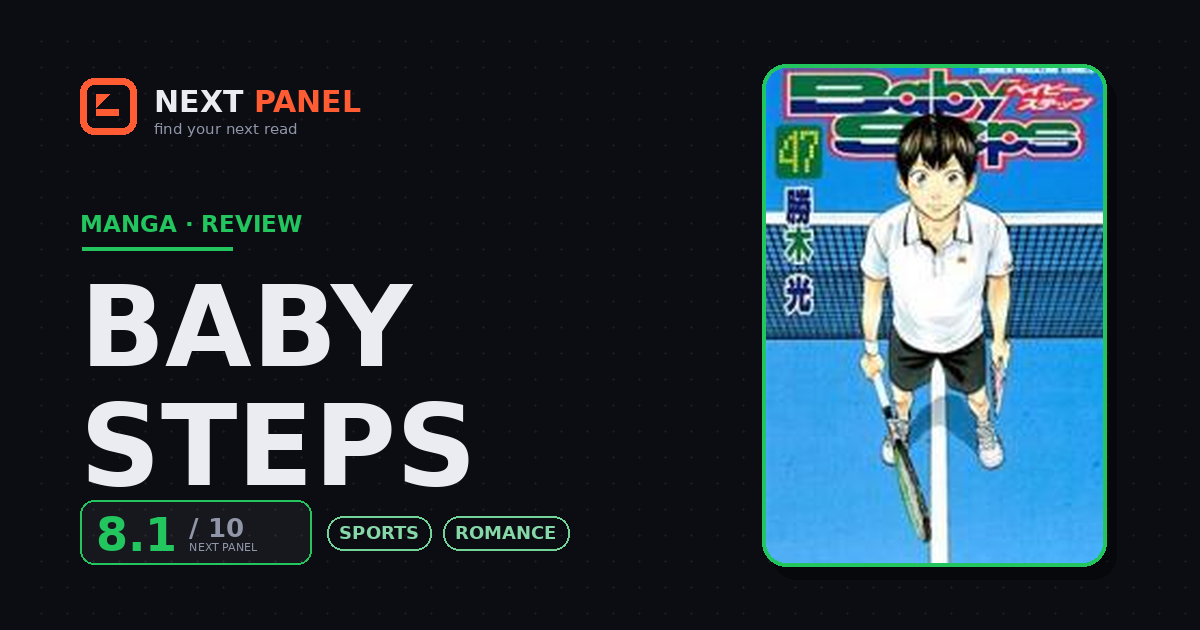
Is Baby Steps Worth Reading? Review & Where to Read
Quick Answer
Yes, especially if you want a sports manga about strategy and self-improvement rather than raw talent or superpowers. It's one of the most technically honest tennis stories out there.
Quick Verdict
“Nobody in this manga wins with a special move. They win because they out-thought and out-worked the guy across the net, and that's exactly the point.”
Best for: Readers who want a sports story built on strategy, note-taking, and incremental improvement instead of raw talent or flashy techniques.
Not for: Readers who want fast pacing or dramatic power-ups rather than a patient, methodical climb.
- Type
- Manga
- Genres
- Romance, Sports
- Status
- Completed
- This review
- Minor Spoilers
- Author
- Hikaru Katsuki
- Publisher
- Kodansha (Weekly Shōnen Magazine)
- Platform
- K MANGA
| Quick facts | |
|---|---|
| Format | Manga (shōnen), 464 chapters, 47 volumes |
| Run | 2007–2017 · completed |
| Community score | AniList 7.9 · MangaUpdates 8.6 |
| Where to read | K MANGA — official |
Overview
Ei-chan is the kind of student teachers point to as a role model — perfect notes, perfect attendance, zero wasted motion — and exactly the kind of person nobody expects to become a competitive athlete. When he picks up tennis almost by accident, he doesn't bring any natural talent to it. What he brings is the same obsessive, structured thinking that made him a straight-A student, and Baby Steps spends its (very long) run showing what happens when that mindset gets pointed at a sport most players approach on instinct.
The manga's whole identity comes from that mismatch. Ei-chan isn't the fastest or strongest player on any court he steps onto. He wins, when he wins, because he's done more homework than his opponent.
What it does well
The tennis itself is the best part, which isn't a given for a sports manga this long. Katsuki draws matches with real tactical logic — you can see the shot selection, the positioning, the exact reason a strategy is working or failing, rather than just an artist's impression of "impressive tennis." Ei-chan's notebooks aren't a gimmick either; his habit of logging opponents' tendencies and adjusting mid-match is the actual throughline of the series, and it makes every win feel like a puzzle solved rather than a plot convenience.
The supporting cast pulls their weight too. Natsu, the promising junior player who becomes his training partner, gets a real career and real stakes of her own instead of just existing to cheer Ei-chan on, and the parade of rivals each bring a genuinely different style and outlook to the court, so the matches don't blur together even after dozens of volumes.
Where it falls short
The patience that makes the tennis compelling is a real ask over 47 volumes. This isn't a manga that skips through training with a montage — it shows the work, match by match, adjustment by adjustment, and that pacing can feel like a slog if you're not fully bought into the format. By the later stretches, the rhythm of "study opponent, adjust strategy, win narrowly" repeats often enough that some arcs read more like confirmation of what you already know about Ei-chan than new ground.
It also asks for a real time commitment. This isn't a story you finish in a weekend, and its steady, unhurried tone won't suit everyone looking for a sports manga with more spectacle.
Verdict
Baby Steps is one of the smartest, most technically grounded sports manga out there — a story about winning through preparation and observation rather than talent or grit alone. If you want tennis (or any sport) treated like a genuine intellectual problem to solve, this delivers on a scale few other series attempt.
Strengths & Weaknesses
Strengths
- Ei-chan's whole method — meticulous notebooks, tracking his opponents' patterns, treating tennis like a subject to study — makes the sport genuinely interesting even if you've never watched a match.
- Matches are drawn with real tactical clarity: you can follow exactly why a shot works or fails, which is rare for a sports manga this long-running.
- The supporting cast of rivals and training partners each bring a different playstyle and philosophy, so matches stay varied instead of repeating the same dynamic.
- Natsu, his training partner and eventual love interest, gets her own real ambitions and career arc instead of existing only to support Ei-chan's story.
Weaknesses
- The methodical pacing that makes the tennis compelling also means the series can feel slow if you're used to sports manga that skip ahead through montages.
- 47 volumes is a long commitment, and the formula of match-analysis-adjustment repeats often enough that some stretches feel like a victory lap rather than new ground.
Similar Titles
Another sports story more interested in psychology and technique than spectacle.
Shares the same love of showing a competitor's internal thought process and strategy in real time.
Haikyuu!!
For readers who want the same disciplined-training ethos with a faster, more crowd-pleasing pace.
Where to Read Officially
| Platform | Format | Pricing | Region notes | Link |
|---|---|---|---|---|
| K MANGA | Digital chapters | Free + Paid | Region availability varies | Open |
Frequently Asked Questions
Is Baby Steps finished?
Yes, it ran for 47 volumes over a full decade and has a complete ending.
Do you need to like tennis to enjoy it?
No. The appeal is watching a methodical, unathletic kid reverse-engineer a sport through observation and note-taking — the tennis is the vehicle, not the requirement.
Where can I read Baby Steps in English?
Kodansha publishes it officially through K MANGA, its digital manga platform, with early chapters free and the rest available as you unlock them.