Is Ping Pong Worth Reading? Review & Where to Read
Quick Answer
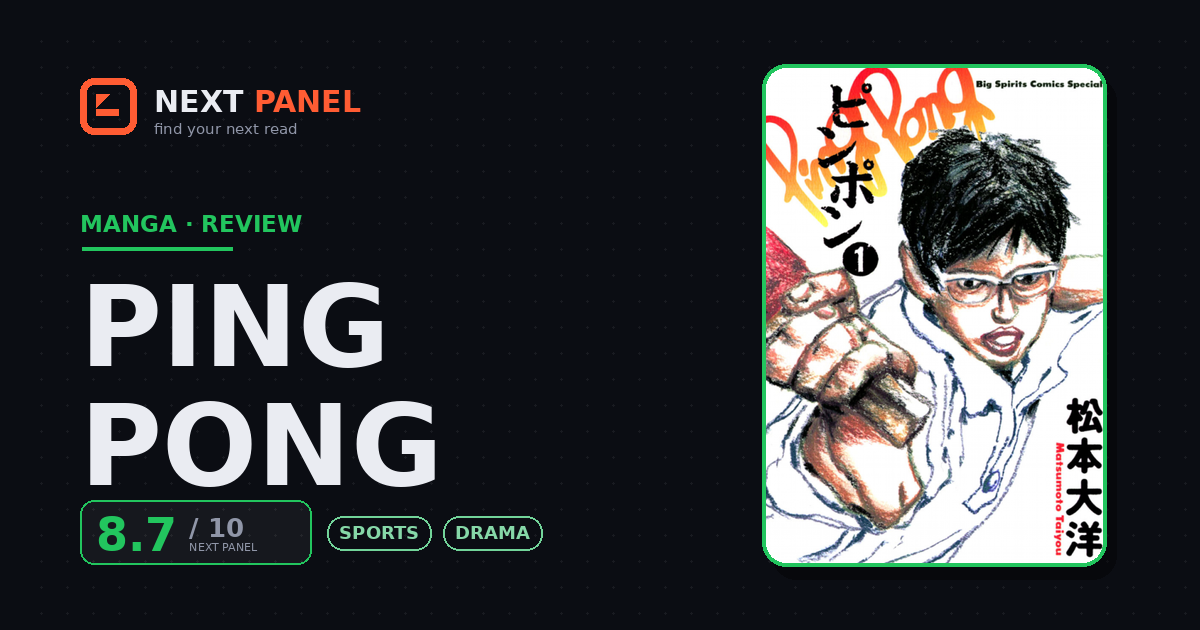
Yes — it's a classic, with one caveat about the art. Ping Pong uses high-school table tennis as a lens for a deeper story about talent, passion, and why people compete at all. Taiyo Matsumoto's rough, kinetic art is the whole personality of the book and an acquired taste, but the character writing is some of the best the sports genre has. At five volumes, it's tight and complete.
Quick Verdict
“Not really about table tennis — a sharp, soulful study of talent and why we play, in art that looks like nothing else (and won't be for everyone).”
Best for: Readers who want a soulful, character-first sports story told in a bold, expressive style.
Not for: Readers who want clean, conventional art, a long series, or by-the-numbers tournament spectacle.
- Type
- Manga
- Genres
- Drama, Sports
- Status
- Completed
- This review
- Minor Spoilers
- Author
- Taiyo Matsumoto
- Publisher
- Shogakukan (Viz Media, EN)
- Platform
- VIZ
| Quick facts | |
|---|---|
| Format | Manga, 55 chapters, 5 volumes |
| Run | 1996–1997 · completed |
| Community score | AniList 8.5 · MAL 6.0 · MangaUpdates 8.3 |
| Where to read | VIZ — official |
Overview
Ping Pong is a seinen sports manga by Taiyo Matsumoto, serialized in the mid-1990s and complete in five volumes. On the surface it's about high-school table tennis; underneath, it's a character study about talent, motivation, and why people compete at all. It follows two childhood friends — Makoto 'Smile' Tsukimoto, a gifted but detached player who holds himself back, and Yutaka 'Peco' Hoshino, a cocky natural who's coasted on ability — as they and a handful of rivals are pushed toward what each of them actually wants from the game. Viz publishes it in English in collected editions, and Masaaki Yuasa adapted it into an acclaimed 2014 anime.
What it does well
This is a character piece first and a sports manga second, and that's its great strength. Every major player — not just the two leads — gets a real interior life: a reason they picked up a paddle, a fear, a thing they're chasing or running from. By the time the matches arrive, they aren't about points; they're about whether someone will find joy in the game again, or admit what they're not, or finally try. That makes the table-tennis scenes hit far harder than a standard win-the-tournament arc.
Matsumoto's art is the other half of the magic. It's rough, sketchy, and kinetic — nothing like clean mainstream linework — and it's astonishing at conveying speed and motion. A rally in Ping Pong feels faster and more alive than the same scene would in a slicker style, and the expressive figures carry enormous emotion. It's a book that looks the way its themes feel.
It's also tight: five volumes, no filler, every chapter pulling toward a genuinely moving payoff. For all its depth, it never overstays, and the ending lands the themes it's been building with real grace.
Where it falls short
The art is the honest catch. Matsumoto's style is a true acquired taste, and readers who come in expecting polished, conventional manga linework can bounce off it hard — it asks you to meet it on its terms. If that's a dealbreaker, this won't change your mind.
It's also dense and quick. The story moves fast and trusts you to keep up, so it rewards close reading more than a casual skim. And because it's a focused character study rather than a sprawling sports epic, anyone hoping for a big roster of techniques or long tournament spectacle should look elsewhere.
Verdict
Ping Pong is one of the genre's true classics, and it earns it — a soulful, beautifully observed story about talent and why we play, told in art that looks like nothing else. The style won't be for everyone, and it's short and dense by design, but if you want a sports manga that's really about people, there are few better. Meet the art halfway and it's unforgettable.
Strengths & Weaknesses
Strengths
- It's a character study first: every major player gets a real interior life, so the matches carry genuine emotional stakes instead of just points.
- Matsumoto's art is wildly expressive and kinetic — the table-tennis sequences convey speed and motion better than far slicker styles.
- It's tight and complete at five volumes, with no filler and a genuinely moving payoff.
- The themes — talent versus effort, joy versus pressure — land with rare honesty for a sports manga.
Weaknesses
- Matsumoto's rough, sketchy art is a true acquired taste, and readers expecting clean, conventional linework may bounce off it.
- It's dense and moves fast, so it rewards close reading more than a casual skim.
- It's short and character-focused, so anyone wanting drawn-out tournament spectacle or a big roster of techniques won't find it here.
Similar Titles
A sports classic with heart, if you want another genre cornerstone.
Another artful, character-deep manga about mastery and motivation (also gorgeously drawn).
A seinen about talent, effort, and passion, just pointed at art instead of sport.
Where to Read Officially
| Platform | Format | Pricing | Region notes | Link |
|---|---|---|---|---|
| VIZ | Print & digital volumes | Paid | Region availability varies | Open |
Frequently Asked Questions
Do I need to like table tennis to enjoy Ping Pong?
Not at all. The sport is really a vehicle for a story about talent and motivation, so it works even if you've never picked up a paddle.
Is the manga or the anime better?
Both are excellent. Masaaki Yuasa's 2014 anime is a faithful, acclaimed adaptation, but the manga is the original and well worth it for Matsumoto's art.
Where can I read it officially?
Viz publishes Ping Pong in English in collected editions.