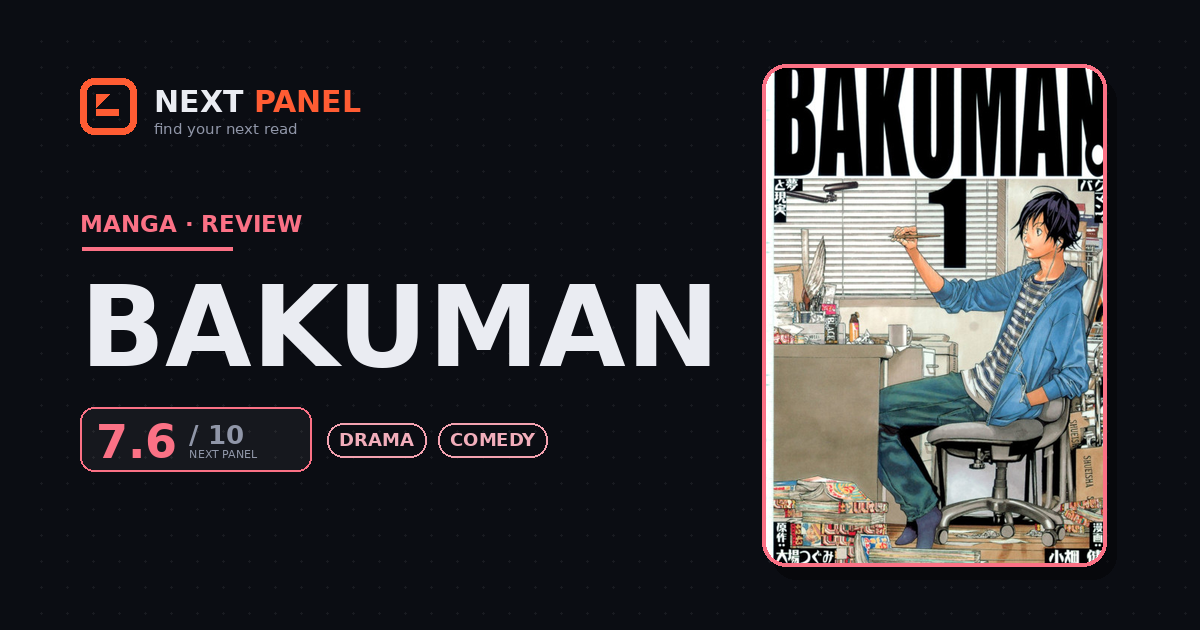
Is Bakuman Worth Reading? Review & Where to Read
Quick Answer
Yes, especially if you love manga. Bakuman's behind-the-scenes look at the industry is fascinating and motivating, and the craft is top-notch. The big catch is a frustrating, passive central romance.
Quick Verdict
“From the Death Note team, a fascinating and motivating look inside the manga industry — essential for manga fans, even with a frustrating romance and some dated attitudes.”
Best for: Readers fascinated by how manga gets made who want an inspiring industry drama.
Not for: Readers who want a strong romance, action, or a story without dated attitudes.
- Type
- Manga
- Genres
- Drama, Comedy
- Status
- Completed
- This review
- Minor Spoilers
- Author
- Tsugumi Ohba
- Artist
- Takeshi Obata
- Publisher
- VIZ Media
- Platform
- VIZ
| Quick facts | |
|---|---|
| Format | Manga (shōnen), 176 chapters, 20 volumes |
| Run | 2008–2012 · completed |
| Community score | AniList 8.1 · MAL 8.4 · MangaUpdates 8.5 |
| Where to read | VIZ — official |
Overview
Bakuman is a manga about making manga, from the Death Note team of writer Tsugumi Ohba and artist Takeshi Obata. Moritaka Mashiro, a gifted artist, teams up with Akito Takagi, a sharp writer, to chase an improbable dream: getting serialized in Weekly Shonen Jump and becoming top creators. It's a behind-the-scenes look at the brutal, fascinating manga industry, the editors, deadlines, reader rankings, rivalries, and grind of trying to make it, wrapped around the boys' friendship and Mashiro's long-distance romance with aspiring voice actress Miho Azuki. For anyone curious how manga actually gets made, it's catnip, and it's complete.
What it does well
The industry stuff is the real draw, and it's genuinely fascinating. Bakuman walks you through how serialization, editors, and the ruthless ranking system work, and it makes that process tense and motivating rather than dry. You come away understanding the medium far better, and oddly inspired.
It's also a polished package. This is the Death Note team, and Obata's art plus Ohba's sharp, structured writing give it real craft. The competition, chasing serialization, surviving the rankings, racing rivals, generates specific, high-stakes drama that a vaguer "follow your dreams" story never could.
The supporting cast helps a lot. The rival creators, especially the eccentric geniuses the boys measure themselves against, are highlights, and the sheer passion for the craft running through the whole thing is infectious. When it's about the work — the late nights, the do-or-die ranking results, the thrill of a chapter landing — it sings.
Where it falls short
The romance is the glaring weak point. Mashiro and Azuki agree to chase their dreams separately and not even meet again until both succeed, then marry, a premise that's passive, frustrating, and leaves Azuki badly underdeveloped as a character. It drags down every stretch it dominates.
Some of the gender attitudes feel dated, too, and the structure gets repetitive: new series, ranking battle, cancellation or hit, repeat. Across twenty volumes that cycle can wear, and your mileage depends on how much the industry fascination carries you past the softer romance.
Verdict
Bakuman is close to essential for manga fans, purely for its insider look at how the medium gets made and the craft of the team behind it. Go in for the industry drama, the rivalries, and the infectious passion rather than the love story, which is its real weakness. If you want a strong romance or aren't drawn to the meta angle, it'll frustrate you. But if you've ever wondered how your favorite series got made, few things scratch that itch better, and it's complete.
Strengths & Weaknesses
Strengths
- Its detailed, behind-the-scenes look at the manga industry is fascinating, informative, and genuinely motivating.
- It's made by the Death Note team, and Obata's art plus Ohba's sharp writing give it real polish.
- The underdog-chasing-serialization tension — rankings, deadlines, rivals — is compelling and specific.
- The rival creators are a highlight, and the passion for the craft is infectious.
Weaknesses
- The central romance is a real weak point: the 'succeed first, marry later, don't even meet until then' setup is passive and frustrating, and Azuki is underdeveloped.
- Some of the gender attitudes feel dated.
- The cycle of new series, ranking battle, and cancellation repeats, which can drag.
Similar Titles
The same creative team's masterpiece, a far darker and tenser thriller.
Another story about young people pouring themselves into a creative pursuit.
Another story about driven young people obsessively chasing the top of their field.
Where to Read Officially
| Platform | Format | Pricing | Region notes | Link |
|---|---|---|---|---|
| VIZ | Print & digital volumes | Free + Paid | Region availability varies | Open |
Frequently Asked Questions
Do I need to know about the manga industry?
No, explaining it is half the appeal. Bakuman walks you through how serialization, editors, and rankings work, which is a big part of what makes it interesting.
Is it finished?
Yes, it's complete in 20 volumes, so you can read the whole story.
Is the romance good?
It's the most divisive part. The long-distance, succeed-before-we're-together premise frustrates a lot of readers. Go in for the industry drama and friendship more than the love story.