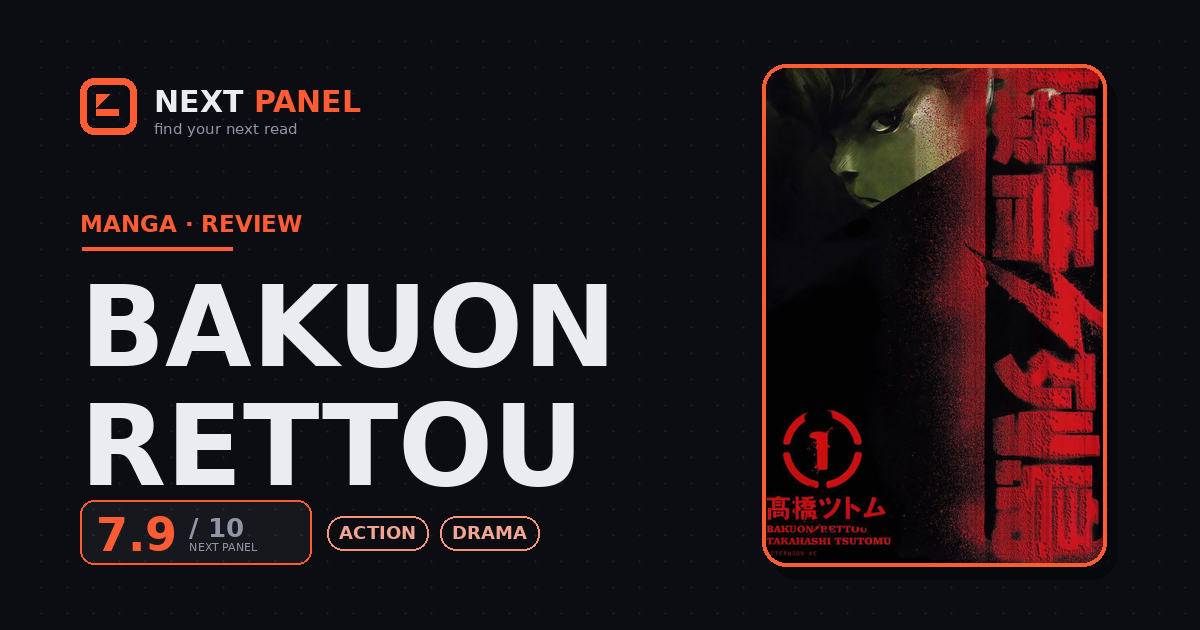
Is Bakuon Rettou Worth Reading? Review & Where to Read
Quick Answer
Worth reading if you want a slower, character-driven gang drama with real emotional weight behind the violence.
Quick Verdict
“Worth it for a gang drama that earns its tragedy, patience required for the deliberate pacing and thick cast.”
Best for: Readers who want a slow-burn, character-driven gang drama with real emotional stakes and lived-in 1980s bike culture.
Not for: Readers who want fast plot momentum, an easy entry point with minimal cast to track, and an official English release.
- Type
- Manga
- Genres
- Drama, Action
- Status
- Completed
- Author
- Tsutomu Takahashi
- Publisher
- Kodansha
| Quick facts | |
|---|---|
| Format | Manga, 105 chapters, 18 volumes |
| Run | 2002–2012 · completed |
| Community score | AniList 8.2 · MangaUpdates 7.8 |
Overview
"Bakuon Rettou" follows Takashi Kaze, a teenager whose parents move him to a quiet part of Tokyo in the 1980s hoping to keep him away from bad influences. It doesn't work. Takashi falls in with a new crowd almost immediately, gets pulled into a motorcycle rally, and ends up joining a biker gang. From there the manga settles into his years running with that gang: the rivalries, the loyalty, the friendships that don't survive the lifestyle, and the slow realization that the freedom of the open road comes with a body count. Author Tsutomu Takahashi has said this one draws on his own past, and that autobiographical weight shows in how lived-in the whole thing feels.
What it does well
This is a gang manga more interested in what the lifestyle costs than in how cool it looks, though it doesn't skimp on the cool parts either. The bike culture is rendered with real specificity, not just macho posturing, and the friendships inside Takashi's gang carry actual weight because Takahashi takes the time to make each member a person before putting them in danger. When people get hurt or die, and this manga isn't shy about that, it lands instead of feeling like shock value. The art has a rough, sketchy energy that fits the setting perfectly, all speed lines and scarred faces, and it ages well instead of feeling dated for being a product of the early 2000s. It's also refreshingly unsentimental about nostalgia: this isn't a rose-tinted look back at youth, it's clear-eyed about how reckless and destructive that era actually was, and about how easily loyalty curdles into obligation once people start getting hurt.
Where it falls short
The pacing is slow by modern shonen standards, this is a seinen character study first and a plot-driven story second, so readers looking for constant momentum may find some stretches sluggish, especially in the early volumes before the gang's internal politics start driving the plot. The cast is large and the Japanese biker-gang terminology and hierarchy takes a chapter or two to get comfortable with if you're not already familiar with bosozoku culture, and a few side characters blur together before their personalities separate out. And because it's a 2000s seinen title that never picked up an English publisher, you're reading it through scanlations, which means inconsistent translation quality depending on which chapters you land on.
Verdict
If you want a gang drama that treats its violence and its friendships with equal seriousness, and you don't need constant plot momentum to stay engaged, this is one of the better entries in the genre and it's criminally under-read. It rewards the patience it asks for.
Strengths & Weaknesses
Strengths
- Treats the human cost of gang life seriously instead of glamorizing it
- Deep, specific bike culture rendered with real authenticity
- Large cast of gang members who feel like real people before tragedy hits
- Rough, expressive art that suits the setting and hasn't aged badly
Weaknesses
- Slow, deliberate pacing compared to modern shonen gang stories
- Large cast and bosozoku terminology take time to get comfortable with
- No official English release, so translation quality varies by scanlation
- Semi-autobiographical tone means less plot escalation than genre fans might expect
Similar Titles
Same delinquent-gang genre with a similarly unglamorous take on violence and loyalty
A more modern, faster-paced gang drama for an easier entry point into the genre
Frequently Asked Questions
Is there an official English release?
No, as of this review there's no official English license. It's only available through scanlations.
Is this based on a true story?
The author, Tsutomu Takahashi, has described it as drawing heavily on his own youth in a motorcycle gang, so it's semi-autobiographical rather than a strict memoir.
Is the series complete?
Yes, it ran for 105 chapters across 18 volumes and is fully finished.
Do I need to know bosozoku (biker gang) culture going in?
No, but expect a chapter or two of adjustment to the terminology and gang hierarchy before it clicks.