Is Crows Worth Reading? Review & Where to Read
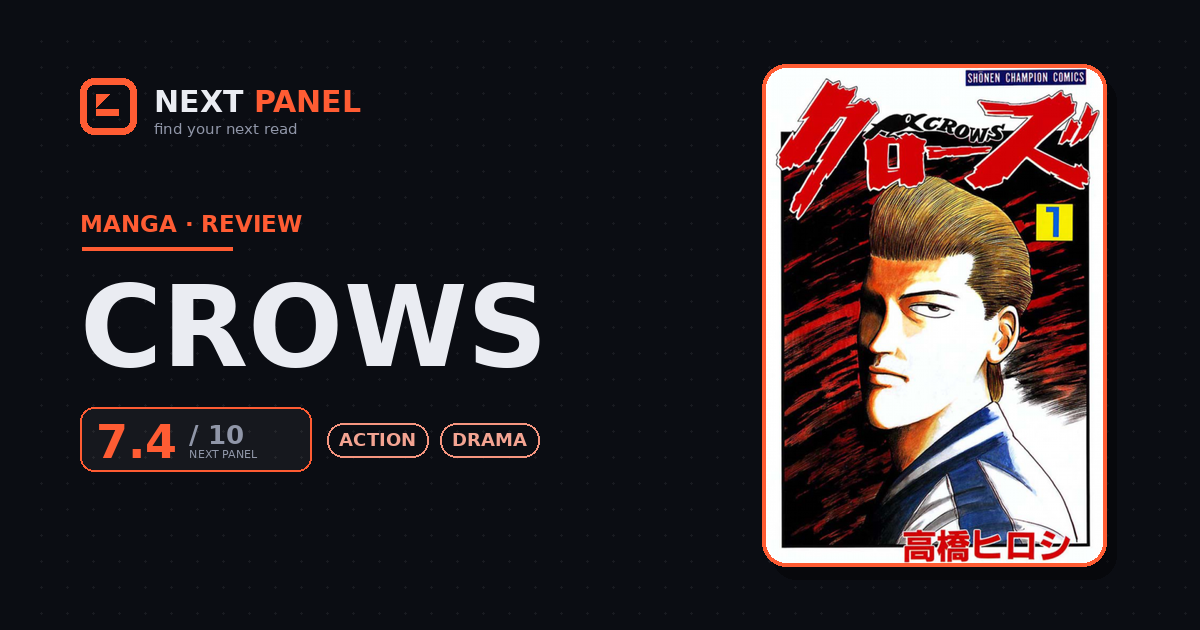
Quick Answer
If you want the real ancestor of every delinquent-school manga that followed, yes — it's rough around the edges but the fights and the camaraderie still land.
Quick Verdict
“Loud, simple, and completely sincere about what it's selling: guys who'd die for each other over a school that isn't worth dying for.”
Best for: Readers who want a straightforward delinquent brawler built on loyalty and turf, not subtlety.
Not for: Readers who want a tight plot, deep characterization, or consequences that stick.
- Type
- Manga
- Genres
- Drama, Action
- Status
- Completed
- This review
- Minor Spoilers
- Author
- Hiroshi Takahashi
- Publisher
- Akita Shoten
| Quick facts | |
|---|---|
| Format | Manga (shōnen), 101 chapters, 26 volumes |
| Run | 1990–1998 · completed |
| Community score | AniList 8.0 · MAL 8.2 · MangaUpdates 8.2 |
Overview
Crows is the manga that basically invented the modern delinquent-school genre, and it's worth reading as much for that lineage as for the story itself. Harumichi Bouya transfers into Suzuran High School, a legendary dumping ground for delinquents so notorious that its students are nicknamed "Crows" for the black uniforms and the reputation that comes with them. Bouya isn't looking to fight anyone — he just wants friends — but Suzuran doesn't really allow for neutral parties. He's quickly pulled into the orbit of Hiromi Kirishima's crew, who are gunning for the reigning school boss, Hideto Bandou, and from there the book sprawls outward into turf wars with rival schools like Housen Academy and outside biker gangs.
It's Hiroshi Takahashi's first major series, and you can feel him building the template — the rankings, the rival schools, the code of honor among thugs — that dozens of manga after it would borrow wholesale.
What it does well
The fights are the main event, and they're genuinely good: heavy, physical, and drawn with a real sense of impact rather than choreographed spectacle. Nobody in Crows has a special move or a power system. It's fists, numbers, and who's willing to take the most damage to win, and Takahashi stages it with a clarity that a lot of later imitators lost.
Suzuran itself is the other draw. It has its own internal hierarchy, its own history of who beat whom and why it still matters, and a real sense of place that makes the school feel lived-in rather than generic. That groundwork is why the setting spun off a sequel, spin-offs, and live-action films — there's an actual world here, not just a stage for fights.
And underneath all the posturing, the book takes its loyalty seriously. Bouya's slow acceptance by guys who have no reason to trust an outsider, and the way the crew closes ranks around each other regardless of the odds, gives the violence an emotional core that keeps it from feeling empty.
Where it falls short
The cast is huge, and Takahashi doesn't always slow down to make sure you can tell everyone apart, especially once rival schools start piling on named characters of their own. If you're not tracking who's who, entire fight arcs can start to blur.
Structurally, this is not a manga with much plot beyond escalating conflicts over pride and territory — there's no larger mystery or goal, just the next school that needs to be put in its place. And being an early-'90s shōnen champion series, the art in the first several volumes is noticeably rougher than the clean, confident linework Takahashi and his successors would later refine.
Verdict
Crows is a little unpolished by modern standards, but it's the real foundation for an entire genre, and the fights and the loyalty at its center still hit. If delinquent-school stories are your thing, this is where to start.
Strengths & Weaknesses
Strengths
- The fights are drawn with real weight and momentum, favoring brutal, grounded brawling over anything flashy or choreographed.
- Suzuran itself feels like a real place with its own history, factions, and pecking order, not just a backdrop for the next fight.
- Harumichi Bouya's arc from outsider to someone the school's toughest guys respect gives the sprawling cast a throughline to follow.
- The loyalty between characters who'd otherwise have no reason to like each other is played with more sincerity than the genre usually bothers with.
Weaknesses
- The cast is enormous and a lot of names and faces blur together, especially across rival schools introduced in later volumes.
- The plot is really just a string of escalating fights strung on turf and pride; don't expect much beyond that.
- Takahashi's early art is rougher than what the genre's later, more polished successors would deliver.
Similar Titles
Another foundational delinquent-school series, with more comedy mixed into the brawling.
A modern, plot-heavier take on the same delinquent-gang loyalty and turf-war dynamics.
Shares the same raw, physical fixation on fighting and toughness as the point of the story.
Frequently Asked Questions
Is Crows finished?
Yes. It ran in Monthly Shōnen Champion from 1990 to 1998 and is complete at 26 volumes.
Is there an English translation?
Not yet as of this review — Kodama Tales licensed Crows in June 2026 with an official English release planned for February 2027. No official English edition exists before then.
Is there a sequel?
Yes, Worst continues the story at Suzuran with a new cast, and there's also a Crows x Worst crossover era and several live-action Crows Zero films.