Is Bibliomania Worth Reading? Review & Where to Read
Quick Answer
Yes — it's a short, visually stunning psychological horror that reimagines Alice in Wonderland with real thematic teeth, though there's currently no official English translation.
Quick Verdict
“Twelve chapters is barely enough time to get attached to anyone here, and yet Bibliomania still lands its point about denial and self-delusion harder than manga three times its length manage.”
Best for: Readers who want a compact, visually striking psychological horror one-shot rather than a long-term series commitment.
Not for: Readers who want a large ensemble cast with room to develop, or a story with a longer runtime to settle into.
- Type
- Manga
- Genres
- Horror, Fantasy
- Status
- Completed
- This review
- Minor Spoilers
- Author
- Orval
- Artist
- Macchiro
- Publisher
- KAI-YOU
| Quick facts | |
|---|---|
| Format | Manga, 12 chapters, 1 volumes |
| Run | 2016–2018 · completed |
| Community score | AniList 7.8 · MangaUpdates 7.7 |
| Content | Body horror, disturbing imagery |
Overview
Alice wakes up in Room 431 of a manor she doesn't recognize, hosted by a talking serpent who explains the rules of her new existence: the further she strays from her room, the more her body decays. Bibliomania takes that premise and uses it as a literal engine for psychological horror, sending Alice through room after room, each one occupied by someone who's chosen to live inside a fantasy rather than face what's actually true about their life.
What it does well
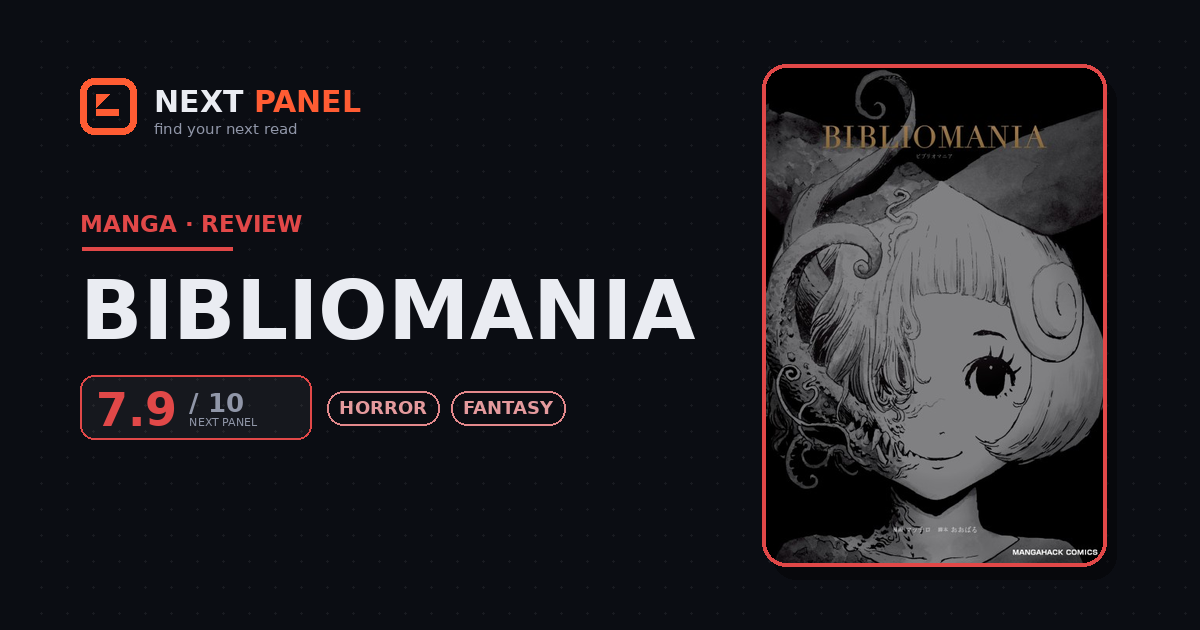
The hook here is visual before it's anything else. Macchiro's art is dense and unsettling in a way that rewards slowing down — every room Alice enters has its own visual logic, and the decay mechanic gives the artist a constant, literal way to show psychological damage on the page rather than just implying it. That's a smart trick for a horror story working with a limited page count: it doesn't need paragraphs of narration to communicate what's at stake, because the body itself is doing the talking.
The room-by-room structure works almost like a set of linked short stories, each one built around a different flavor of denial or self-delusion. It's an efficient way to cover a lot of thematic ground in twelve chapters, and it keeps a story this short from feeling thin — every stop along the manor adds another angle on the same central idea instead of just repeating it. And the ending actually earns its reveal, tying the manor's rules and Alice's own situation together in a way that recontextualizes what came before rather than just cutting to black.
Where it falls short
The tradeoff for that efficiency is depth of character. Twelve chapters is not a lot of time, and while Alice herself gets real development, most of the manor's other occupants function more as vivid ideas than as people you get attached to. If you're looking for a horror story with room to sit with its cast, this isn't built for that.
The early chapters also move fast on establishing the manor's rules, and it can take a chapter or two to get comfortable with the internal logic before the story's rhythm clicks. And practically speaking, there's no official English translation yet — right now, reading it means tracking down a French, German, or Spanish print edition, or an unofficial scanlation.
Verdict
Bibliomania is a tight, visually striking psychological horror that gets more mileage out of twelve chapters than a lot of horror manga manage in fifty. If body horror as literal metaphor and a compact, complete story appeal to you, it's well worth seeking out even without an English release yet.
Strengths & Weaknesses
Strengths
- Macchiro's art is the immediate hook — dense, unsettling, and detailed enough to reward slowing down on nearly every page.
- The central conceit, a body that rots the further you stray from denial, is a genuinely clever, literal way to dramatize psychological horror rather than just describing it.
- Each room's occupant works almost like a self-contained short story about a different flavor of self-delusion, which keeps a short page count feeling dense rather than thin.
- The ending pulls its threads together in a way that reframes what came before instead of just stopping.
Weaknesses
- Twelve chapters doesn't leave much room to get attached to anyone beyond Alice herself, so some of the room-by-room encounters land more as ideas than as characters.
- The pacing front-loads a lot of world rules quickly, and a reader adjusting to the manor's logic may need a chapter or two to get their footing.
- There's no official English release yet, so reading it currently means an import copy in French, German, or Spanish, or an unofficial translation.
Similar Titles
Uzumaki
similar body-horror-as-metaphor approach to psychological dread
same short, dense, visually driven horror format
if you want another dark fantasy that treats its horror premise as literal rather than metaphorical only
Frequently Asked Questions
Is Bibliomania in English?
Not officially yet — it's been published in French, German, and Spanish, but there's no official English edition at this time.
How long is it?
It's a compact, complete one-shot of about 330 pages across 12 chapters, so it's a quick, self-contained read.
Is it connected to the original Alice in Wonderland?
Only loosely — it borrows names and imagery from Lewis Carroll's story but tells its own dark, self-contained psychological horror narrative.