Is Billy Bat Worth Reading? Review & Where to Read
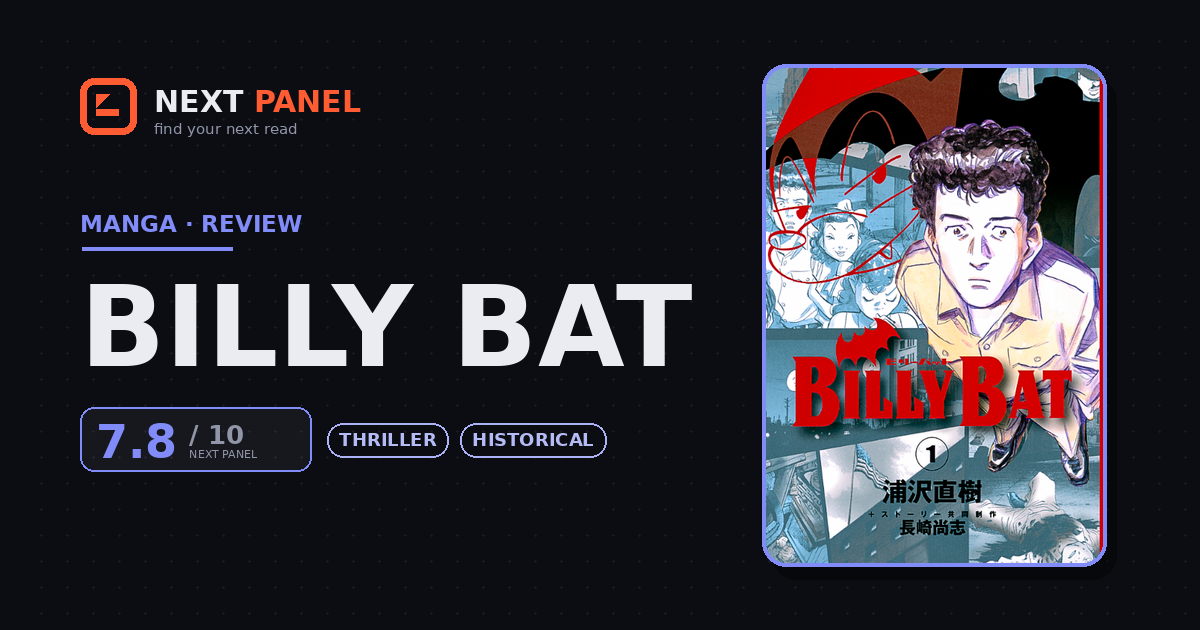
Quick Answer
Yes, if you like conspiracy thrillers — this is Urasawa at his most ambitious, hopping across decades with his usual craft. Know going in that it sprawls, and the ending answers in mood what some readers want answered in plot. With the English release finally underway, it's a good time to start.
Quick Verdict
“Nobody stages paranoia like Urasawa, and this is him swinging for the fences — just don't expect every mystery to pay off cleanly.”
Best for: Readers who want a big historical conspiracy thriller and enjoy trusting an author through slow-burn stretches.
Not for: Readers who want a tight plot, a small cast, and an ending that resolves every question.
- Type
- Manga
- Genres
- Thriller, Historical
- Status
- Completed
- This review
- Minor Spoilers
- Author
- Naoki Urasawa & Takashi Nagasaki
- Artist
- Naoki Urasawa
- Publisher
- Kodansha
- Platform
- Kana (Abrams ComicArts)
| Quick facts | |
|---|---|
| Format | Manga (seinen), 165 chapters, 20 volumes |
| Run | 2008–2016 · completed |
| Community score | AniList 8.5 · MangaUpdates 8.3 |
| Content | Violence, assassinations, wartime cruelty |
| Where to read | Kana (Abrams ComicArts) — official |
Overview
Kevin Yamagata has a good thing going. It's 1949, he's a Japanese-American cartoonist in Los Angeles, and his detective strip Billy Bat — a wisecracking bat working noir cases — is selling. Then a studio colleague mentions he might have seen the same bat in Japan years earlier. Kevin, honest to a fault, gets on a boat to check whether he accidentally stole his own character.
That small question — where did this image come from, and who does it belong to? — cracks open into one of the strangest, most ambitious thrillers in manga. The bat turns out to be much older than Kevin's strip, and it keeps surfacing: in scrolls, in murders, in the hands of people who hear it talk. The story follows cartoonists, assassins, priests, and true believers across the twentieth century, all circling the same drawing. Urasawa co-writes with his longtime collaborator Takashi Nagasaki, and it's the biggest swing either of them has taken.
What it does well
The craft, first. Urasawa draws faces that act — doubt, guilt, and false friendliness all read instantly, which matters in a story where you're constantly deciding who to trust. Every era looks specifically lived-in: postwar Los Angeles, occupied Tokyo, Dallas in the sixties. He can stage two people talking in a diner so it feels like a bomb is under the table. And his chapter endings still do the thing his readers know well: one final panel that makes you flip to the next chapter even though it's two in the morning.
The structure is the boldest part. Billy Bat jumps decades and swaps casts mid-arc, trusting you to keep up, and the trick is that it never stops feeling like one story. The bat image threads through everything, so each new era plays like another verse of the same song rather than a spin-off. When the story steers toward real historical events, the dread compounds — you know roughly what's coming, and the series uses that knowledge against you.
It's also smarter than it strictly needs to be. The strips-within-the-strip are drawn in their own vintage cartoon style and carry actual plot weight, and the whole series keeps worrying at real questions: who owns an image, what a story does once it leaves its author, why people will kill for a picture. By the middle stretch, the idea of a cartoon character as something genuinely dangerous stops feeling silly and starts feeling true.
Where it falls short
It sprawls, and not always productively. The cast balloons, a few era arcs are much weaker than the best ones, and there's a drifting stretch past the midpoint where new threads open faster than old ones close. You can feel the authors improvising at times, which is thrilling when it works and baggy when it doesn't.
Then there's the ending. Without spoiling anything: the series answers its biggest questions in mood and theme rather than plot mechanics. Some readers find the final volumes moving; plenty find them evasive. If you measure a mystery by how cleanly it resolves, this one will leave you annoyed. It's the main reason the series sits a notch below Monster in most people's Urasawa rankings, including mine.
Verdict
Billy Bat is a flawed giant — the most ambitious thing Urasawa has made, and the messiest. The highs are extraordinary: era-hopping suspense, gorgeous period cartooning, and a central idea strong enough to carry twenty volumes. The lows are real: sprawl, drift, and an ending that trades resolution for atmosphere. If you loved the generational paranoia of 20th Century Boys, this pushes the same muscles harder and further. Read it for the ride and the ideas, make peace with the landing before you start, and you'll get one of the most distinctive thrillers on the shelf — one that English readers can finally buy legally.
Strengths & Weaknesses
Strengths
- Urasawa's cartooning does the heavy lifting: faces act, quiet conversations play like countdowns, and every era — postwar Los Angeles, occupied Japan, 1960s Texas — looks specifically lived-in rather than generically old.
- The structure is genuinely daring. It jumps between decades and casts mid-arc, yet one image keeps threading everything together, so what could have been an anthology of history episodes reads as a single accelerating story.
- The comic-within-the-comic is more than a gimmick. The Billy Bat strips are drawn in their own period cartoon style, they're fun to read, and they carry real plot weight.
- It has ideas under the suspense — about authorship, about whether an image can belong to anyone, and about how a story outlives whoever drew it first.
Weaknesses
- It sprawls. The cast keeps growing, some era arcs land much harder than others, and there's a stretch past the midpoint where new threads open faster than old ones close.
- The ending is impressionistic. The biggest questions get answered in theme and mood rather than plot mechanics, which frustrates readers who want a firm solution.
- It withholds a lot for a long time — if you need steady payoffs, the slow burn can feel like stalling.
Similar Titles
Urasawa's other decades-spanning conspiracy — tighter emotionally, with the same childhood-secret engine.
His most controlled thriller, if you want the suspense without the historical sprawl.
Urasawa and Nagasaki again, doing a compact sci-fi mystery instead of a century-wide one.
Where to Read Officially
| Platform | Format | Pricing | Region notes | Link |
|---|---|---|---|---|
| Kana (Abrams ComicArts) | Print volumes (English release began June 2026) | Paid | Region availability varies | Open |
Frequently Asked Questions
Is Billy Bat available in English?
Yes, finally. Abrams ComicArts' Kana imprint began publishing it in June 2026 at a pace of about four volumes a year, with all 20 volumes planned.
Is Billy Bat finished?
Yes. It completed its run in Kodansha's Morning magazine and is finished at 20 volumes in Japan.
Do I need to read Urasawa's other manga first?
No. It's fully standalone. If anything, it's the biggest swing of the bunch, so some readers prefer starting with Monster or 20th Century Boys to see if his style clicks.