Is Black Jack Worth Reading? Review & Where to Read
Quick Answer
Yes, especially if you like episodic stories. Black Jack is a doctor drama built from short, self-contained cases, and the best of them are some of the most moving chapters Tezuka ever drew. The medicine is pure fantasy and the quality varies, but the heart is real.
Quick Verdict
“Episodic, melodramatic, often medically impossible — and still one of the most humane things in comics, because the doctor who drew it meant every word.”
Best for: Readers who like episodic stories with heart and a strong recurring lead they can dip in and out of.
Not for: Readers who want one continuous plot and up-to-date medical realism.
- Type
- Manga
- Genres
- Drama
- Status
- Completed
- This review
- Minor Spoilers
- Author
- Osamu Tezuka
- Publisher
- Akita Shoten
- Platform
- Vertical
| Quick facts | |
|---|---|
| Format | Manga (shōnen), 243 chapters, 25 volumes |
| Run | 1973–1983 · completed |
| Community score | AniList 8.1 · MAL 8.3 · MangaUpdates 8.4 |
| Content | Graphic surgery, medical content |
| Where to read | Vertical — official |
Overview
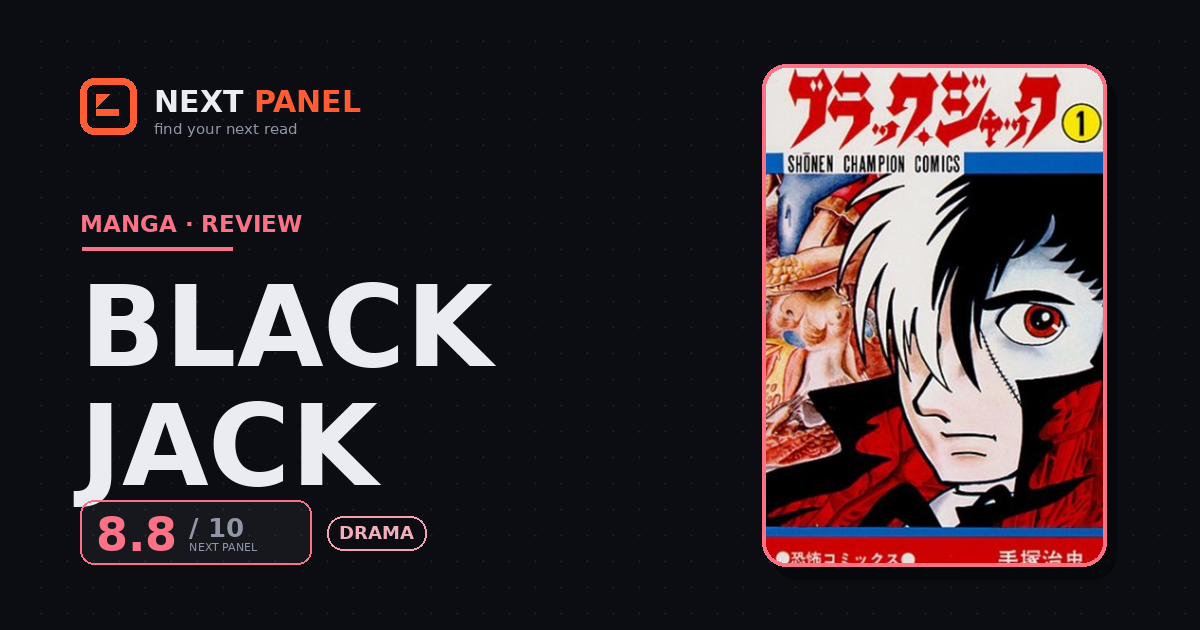
In 1973, Akita Shoten told Osamu Tezuka to draw whatever he wanted. What he wanted was Black Jack: a genius surgeon with a scarred face and no medical license, who charges outrageous fees and then, more often than not, does the impossible to save someone anyway. It ran for a decade in Weekly Shonen Champion and became one of Tezuka's most beloved works.
The format is simple. Each chapter is its own case. A patient, a problem, a fee, an operation, and a turn at the end that's usually about people rather than scalpels. There's a loose ongoing thread — Black Jack's past, his strange child-like assistant Pinoko, recurring rivals — but you don't need any of it to start.
What it does well
The episodic structure is the reason this still works fifty years on. Most chapters are tight and complete, so the series never sags under a giant plot. You can read one before bed or ten in an afternoon, and each one is built to pay off on its own. That makes it one of the easiest classic manga to actually get through.
Underneath the cases, Tezuka is asking real questions. He trained as a doctor, and Black Jack is where he uses that. Who deserves treatment? What is a life worth when someone can't pay? When is keeping a person alive the wrong call? The best chapters put Black Jack between bad options and let him — and you — sit in the discomfort. They hit harder than the melodramatic surface would lead you to expect.
And Black Jack is a genuinely good lead. The cold-rates-warm-heart setup could have gone stale fast, but Tezuka feeds you his history in small pieces and surrounds him with a strange, memorable supporting cast. He stays compelling for hundreds of chapters, which is not easy.
Where it falls short
The medicine is fantasy. This is 1970s drama, and Black Jack routinely performs operations that are flatly impossible. If you need clinical realism, this will drive you up the wall — you have to accept it as a vehicle for the emotional story, not a depiction of surgery.
It's also long and uneven. With well over two hundred stories, some are all-time greats and some are filler you'll forget by the next chapter. And Tezuka leans hard on melodrama; a few endings telegraph their twist, and the sentiment can get thick.
Verdict
Black Jack is a comfort-read classic with surprising depth. Take it as drama rather than medicine, accept that not every chapter is a winner, and you've got hundreds of short, sharp, often moving stories from one of the form's masters. It's an easy series to recommend precisely because you can start anywhere and feel its quality in a single sitting.
Strengths & Weaknesses
Strengths
- The episodic format is the whole strength. Most chapters are a tight, self-contained case with a beginning, middle, and gut-punch end, so you can read one or ten and it always pays off.
- Tezuka trained as a doctor, and it shows. The questions under each case — who deserves care, what a life is worth, when to let someone go — land harder than the melodrama on the surface suggests.
- Black Jack himself carries it. The cold fees and secret soft heart could be a cliche, but his backstory comes out a piece at a time, so he stays interesting across hundreds of chapters.
Weaknesses
- The medicine is 1970s and frequently impossible — miracle operations no surgeon could ever do. You have to read it as drama, not realism.
- Across 200-plus stories the quality swings. Some chapters are stone classics, others are clearly filler.
- The melodrama can get heavy-handed, and a few of the last-page twists you'll see coming a mile off.
Similar Titles
Where to Read Officially
| Platform | Format | Pricing | Region notes | Link |
|---|---|---|---|---|
| Vertical | Print & digital volumes | Paid | Region availability varies | Open |
Frequently Asked Questions
Do I need to read Black Jack in order?
No. It's episodic, so you can start almost anywhere. Reading in order just lets Black Jack's backstory and the recurring characters build up naturally.
Is the medicine realistic?
Not really. It's 1970s medical drama with plenty of impossible operations. The emotional and ethical questions are the real point, not the surgery itself.
Where can I read Black Jack in English?
Vertical published all 17 volumes. They're out of print in paperback but available digitally; the publisher's page is the place to start.