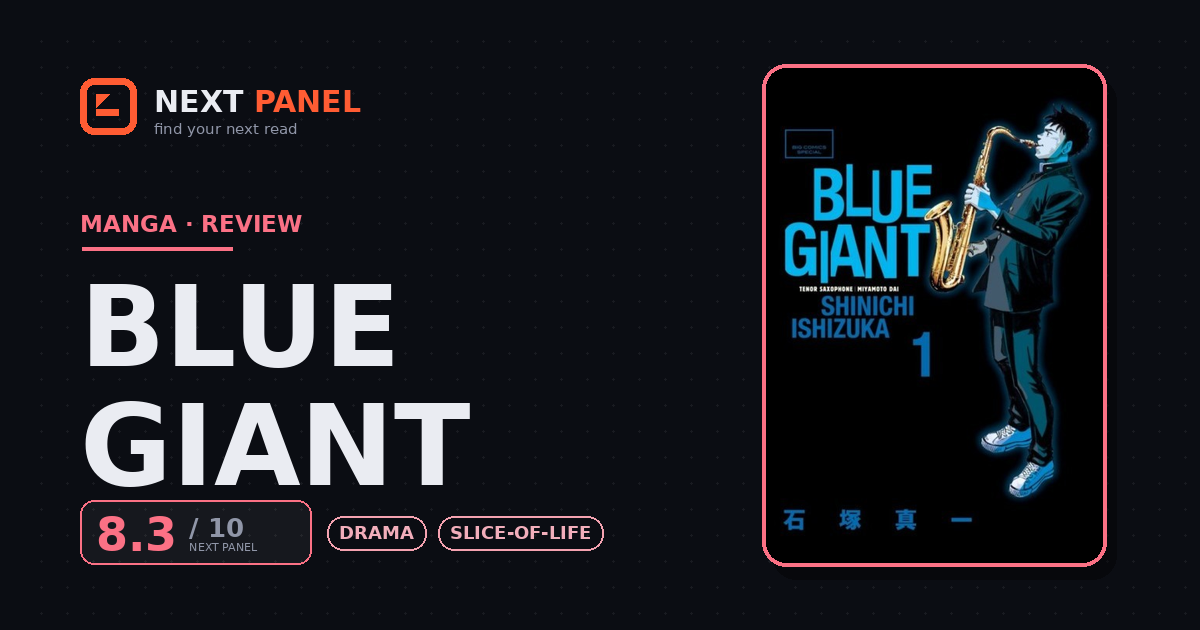
Is Blue Giant Worth Reading? Review & Where to Read
Quick Answer
Yes, if you want a sincere, unashamedly earnest story about chasing a huge ambition with almost nothing to back it up, and don't mind that music itself can't actually be heard in a silent medium. It's less essential if you find pure passion-driven underdog stories thin without a darker edge.
Quick Verdict
“Ishizuka draws sound better than most manga draw sound, and Dai's blunt, unembarrassed hunger to be great carries the whole thing even when the story keeps its plot this simple.”
Best for: Readers who want a sincere, single-minded passion story about chasing an enormous goal from a standing start.
Not for: Readers who want complex plotting, a large ensemble cast, or conflict that goes beyond one person's drive to improve.
- Type
- Manga
- Genres
- Drama, Slice of Life
- Status
- Completed
- This review
- Minor Spoilers
- Author
- Shinichi Ishizuka
- Publisher
- Shogakukan
- Platform
- Seven Seas Entertainment
| Quick facts | |
|---|---|
| Format | Manga (seinen), 80 chapters, 10 volumes |
| Run | 2013–2016 · completed |
| Community score | AniList 8.4 · MangaUpdates 8.1 |
| Content | None significant |
| Where to read | Seven Seas Entertainment — official |
Overview
Dai Miyamoto is a high schooler in Sendai who hears a jazz record, decides on the spot that he's going to become the world's best saxophonist, and then does something most stories skip past: he actually starts from zero. No natural talent, no formal training, just borrowed sheet music and hours spent practicing alone by a river. Blue Giant tracks that climb from total beginner to serious musician, first locally, then in Tokyo's competitive jazz scene, with nothing propping Dai up but stubbornness and hours logged.
What it does well
The biggest achievement here is a genuinely hard problem: making a silent medium feel like it's playing music. Ishizuka leans on loose, aggressive linework, page layouts that break rhythm the way a solo breaks rhythm, and close-up panels of Dai's face mid-performance to sell the sound without a single note actually reaching the reader's ears. It sounds like it shouldn't work on paper. It does.
Dai himself is the other reason this works. He's blunt, single-minded, and almost embarrassingly sincere about wanting to be the best, and the manga refuses to punish him for it or dress it up as arrogance that needs correcting. That confidence, paired with the specific, unglamorous grind of actual practice, scales, breath control, playing until his lip gives out, makes his progress feel earned rather than declared.
Once the story moves to Tokyo and Dai forms a trio with a classically trained pianist and a drummer picking up the instrument from scratch, the manga gets a real engine. Watching three people with wildly different relationships to music and ambition try to become a functioning band gives Dai's raw hunger something to bounce off of, and it's where the series' character work is strongest.
Where it falls short
The plot doesn't ask for much beyond that structure. Practice, play a set, get a little better, repeat, and across ten volumes that's close to the whole shape of the story. If you need real narrative complexity or plotting that goes beyond one person's drive to improve, this can start to feel thin.
The cast outside the core trio also gets short-changed. Family, romantic interests, and rival musicians mostly exist to react to Dai rather than carry their own arcs, so the emotional world of the manga stays narrow even as the scope of Dai's ambition grows. And because the story never really doubts Dai, readers looking for a story that challenges its protagonist's confidence, rather than just rewarding it, may find the stakes feel lower than the premise suggests.
Verdict
Blue Giant is a sincere, technically impressive piece of craft about wanting something enough to actually put in the work for it, and Ishizuka's ability to make silent pages feel like they're playing music is a genuine achievement. It's not a manga chasing complexity, it's chasing feeling, and on that narrower goal, it mostly delivers.
Strengths & Weaknesses
Strengths
- Ishizuka draws jazz performances with real visual force, using motion lines, page layout, and raw facial expression to make silent panels feel loud.
- Dai's total lack of self-doubt is refreshing rather than grating, the manga treats his confidence as a genuine strength rather than something that has to be humbled.
- The slow climb from amateur to serious musician is shown through specific, unglamorous practice rather than skipped over with a training montage.
- The Tokyo arc's central trio dynamic gives Dai's raw talent a real foil in bandmates who bring their own doubts and technical skill to the table.
Weaknesses
- The plot is genuinely simple: Dai practices, plays, and improves, and that's close to the entire structure across all ten volumes.
- Side characters outside the core band get thin development and mostly exist to react to Dai.
- Readers who want the story to interrogate Dai's confidence or put real obstacles in his way may find the lack of a darker edge makes the stakes feel low.
Similar Titles
Another quiet seinen drama about total dedication to a demanding craft.
Shares the focus on a young musician and the emotional weight of performance.
Similar sincere, patient story about chasing an enormous, unlikely dream one step at a time.
Where to Read Officially
| Platform | Format | Pricing | Region notes | Link |
|---|---|---|---|---|
| Seven Seas Entertainment | Print & digital omnibus volumes | Paid | Region availability varies | Open |
Frequently Asked Questions
Do I need to know jazz to enjoy Blue Giant?
No. The manga explains just enough context through Dai's growth that no prior jazz knowledge is needed.
Is the original Blue Giant series finished?
Yes, the original ten-volume run is complete, though Ishizuka has continued the story in sequel series like Blue Giant Supreme and Blue Giant Explorer.
Where can I read Blue Giant officially in English?
Seven Seas Entertainment publishes it in English as two-in-one omnibus volumes, in print and digitally.