Is Space Brothers Worth Reading? Review & Where to Read
Quick Answer
Yes — it's one of the best patient, character-driven dramas in manga, built on real space-program detail and an unusually warm sense of what it means to fail and try again.
Quick Verdict
“Slow, generous, and honest about failure in a way most 'follow your dream' stories aren't — this is a comfort read that actually earns the feeling.”
Best for: Readers who want a patient, low-stakes-feeling drama about adult reinvention, built on real research and a genuine emotional core.
Not for: Readers who want fast pacing and constant external conflict rather than a slow character study.
- Type
- Manga
- Genres
- Drama, Sci-Fi
- Status
- Completed
- This review
- Minor Spoilers
- Author
- Chuya Koyama
- Publisher
- Kodansha
- Platform
- Kodansha
| Quick facts | |
|---|---|
| Format | Manga (seinen), 432 chapters, 46 volumes |
| Run | 2007–2026 · completed |
| Community score | AniList 8.6 · MAL 8.8 · MangaUpdates 8.7 |
| Where to read | Kodansha — official |
Overview
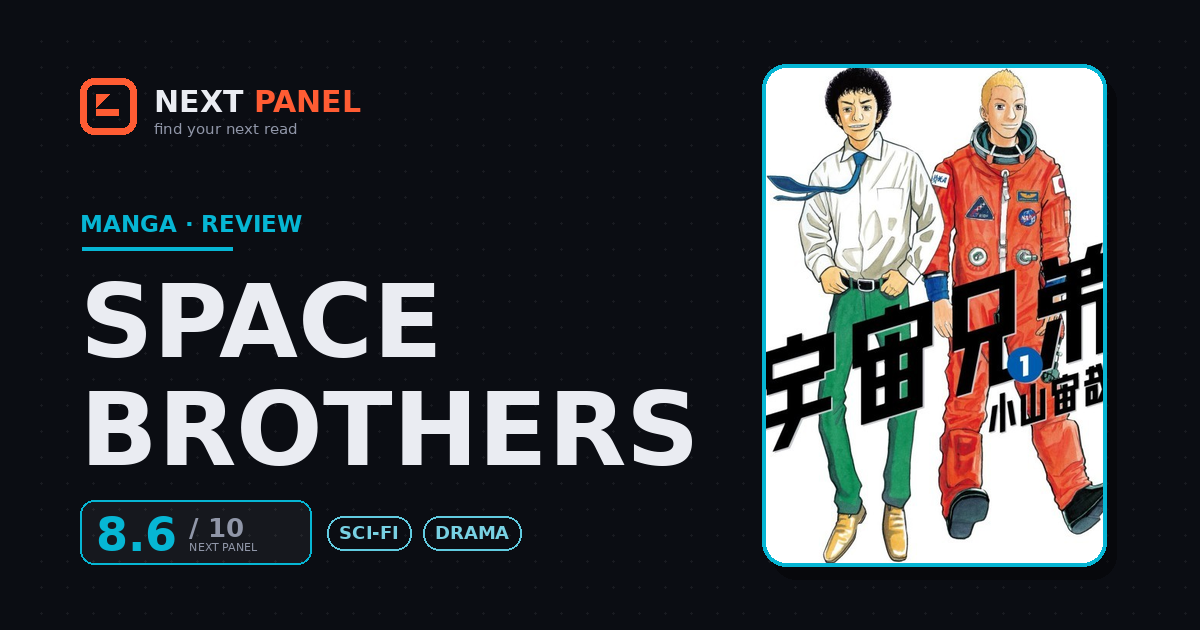
Space Brothers follows Mutta Nanba, a talented but stalled engineer in his early thirties who gets fired from his job on the same day he learns his younger brother Hibito has been selected for a Japanese astronaut mission. As kids, the two brothers swore they'd both become astronauts together. Hibito kept that promise. Mutta, adrift and humiliated, decides — almost on impulse at first, then with growing seriousness — to actually try to catch up. The manga follows him through JAXA's grueling, multi-stage astronaut selection process and beyond, tracking years of setbacks, small victories, and slow personal growth. It's written and drawn by Chuya Koyama, ran in Kodansha's Morning from 2007 to 2026, and is available in English digitally through Kodansha.
What it does well
Mutta is one of the better character studies in long-running manga. He's not a prodigy or a chosen one — he's a competent, slightly stuck adult who has to relearn discipline, humility, and patience in his thirties, and watching him do that convincingly, across years of in-story time, is the whole engine of the series. Koyama resists the urge to rush his growth, which makes every small win feel genuinely earned rather than scripted.
The research is a real strength. The selection arcs walk through psychological evaluations, teamwork drills, technical exams, and the isolation tests real astronaut candidates go through, and the manga clearly did its homework. That specificity gives even quiet, procedural chapters a pull, because you're learning something real alongside Mutta.
What sets Space Brothers apart from most 'chase your dream' stories is how it treats failure. Characters wash out, get passed over, or fall short in ways that would end most manga heroes' arcs, and the story treats those outcomes with real compassion instead of humiliation. It's a series fundamentally interested in what people do after they don't get what they wanted, and that makes its eventual triumphs land much harder.
The supporting cast reinforces this. Fellow candidates, JAXA staff, and Mutta's family are all given enough interiority that their subplots matter on their own terms, not just as obstacles or cheerleaders for the protagonist.
Where it falls short
The pacing is genuinely slow, by design, and the astronaut-selection arcs in particular linger on procedural detail that will test some readers' patience even as it rewards others. This isn't a manga to read for momentum.
At over 40 volumes, the sheer length means some emotional beats repeat: a setback, a moment of doubt, a quiet talk that gets someone back on track. The formula works because the character work underneath it is strong, but by the later volumes you can feel the machinery a little more than you did early on. And because the tone stays so even-keeled and kind throughout, readers looking for sharper conflict or bigger dramatic turns may find it too gentle for their taste.
Verdict
Space Brothers is a rare long-runner that never loses sight of what made it good in the first place: a believable adult finally getting serious about an enormous, specific dream, told with real research and real patience for failure. It's slow and it's long, but it earns both, and it closes out one of manga's most quietly rewarding character arcs.
Strengths & Weaknesses
Strengths
- Mutta is a genuinely great lead: a talented but directionless thirty-something who gets fired and, almost on a whim, decides to chase the childhood promise he made to become an astronaut alongside his younger brother, who's already in the program.
- The astronaut-selection process is researched in real, satisfying detail — psychological tests, teamwork exercises, technical exams — so the story earns its tension instead of manufacturing it.
- It treats failure as normal and survivable rather than catastrophic, which gives the whole series an unusually kind, mature emotional register for a story about elite achievement.
- The supporting cast of fellow candidates, engineers, and family members are given real interior lives, so the world around Mutta feels lived-in rather than like scenery for his arc.
Weaknesses
- The pace is deliberately slow, and the astronaut-selection arcs in particular spend a lot of time on process and detail that some readers will find dry.
- With over 40 volumes, the back half of the run repeats some emotional beats — another setback, another quiet pep talk, another small win — that lose a little impact through sheer repetition.
- Its low-key, grounded tone means it rarely goes for big dramatic swings, so readers wanting higher stakes or sharper conflict may find it too gentle.
Similar Titles
Another patient, character-first drama about someone slowly rebuilding themselves through a demanding pursuit.
A similarly grounded, research-heavy story about obsession and endurance, if you want the mountaineering equivalent.
Another quietly moving story about chasing an enormous, specific dream one realistic step at a time.
Where to Read Officially
| Platform | Format | Pricing | Region notes | Link |
|---|---|---|---|---|
| Kodansha | Digital chapters & volumes | Paid | Region availability varies | Open |
Frequently Asked Questions
Is Space Brothers finished?
Yes. It ran in Kodansha's Morning from 2007 to 2026 and wrapped at 46 volumes.
Do you need to know anything about real space programs to follow it?
No. The manga explains NASA and JAXA processes as it goes, and its accuracy is part of the appeal rather than a barrier to entry.
Is the anime a good alternative to reading the manga?
The anime covers a large chunk of the story and is well-regarded, but the manga runs much further and finishes the story the anime doesn't get to.