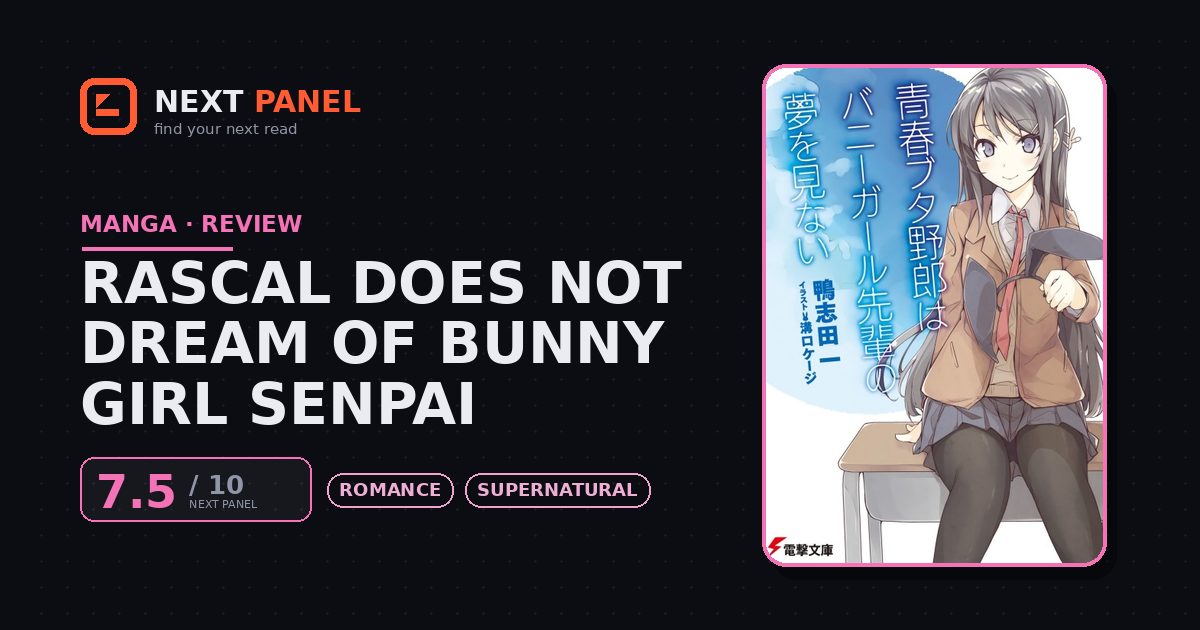
Is Rascal Does Not Dream of Bunny Girl Senpai Worth Reading? Review & Where to Read
Quick Answer
Yes, at least for this arc — it's a compact, well-drawn adaptation of one of the stronger 'Adolescence Syndrome' stories, even if it only covers a slice of the full light novel series.
Quick Verdict
“The bunny girl premise is a clever hook, and this first arc earns the mystery instead of just coasting on it.”
Best for: Readers who want a grounded, character-driven supernatural romance without a huge cast or a sprawling plot.
Not for: Readers who want the complete, multi-arc story in manga form rather than just its opening chapter.
- Type
- Manga
- Genres
- Romance, Supernatural
- Status
- Ongoing
- This review
- Minor Spoilers
- Author
- Hajime Kamoshida
- Artist
- Tsugumi Nanamiya
- Publisher
- Kadokawa (Dengeki G's Comic)
- Platform
- Yen Press
| Quick facts | |
|---|---|
| Format | Manga (shōnen), 6 chapters, 1 volumes |
| Run | 2014–2014 · ongoing |
| Community score | AniList 8.5 |
| Content | None significant |
| Where to read | Yen Press — official |
Overview
Sakuta Azusagawa is the kind of high schooler who's stopped expecting anything interesting to happen, right up until he runs into a girl in a bunny costume wandering the library on a day when the rest of the city seems to have forgotten she exists. That girl is Mai Sakurajima, a former child star turned reclusive high schooler, and the 'forgotten' part isn't a metaphor — people around her have started to lose the ability to perceive her at all, a condition the story labels 'Adolescence Syndrome.'
The manga adapts this opening arc: Sakuta, mostly immune to whatever's happening to Mai, becomes the one constant she has left, and the two of them have to figure out both what's causing it and what to do about a relationship built on him being the only person who still sees her clearly.
What it does well
The premise works because it isn't just a supernatural gimmick — being genuinely forgotten by the people around you is a sharp, legible metaphor for adolescent invisibility, and the story leans into that emotional read instead of turning it into a puzzle-box mystery. Mai's isolation feels earned rather than arbitrary.
Sakuta and Mai's chemistry is the other clear strength. Their scenes together run on quick, dry banter rather than the shy stammering a lot of manga romances default to, which makes them feel like two specific, somewhat prickly people rather than genre archetypes. Nanamiya's linework backs that up — expressions land clearly even in scenes that are mostly two people talking, which matters a lot for a story this dialogue-heavy.
As a first arc, it also has real shape: a beginning, an escalation, and a genuine resolution, rather than trailing off on a cliffhanger the way a lot of ongoing adaptations do.
Where it falls short
The biggest catch is scope — this manga release only covers the opening arc of a much longer light novel series, so anyone hoping for the full 'Adolescence Syndrome' saga in comic form will hit the edge of what's currently adapted and need to jump to the novels (or later, arc-specific manga) to keep going. That's a real limitation if you want everything in one format.
The pacing occasionally shows its light-novel-condensed-into-manga seams too, moving through some emotional beats faster than the prose probably does, and a few side characters get comparatively thin space to register. The core premise, while well handled here, also isn't wholly novel if you've read other stories that use a soft supernatural hook to dramatize social anxiety.
Verdict
As a self-contained first arc, Rascal Does Not Dream of Bunny Girl Senpai's manga is a well-drawn, emotionally sharp entry point into the series — Sakuta and Mai carry it, and the central metaphor lands. Just go in knowing it's one slice of a bigger story, not the whole thing.
Strengths & Weaknesses
Strengths
- The central mystery — a beloved actress slowly becoming invisible to everyone but Sakuta — is a strong emotional metaphor for being overlooked, and the manga plays it straight instead of over-explaining it.
- Sakuta and Mai's dynamic is sharp and quick, built on dry banter rather than generic shyness, which makes their scenes together land better than most first-arc romance setups.
- Nanamiya's art keeps the character acting expressive and legible even in quieter, dialogue-heavy scenes, which is where a lot of adaptations lose momentum.
- It's a fast, self-contained read as a first arc — you get a real beginning, middle, and resolution rather than a half-finished setup.
Weaknesses
- The manga only adapts a portion of the full light novel series, so readers who want the whole 'Adolescence Syndrome' arc structure will eventually need to go to the novels.
- Some of the emotional beats move quickly given the format, and a few supporting cast members get less development here than they do in the source novels.
- The 'invisible girl' premise, while well executed, isn't hugely original if you've read other stories built around social-anxiety-as-supernatural-phenomenon.
Similar Titles
Another grounded, character-focused story that uses a soft supernatural premise to dig into real adolescent anxiety.
For more sharp, banter-driven teen romance without the supernatural hook.
If you want a heavier, more serious take on being socially invisible and its emotional cost.
Where to Read Officially
| Platform | Format | Pricing | Region notes | Link |
|---|---|---|---|---|
| Yen Press | Print & digital volumes | Paid | Region availability varies | Open |
Frequently Asked Questions
Does the manga cover the whole Rascal Does Not Dream story?
No — the English manga release covers the first 'Bunny Girl Senpai' arc; the full story continues across multiple light novel volumes and later manga adaptations of specific arcs.
Do I need to watch the anime first?
No, the manga adapts the same first arc as the anime's opening story and works fine as a standalone entry point.
Where can I read it officially in English?
Yen Press publishes the manga in English, in print and digital formats.