Is Capeta Worth Reading? Review & Where to Read
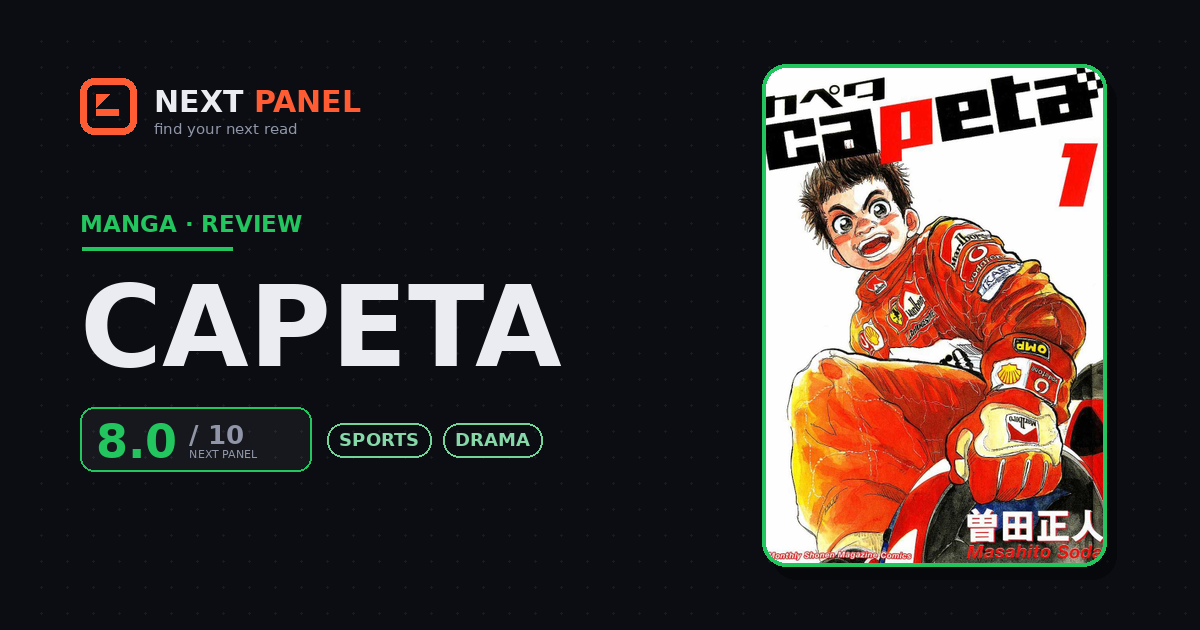
Quick Answer
If you want a sports manga that actually respects the mechanics and money problems of its sport instead of hand-waving them, yes. It's a patient, detailed climb from go-karts to real motorsport.
Quick Verdict
“Most racing manga treat the cars as an afterthought to the drama. Capeta treats the cars like they matter, and the drama is better for it.”
Best for: Readers who want a grounded, technically detailed sports story about earning every inch of progress.
Not for: Readers who want a fast-paced story that skips over the financial and mechanical realities of its sport.
- Type
- Manga
- Genres
- Drama, Sports
- Status
- Completed
- This review
- Minor Spoilers
- Author
- Masahito Soda
- Publisher
- Kodansha
- Platform
- K MANGA (Kodansha)
| Quick facts | |
|---|---|
| Format | Manga (shōnen), 119 chapters, 32 volumes |
| Run | 2003–2013 · completed |
| Community score | AniList 8.0 · MangaUpdates 8.4 |
| Where to read | K MANGA (Kodansha) — official |
Overview
Capeta follows Capeta Taira, a kid from a poor single-parent household who stumbles into go-kart racing after his father, a scrap-metal worker, builds him a kart out of spare parts. From that unglamorous start, the manga tracks his slow, expensive, mechanically detailed climb up the ranks of competitive motorsport, and Masahito Soda treats every step of that climb like it actually matters.
What it does well
What sets Capeta apart from most sports manga is how seriously it takes the non-glamorous parts of its sport. Racing costs money, karts need real maintenance, and Capeta's family genuinely can't afford most of what his rivals take for granted — the manga doesn't skip past any of that to get to the next race, and that grounding makes his progress feel earned rather than inevitable. The racing sequences themselves are detailed enough that readers who actually care about motorsport mechanics will find plenty to chew on, from cornering technique to kart setup, without the manga losing readers who just want to see Capeta win.
The relationship between Capeta and his father is the emotional backbone of the whole series, and it's handled with a plainspoken warmth that never tips into melodrama. Rivals get similar respect — they're not written as pure obstacles but as racers with their own resources, pressures, and reasons for competing, which makes the races themselves feel like genuine contests rather than foregone conclusions dressed up as tension.
Where it falls short
The same technical patience that makes the racing convincing can also slow the story down, especially in stretches focused on kart setup and mechanical detail that casual readers may find themselves skimming. Capeta's core character, earnest and relentlessly hard-working, doesn't shift much across the run even as his skill level rises dramatically, so readers hoping for a more complicated protagonist arc may find him a little flat by the later volumes. Being a long-runner also means some middle stretches feel like they exist mainly to get to the next tournament rather than advance anything new.
Verdict
Capeta is a patient, well-researched sports manga that respects both its sport and its underdog premise enough to slow down and earn its victories. If you want racing manga that treats the racing seriously, this is one of the best examples of the genre.
Strengths & Weaknesses
Strengths
- The manga treats the money and mechanics of racing as real obstacles, not background flavor, which grounds Capeta's climb in a way most racing stories skip past.
- Capeta's relationship with his father is written with real warmth without turning saccharine, and it anchors the story even in its more technical stretches.
- The racing sequences are detailed enough to satisfy readers who actually care about motorsport, without losing readers who don't.
- Rivals are written as genuine foils with their own resources and pressures, rather than obstacles that exist purely to be overcome.
Weaknesses
- The technical detail that's a strength for motorsport fans can slow the pacing for readers who just want the next race.
- Capeta's earnest, hard-working underdog archetype doesn't get much variation across the run, even as his skill grows.
- The long-runner structure means some mid-series arcs feel like they're marking time before the next major tournament.
Similar Titles
Initial D
Shares the technical, gearhead-focused approach to racing as a genuine skill to master.
Similar underdog-from-nothing structure applied to a different competitive sport.
Haikyuu!!
Same interest in incremental, hard-earned skill growth over instant talent.
Where to Read Officially
| Platform | Format | Pricing | Region notes | Link |
|---|---|---|---|---|
| K MANGA (Kodansha) | Digital chapters | Digital volumes | Free + Paid | Region availability varies | Open |
Frequently Asked Questions
Is Capeta finished?
Yes, it's a complete series, running to over 30 volumes in Japan before concluding.
Do I need to know about motorsport to follow it?
No — the manga explains racing concepts as Capeta learns them, so no prior knowledge is required.
Where can I read it officially in English?
Kodansha publishes it digitally through K MANGA, with free chapters available alongside paid volumes.